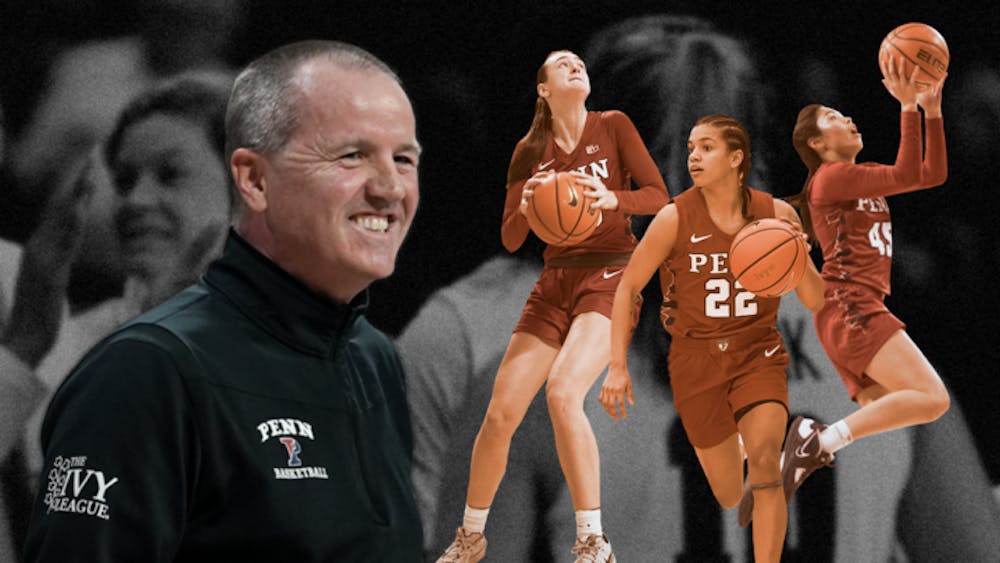
In a league without athletic scholarships, Penn has built a recruiting juggernaut.
The Ivy League women’s basketball “Rookie of the Year” award was first handed out after the 1979-80 season. Before coach Mike McLaughlin’s arrival on campus in 2009, only one player from Penn had earned this honor. But since taking over the program, McLaughlin has seen seven of his 15 seasons end with the Ivy League Rookie of the Year coming from the Red and Blue.
Over that same time frame, three winners have come from Princeton; two from Harvard; one each from Yale, Columbia, and Brown; and none from Dartmouth or Cornell.
Two of Penn’s seven award winners have been unanimous selections: 2021 College graduate Eleah Parker in the 2017-18 season, and, most recently, sophomore forward Katie Collins after her 2024-25 campaign. The latter’s honor follows teammate junior guard Mataya Gayle’s award for the 2023-24 season — marking the second time in McLaughlin’s tenure that Penn has produced back-to-back winners. 2017 College graduate Sydney Stipanovich and 2018 graduate Michelle Nwokedi were the first duo to achieve the feat in 2014 and 2015.
Penn women’s basketball’s ability to field star-studded rosters year after year doesn’t come down to chance. It’s a full-time effort for McLaughlin and his recruiting staff.
“There are four of us who are actively recruiting. … We’re all heavily involved for 12 months out of the year,” McLaughlin said. “There’s really no break.”
Up until this year, that effort was spearheaded by former assistant coach and recruiting coordinator Kelly Killion, who left Penn in the offseason for American University. Former assistant recruiting coordinator Ashley Robinson was promoted to fill Killion’s vacancy, and former assistant coach Andre Gibbs stepped into Robinson’s old position. New assistant coach Ryan Weise rounds out the Red and Blue’s coaching and recruiting staff this season.
RELATED:
Texas trip, Christmas Classic highlight Penn women’s basketball 2025-26 schedule
A look into the 2025 Ivy League women’s basketball preseason poll
Fit, size, strength, speed, and skillset are just some of the elements the quartet evaluates in a prospect.
“Every coach wants a certain style. I want a kid that’s driven. I want a kid that loves to do this every day,” McLaughlin said. “I love Penn. I want to bring in kids who are qualified and can succeed here. I don’t want to put anyone in a position where they’re not going to thrive.”
The vetting process is intense and thorough, with some players on the AAU circuit getting looked at as early as their freshman year of high school.
2023 Wharton graduate Kayla Padilla, who was the 2020 Ivy League Rookie of the Year, first entered Penn’s radar when she was a sophomore in high school. Hailing from Torrance, Calif., a club teammate’s brother was playing at Penn at the time and tipped the coaches off to include Padilla on their list of potential recruits. The conversations with the Penn coaching staff started from there.
“There’s never a full stop on recruiting,” McLaughlin said. “It’s constant. One of us is always engaged with the recruit. There’s a lot of tedious behind-the-scenes [work]. Everyone sees the result when they’re [at Penn], but it takes a lot of people to get them that far.”
McLaughlin and his staff typically have three avenues to fulfill their needs: American recruits, international recruits, and transfer recruits. While Penn recruits within the U.S. come from all over, McLaughlin noted that he has had significant success recruiting within a 100-mile radius of Philadelphia.
Collins qualifies as one of those success stories, hailing from Manasquan, N.J. For her, the ability to stay close to home was appealing.
“I definitely wanted to stay close,” Collins said. “Penn was definitely the right choice for me, because it had everything I was looking for, and it was close enough so my parents can come to all our games, which is really great.”
The current roster also has no lack of international representation. In fact, two of the four rookies this year come from overseas. Freshman forward Ari Paraskevopoulou is joining the roster from Athens, Greece, while freshman center Kate Lipatova has roots in Moscow. Last year’s leading scorer, 2025 Wharton graduate Stina Almqvist, is from Kinna, Sweden.
The transfer portal adds a third way for McLaughlin to fill in the gaps in his roster outside of the recruiting circuit.
“The transfer pieces are a viable option here at Penn,” McLaughlin said. “It’s a way to reset the program as a class gets a little bit older.”
Penn, like the rest of the Ivy League, does not offer athletic scholarships. With the rise of name, image, and likeness deals in the college athletics landscape, financial benefits have been a significant attraction for top athletes nationwide. McLaughlin is transparent about Penn’s lack of non-need-based financial aid for its athletes. This is typically where he is most involved in the conversations with athletes and their families.
“We tell them what an opportunity like Penn does for them, not just for their experience here, but what it could lead to,” McLaughlin said. “We give the [parents] a plan. We explain to them what our internship program looks like, what our basketball board can do to support their daughter. We take complete responsibility for them on and off the floor, and we truly make everyone part of our family.”
Beyond finances, the recruiting conversation often centers around reviewing academic transcripts. Unlike some schools, the coaching staff cannot guarantee any of their recruits admission to the University — another nod to the school’s academics-first mentality.
While the coaches do work alongside the Penn Athletics staff to help identify athletes who would be able to successfully matriculate to Penn, at the end of the day, recruited athletes go through the same application process as the rest of the student body.
Once offers are extended, the coaches enter an anxiety-inducing waiting game. After spending much of the last few months choosing which players they want, the roles are now reversed, and the players have to choose Penn, too.
For Padilla, the allure of attending one of the top undergraduate business schools in the nation was hard to pass up. With practically the entire Ivy League extending her an offer, the relationships she developed with members of the Penn program during the recruiting process were hard to beat.
“At the end of the day, you can get an education anywhere” Padilla said. “Obviously, the quality of that will differ, but it’s really the people you surround yourself with that will make the biggest impact on your college experience. The coaching staff and the teammates that I had were the people and the things that made my experience what it was, and that was a great one. I’m just glad that I had prioritized that aspect of the recruiting process.”
For Woodstock, Ga. native Gayle, Penn was one of the 13 schools — including multiple Ivy League institutions — that offered her the opportunity to play ball at the next level. For Gayle, visiting campus and absorbing the Philadelphia culture, combined with a positive experience with the coaching staff, solidified her decision.
“I wanted to come to a place where I thought I could come in and help the program a lot,” Gayle said. “I wanted to play. I liked the way coach [McLaughlin] talked. He was like, ‘I’m not giving you a spot, but you can come in here and you can earn it.’”
Having an outstanding rookie year means nothing, though, if those players can’t develop into key contributors in the future. Of the seven rookie of the year award winners, all but Collins have made an All-Ivy team. All five winners who have graduated were first team All-Ivy honorees, with Parker earning the Ivy League Defensive Player of the Year title and 2014 graduate Alyssa Barone and Stipanovich earning Ivy League Player of the Year nods.
Needless to say, the coaching staff has found success in ensuring that their players aren’t just settling for one good season. This bodes well for Gayle and Collins, who still have plenty of time left representing the Red and Blue.
“Looking back, it’s definitely a perk,” Collins said. “It’s important to come to a program that emphasizes freshmen, because sometimes teams just push them to the side and expect them to know everything, but allowing the freshmen to grow and do well is really important. It’s just not something that I considered, but I honestly wish I did.”