

Penn’s Faculty Senate is set to sponsor two new initiatives aimed at encouraging faculty to learn about the projects and concerns of other departments and schools.
Both projects were discussed during an October meeting of the Senate Executive Committee, chaired by history professor Kathleen Brown. The initiatives were organized by faculty members in an effort to break down barriers between the faculty and staff of Penn’s 12 graduate schools.
The first project, which was presented by history and sociology of science professor Harun Küçük and Perelman School of Medicine professor John Holmes, will consist of a series of listening sessions for faculty. According to an announcement of the project published after the meeting, the initiative is designed to expand “cross-campus understanding of faculty teaching, research, and service.”
In a written statement to The Daily Pennsylvanian, Brown described the need for faculty to “learn about the situation of colleagues across schools.”
“Ultimately, we hope a faculty survey springs from these small discussion groups,” Brown wrote, adding that the initiative will feature “standing faculty across ranks as well as non-standing faculty gathering in small groups.”
The announcement also highlighted that the listening sessions will assess “faculty morale” and generate “feedback on Penn’s strengths and vulnerabilities as an institution of higher education.”
The second initiative, a panel proposed by University of Pennsylvania Carey Law School professor and past Faculty Senate chair Eric Feldman, similarly seeks to foster open dialogue between faculty members. Brown characterized the panel as a way to bring “Penn faculty together” to discuss “important topics.”
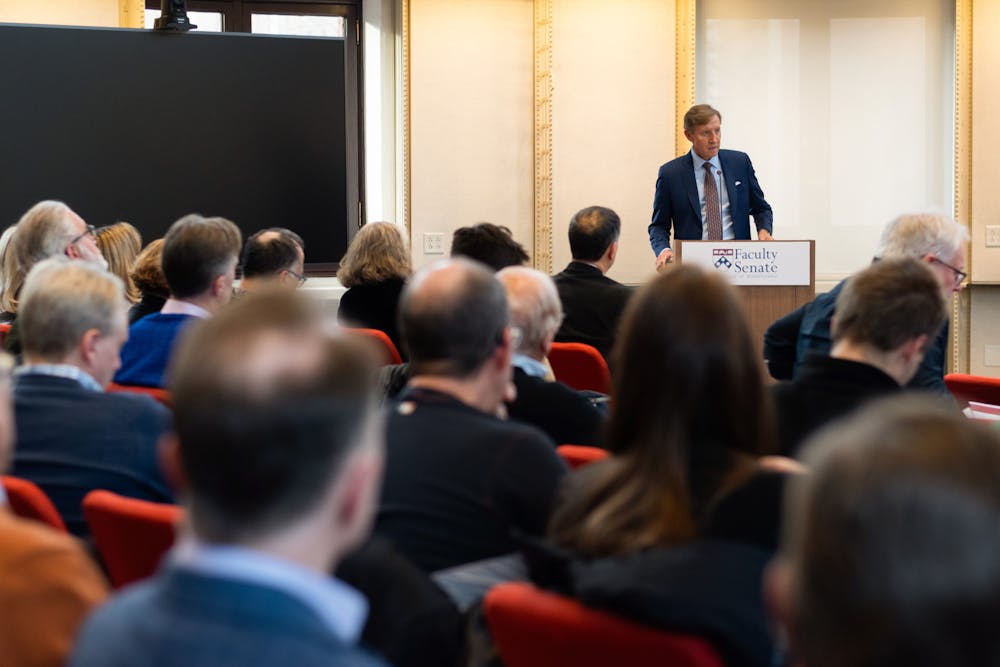
On Oct. 29, the Faculty Senate hosted its first panel — titled “Viewpoint Diversity?” — as part of the initiative.
RELATED:
Meet Kathleen Brown, the historian at the helm of the Faculty Senate
Penn Faculty Senate overwhelmingly passes resolution urging University to reject White House compact
“Our interest in having this conversation was to think about Penn’s intellectual climate, and to inspire our colleagues across the university to do the same,” Feldman wrote in a statement to the DP.
Feldman explained that the Faculty Senate’s focus on viewpoint diversity was to “[try] to better understand what it means to have a campus on which the full spectrum of intellectual diversity is present.”
According to Feldman, the event drew “roughly 50 faculty members” and featured three panelists — College of Arts and Sciences Dean Peter Struck, Penn Integrates Knowledge University Professor Kevin Johnson, and Penn Carey Law professor Lisa Fairfax.
Feldman wrote that each panelist “brought different individual and disciplinary perspectives to the meaning of viewpoint diversity.” Although the discussion revealed strong disagreements among attendees, he stated that this was communicated through “open, honest, thoughtful, and respectful dialogue.”
“Being able to engage with colleagues with whom one strongly disagrees, to listen respectfully, to voice one’s views thoughtfully, and sometimes to change your mind, is an important part of what it means to be a scholar,” Feldman added. “That’s why we organized this event — it was an opportunity to participate in the sort of conversation that can only happen on a campus of this sort.”
The emphasis on faculty conversations represents a shift in the Faculty Senate’s approach to facilitating dialogue, according to Feldman.
In previous years, the Senate hosted outside speakers on topics including academic freedom and the value of higher education. This year, Feldman wrote, the Faculty Senate decided to “take advantage of the extraordinary range of intellectual talent on [Penn’s] campus” and “make good on the promise of an academic community."
The initiatives also reflect Brown’s interest in bolstering Penn’s shared governance and institutional transparency — both of which she discussed in an interview with the DP at the beginning of the semester.
Feldman wrote that these projects will help the Faculty Senate “identify issues of common concern to all members of Penn’s standing faculty” and create space for meaningful change.
“Open dialogue is the lifeblood of academic institutions,” he continued. “It is why we — the faculty, the students, and everyone on campus — is here.”
RELATED:
Meet Kathleen Brown, the historian at the helm of the Faculty Senate
Penn Faculty Senate overwhelmingly passes resolution urging University to reject White House compact
Senior reporter Christine Oh leads coverage of student life and can be reached at oh@thedp.com. At Penn, she studies English and philosophy. Follow her on X @ChristineOh_.


