

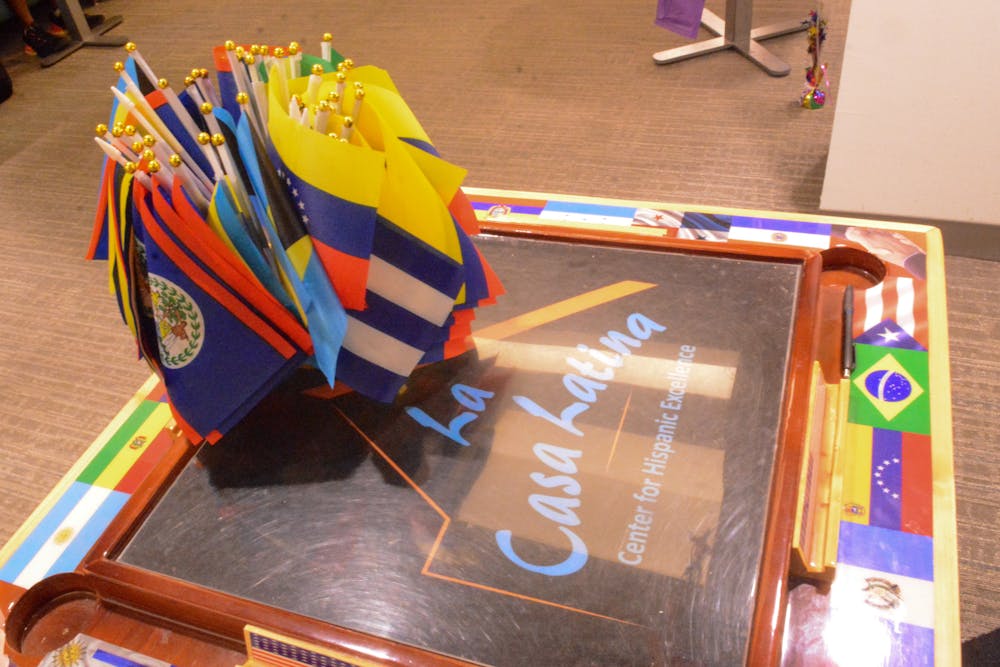
Penn’s School of Arts and Sciences hosted a Knowledge by the Slice lecture on Latin American politics on Oct. 16.
The Knowledge by the Slice series allows students, professors, and faculty members in the Penn community to come together to learn more about a topic while enjoying a slice of pizza and refreshments. At the event, titled “Dispossessions and Disparities Across Latin America,” sociology professor Letícia Marteleto and political science professor Tulia Falleti shared their perspectives to a room of 30 attendees in Irvine Auditorium.
Marteleto began by discussing how she first got interested in the issue of fertility in Brazil and referenced how pandemics have had a large impact on fertility in Brazil.
“[When the] Zika epidemic of 10 years ago hit, it was a disease that is transmitted by the Aedes mosquito,” Marteleto said. “It’s an arboviral disease. And it was discovered that one of the consequences was fetal malformation, and Brazil was the place where this was the highest.”
Brazil’s structures of inequality impact its fertility rate, but they also are a reflection of their historical past, she explained.
“Brazil is a country that had the largest number of enslaved people sent, more than [America], so it has a large Afro descendant population,” Marteleto added. “In terms of the fabric of Brazil, it is very similar to the United States.”
Falleti also discussed the catalyst for her interest: Indigenous rights.
“For my Ph.D. dissertation, I worked on processes of decentralization of government. That topic led me to be more interested in issues of local participation,” Falleti said. “Through local participation, I arrived to this institution called prior consultation, which involves participation from indigenous communities.”
RELATED:
Penn’s sixth annual Climate Week to highlight global ‘climate hotspots’ with over 50 events
Throughout her time at Penn, Falleti has explored this topic and described how both advancement and stagnation are prevalent in the fight for recognition of Indigenous peoples in Latin America.
“There is a very fragile system of legal recognition of communities that shows that, when there is no political will, recognition can be taken away quite easily,” Falleti added. “In the case of Argentina, we have a government that denies the existence of our indigenous peoples, and they are being violently persecuted. So, we need better legal frameworks and tools to implement what has been in the constitution for 31 years now.”
For Amber Green, associate director of program and events for Penn Arts and Sciences, diversity in thought and content is especially important for the Knowledge by the Slice series programming.
“[Vice Dean for Academic Excellence and Engagement] Brighid Dwyer's office presented the idea to us,” Green said at the event. “They already pre-selected the two presenters in response to Hispanic Heritage Month, and we basically ran with that idea.”
Green added that she hopes more students take advantage of programs and events through Penn Arts and Sciences.
“All of our events are free and open to the public,” Green said. “We have our dean's forum coming up in the spring, which is a big event. We also have our annual Penn graduate talks … our version of TED Talks for our grad students.”


