

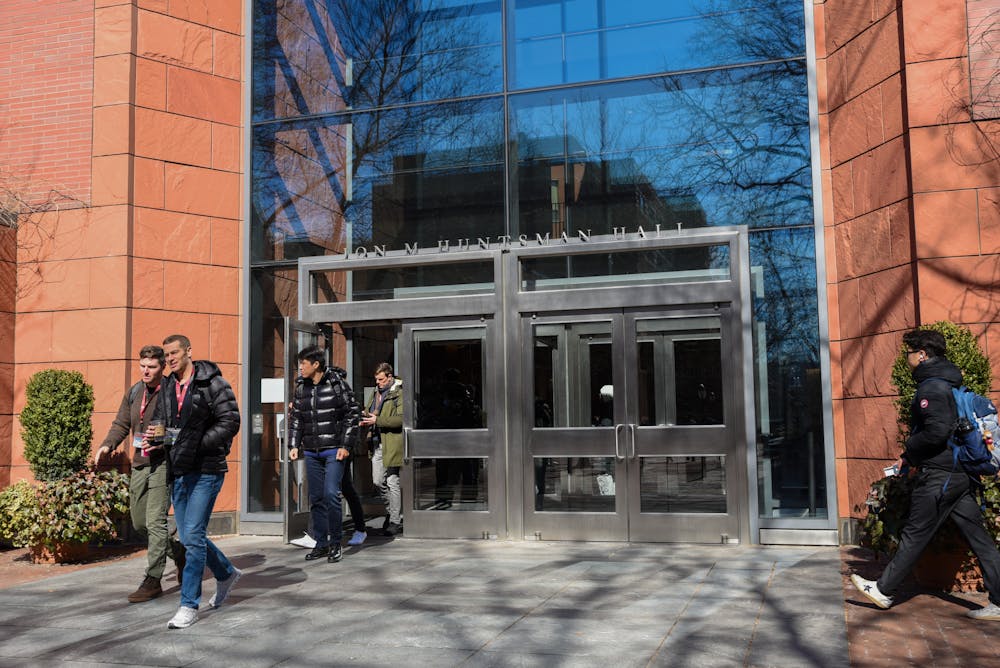
Students in the Wharton School’s Executive Master of Business Administration program have raised concerns about course quality, rising costs, and the use of artificial intelligence within grading practices.
The concerns — first reported by Poets&Quants — were shared during a virtual town hall event for Executive MBA students. Several speakers at the meeting alleged that the repetitive or unclear feedback they received on written assignments was indicative of the use of automated grading systems.
Students in the program are required to disclose when they use AI tools on assignments, but they said similar requirements do not appear to apply to faculty. Speakers at the town hall also noted that when they asked instructors about deducted points, their grades were adjusted without explanation.
In response to a request for comment, a Wharton spokesperson described the school’s disappointment “that comments from a closed Town Hall were shared publicly.”
“Student input is incredibly important to us,” the spokesperson wrote to The Daily Pennsylvanian. “We will continue to collect candid feedback through Town Halls and other methods and use it to guide ongoing enhancements to our program and the student experience.”
The spokesperson added that Wharton has taken “steps to protect the confidentiality of internal meetings and discussions.”
During the town hall, students also raised concerns about outdated course materials and academic rigor, including slides that had not been updated for years.
Other frustrations reported by Poets&Quants centered on the logistical elements of the Executive MBA program, along with its grading structure. The program enforces a curve that caps the class average GPA at 3.5. Students mentioned that this system created tension between students, because a correction to one person’s grade may cause another person’s average to fall.
RELATED:
Wharton School claims sole possession of top spot on 2025 U.S. News Best Business Schools ranking
Wharton launches Master of Science degree in quantitative finance funded by historic donation
The program’s financial burdens were also discussed at the town hall. Students criticized tuition and fees for new classes, for instance, which total $39,770 per academic term, excluding the costs of textbooks and travel.
The recent concerns coincide with faculty efforts across the University to develop guidelines for AI use in classrooms.
In March, the DP reported that professors in departments ranging from Political Science to Electrical and Systems Engineering had amended their course structures in response to the increasing use of AI tools.
Some professors increased the weight of in-person exams to discourage an over-dependence on generative tools, while others experimented with AI as an instructional aid. In November 2023, University-wide guidelines encouraged “productive” AI use in line with Penn’s mission, while acknowledging ongoing concerns about plagiarism and academic integrity.


