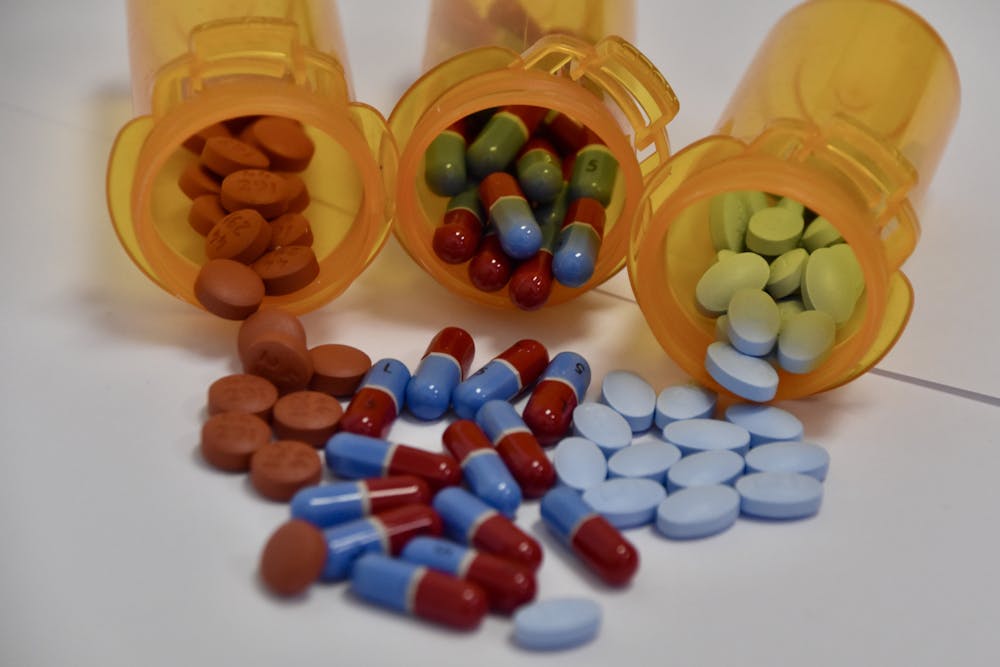
Penn filed a lawsuit alleging that drug manufacturers and pharmacy benefit managers have engaged in price fixing to artificially inflate the cost of diabetes treatments, including insulin.
The lawsuit — filed on July 11 on behalf of the University Board of Trustees — alleges that pharmaceutical companies Eli Lilly, Novo Nordisk, and Sanofi have colluded with PBMs such as CVS Caremark, Express Scripts, and Optum Rx to maintain high prices. Penn argues that PBMs — which serve as intermediaries between drugmakers, insurers, and pharmacies — have misused their connection to drugmakers to keep prices high.
In the suit, Penn notes that “the cost of diabetes medications has risen more than tenfold over the past twenty years,” while “the average cost of consumer goods and services has risen just 1.75-fold.”
“The skyrocketing prices of diabetes medications are not tethered to the rising cost of goods, production costs, investment in research and development, or competitive market forces,” the suit continues. “Instead, Defendants engineered these price increases via an opaque, conspiratorial kickback scheme.”
A University spokesperson declined a request for comment. Representatives for Novo Nordisk, Optum Rx, CVS Caremark, and Sanofi all denied the charges in response to a request from The Daily Pennsylvanian. A request for comment was left with Eli Lilly.
In the case, Penn wrote that CVS Caremark — operating as a PBM and, thus, coordinating with Novo Nordisk, Eli Lilly, and Sanofi “regarding the price of the at-issue diabetes medications” — has “knowingly profited from the artificially inflated list prices produced by the Insulin Pricing Scheme.”
In a statement to the DP, a CVS Caremark spokesperson wrote that “drugmakers alone” — not PBMs — are responsible for setting the price of insulin.
“Three drugmakers control nearly the entire insulin market, and without competitive lower cost generic alternatives, they raised their list prices by as much as 500% in lockstep with one another prior to 2012,” they wrote. “That’s when CVS Caremark fueled increased competition by creating new formulary options to fight back against these manufacturer price hikes. In the years since, we have led the way in driving down the cost of insulin for all patients: insured, uninsured, and underinsured.”
RELATED:
Penn faculty, policy experts reflect on Trump-era shifts in U.S. health care policies
Federal judge stays former Penn swimmers’ Title IX lawsuit pending ruling in similar case
Optum Rx, another PBM named in the litigation, also wrote to the DP that the company has “aggressively and successfully negotiated with drug manufacturers … to lower prescription insulin costs for our health plan customers and their members, who now pay an average of less than $18 per month for insulin.”
“PBMs, like Optum Rx, are the key counterweight to pharmaceutical companies’ otherwise unchecked monopoly power to set and raise drug prices,” the statement read.
A spokesperson for Sanofi emphasized the company’s commitment “to helping patients access the medicine they need at the lowest possible price” in a statement to the DP. The spokesperson also wrote that “Sanofi’s pricing practices have always complied with the law.”
“Under the current system, savings negotiated by health insurance companies and PBMs through rebates are not consistently passed through to patients in the form of lower co-pays or coinsurance,” the Sanofi spokesperson continued. “As a result, patients’ out-of-pocket costs continue to rise while the average net price of our insulin declines.”
Novo Nordisk similarly described the lawsuit as “meritless” in a written statement to the DP, adding that the company “continually review[s] and revise[s] [its] offerings as well as work[s] with diverse stakeholders to create solutions for differing patient needs.”
Penn joins over 400 lawsuits that were consolidated in August 2023 before Judge Brian Martinotti in the District of New Jersey. The litigation has been separated into three tracks for prosecution: state attorney general, self-funded payer, and third-party payer class action, each of which represents different plaintiffs.
2000 University of Pennsylvania Carey Law School graduate and attorney Rachel Sullivan — whose firm, Kozyak Tropin & Throckmorton, is one of four leading the self-funded payer track that includes Penn’s filing — described the importance of the University’s decision to enter the suit in an interview with the DP.
“I think it’s important that such a large employer and such a renowned University is taking a stand against this scheme that’s been going on for a long time,” Sullivan said.
She went on to describe the strategies often used by various members of the industry to avoid the blame for rising prices.
“There’s a lot of finger-pointing,” Sullivan added, noting how manufacturers are blamed for “raising prices,” while PBMs also shoulder blame “because they’re the ones who demand these rebates.”
Sullivan highlighted that “insulin is a special case because of its history” and “because it is so cheap to produce.” As a result, according to Sullivan, insulin prices are “disproportionate” to production costs. She suggested, however, that the ongoing suit may serve as a “test case” for future lawsuits against unfair pharmaceutical pricing.
According to the filing, Penn is seeking punitive damages after the defendants “knowingly, willfully, wantonly and intentionally harmed the health, wellbeing, and financial interests of Plaintiff and its Beneficiaries.”
“These Defendants not only concealed all the facts concerning the true cost of the at-issue medications but went further to make affirmative misrepresentations in marketing materials and other communications that these Defendants worked to lower the ultimate cost of prescription medications,” the suit continued.
RELATED:
Penn faculty, policy experts reflect on Trump-era shifts in U.S. health care policies
Federal judge stays former Penn swimmers’ Title IX lawsuit pending ruling in similar case
Isha Chitirala is a News Editor at The Daily Pennsylvanian and can be reached at chitirala@thedp.com. At Penn, she studies economics and political science. Follow her on X @IshaChitirala.