

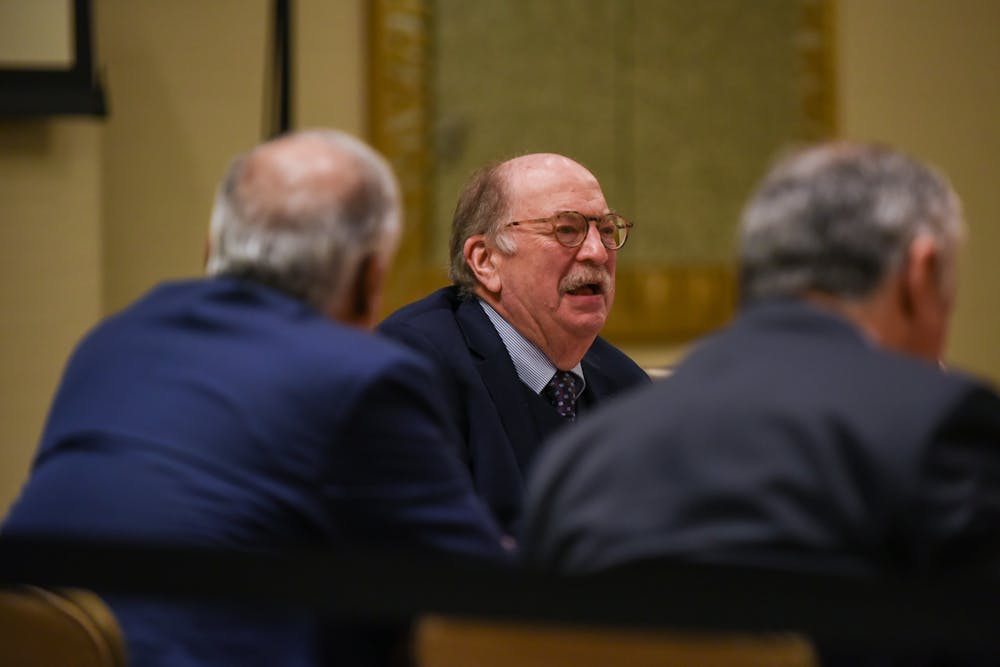
1975 Penn Carey Law graduate and Vice President of Government Affairs Jeffrey Cooper will retire from his post as the University’s top liaison to federal and local governments once his successor is named.
Cooper’s retirement — announced on Friday during the Local, National, and Global Engagement Committee meeting of Penn’s Board of Trustees — is the latest in a string of departures among top Penn administrators. The search for Cooper’s successor has begun, according to a University spokesperson.
“I am remaining in the position until my successor starts,” Cooper wrote in a statement to The Daily Pennsylvanian. “That date is not yet known.”
As Penn’s vice president of government affairs, Cooper manages the relationship between the University and state, local, and federal government entities at both the community and national levels.
Cooper stepped into his role in 2008 after serving as the chief counsel for the Pennsylvania State System of Higher Education and the executive deputy general counsel to former Gov. Ed Rendell's administration. Cooper oversaw 14 college campuses and more than 108,000 students within PSSHE, and led over 100 attorneys during his time in the Rendell administration.
Former Penn President Amy Gutmann made the final decision for Cooper’s 2008 appointment, following a search process led by Senior Executive Vice President Craig Carnaroli, who is also set to leave the University next fall. 1993 Penn graduate and Deputy Provost Beth Winkelstein — whose tenure will end Aug. 22 — and Senior Vice Provost for Research Dawn Bonnell are also among the latest administrators to announce their exits from the University community.
The departures come amid a period of federal scrutiny directed at American universities by 1968 Wharton graduate and President Donald Trump. Cooper predicted the threats to higher education at the Nov. 14 Local, National, and Global Engagement committee meeting, where he warned of financial uncertainty under the incoming administration.
Cooper described the administration change as a "very challenging and changing environment" for Penn. He cited several potential effects of Trump's leadership, including threats to higher education, changes to tax policies, and altered immigration laws.
RELATED:
Senior Executive Vice President Craig Carnaroli to leave Penn for position at Stanford
Penn Board of Trustees votes to raise debt authorization as ‘insurance’ amid financial pressures
He also addressed the House Committee on Education and the Workforce's 2024 congressional probe into Penn, which demanded documents from the University regarding the administration's response to alleged campus antisemitism. He expressed an expectation for increased government involvement moving forward, particularly in regard to political and social issues.
Cooper similarly raised concerns about the status of research funding, especially through the National Institutes of Health amid "proposals to downsize" the agency.
In February, $240 million of Penn’s funding from the National Institutes of Health was jeopardized after the NIH issued a directive capping “indirect costs” — which fund overhead expenses including laboratories and support staff — at 15%.
In March, an additional $175 million of Penn’s federal funding was frozen by the Trump administration. The decision, according to the White House, was due to Penn’s “policies forcing women to compete with men in sports.”
Cooper earned his bachelor's degree from Northwestern University in 1972, graduated from Penn Carey Law in 1975, and went on to work at two professional law firms — where he held associate and partner positions. In 2003, he joined the Commonwealth of Pennsylvania as the chief counsel of higher education and was also appointed as executive deputy general counsel to the governor in 2005.
RELATED:
Senior Executive Vice President Craig Carnaroli to leave Penn for position at Stanford
Penn Board of Trustees votes to raise debt authorization as ‘insurance’ amid financial pressures
Finn Ryan is a News Editor at The Daily Pennsylvanian and can be reached at ryan@thedp.com. At Penn, he studies political science and Russian. Follow him on X @FinnRyan_.


