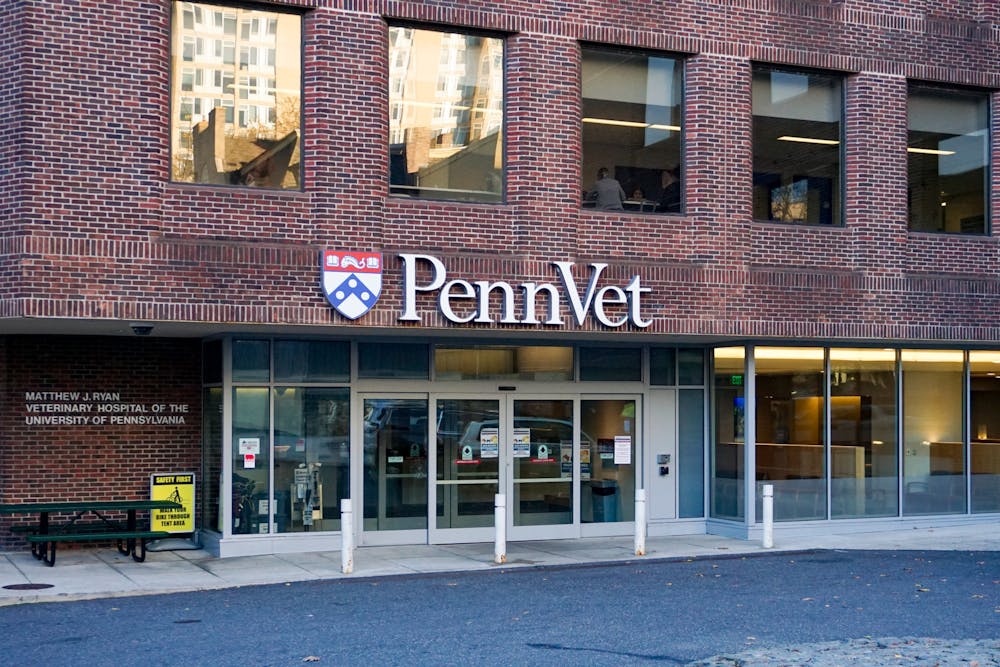
Researchers at Penn’s School of Veterinary Medicine have developed new mechanisms to treat advanced forms of inherited retinal degeneration, bridging a previous gap in patient treatments.
Raghavi Sudharsan and William Beltran — researchers at the Division of Experimental Retinal Therapies at Penn Vet — led a team that designed four gene therapy promoters to target advanced stages of retinal degeneration. Beltran has had previous experience addressing stem cell-based therapies in vision treatment, including work conducted alongside the Children’s Hospital of Philadelphia and the University of Wisconsin-Madison.
The mechanisms address inherited retinal degenerations, genetic disorders that result in vision loss. Using gene therapy and GNGT2-, PDE6H-, and IMPG2-based promoters, which express themselves in the human eye, the technology increases the treatment’s safety and efficacy.
“There are more than 250 different genes that are known to cause vision loss,” Sudharsan said in an interview with The Daily Pennsylvanian. “Many of these genes affect the cells we call ‘photoreceptors,’ the light-sensing cells in the retina. There is no cure for these diseases. There’s no pharmacological intervention that you can do, so the only way we can treat these diseases currently is by using gene therapy.”
The experiments relied on dogs as test subjects. According to Sudharsan, the researchers collaborated with “veterinarians who take very good care of them” while testing the promoters.
“In the end, yes, they are used for experiments, but their entire life period, they are given only care and love that you would expect to give to pets,” Sudharsan said.
The team — consisting of researchers from Penn Vet and the University of Pittsburgh — has been developing the promoters for eight years. Since the team published its findings, Penn has filed a provisional patent on the technology.
“These findings highlight the importance of testing promoters in clinically relevant models and at appropriate disease stages, something that unfortunately cannot be established in cell cultures or retinal organoids,” Beltran told Penn Today. “They lay the foundation for a new generation of gene therapies that are more potent, precise, and responsive to the real-world clinical needs of patients with inherited retinal degenerations, whether people or animals.”
RELATED:
Penn Med, CHOP researchers treat infant with world's first personalized gene-editing therapy
Meet three students from the incoming Perelman School of Medicine class
Beltran has been Sudharsan’s mentor since 2012, and the two have worked together throughout the gene therapy development process.
RELATED:
Penn Med, CHOP researchers treat infant with world's first personalized gene-editing therapy
Meet three students from the incoming Perelman School of Medicine class
Senior reporter Arti Jain leads politics reporting and can be reached at jain@thedp.com. At Penn, she studies economics and political science. Follow her on X @arti_jain_.