

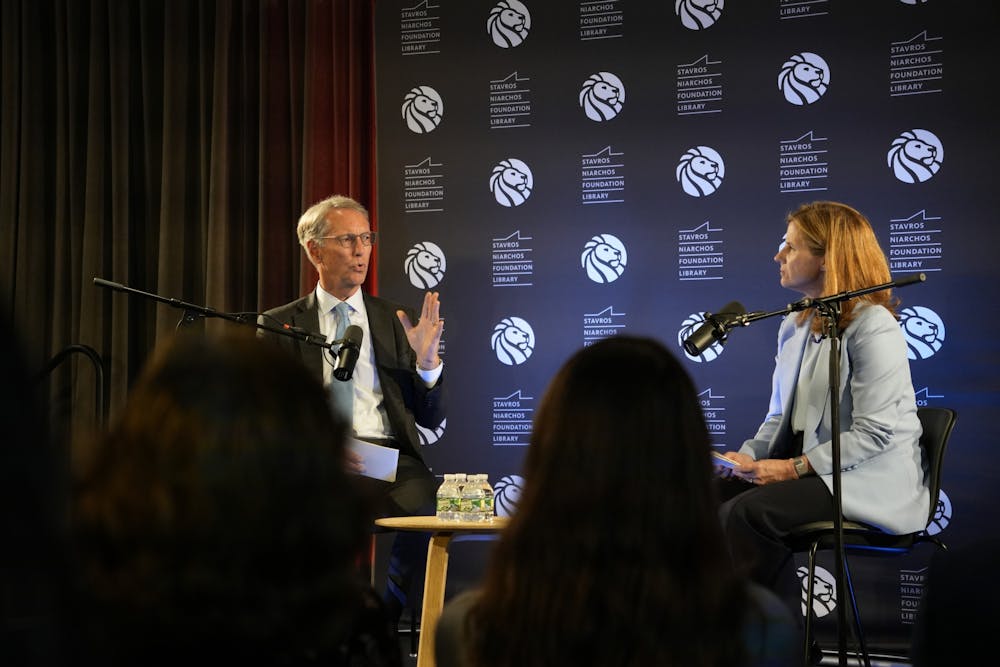
NEW YORK — Former University Board of Trustees Chair Scott Bok and former Penn President Liz Magill discussed Bok’s upcoming book at an event in New York City on Monday, marking their first joint public appearance since resigning from their respective posts in December 2023.
The May 5 event took place one day before the release of Bok’s book — titled “Surviving Wall Street: A Tale of Triumph, Tragedy, and Timing” — at the Stavros Niarchos Foundation Library. During the hour-long event, Magill and Bok discussed the “pervasive role” of Wall Street, the days that led up to their departures from Penn, and the current “crisis” facing “all major, elite” American universities.
Magill began the discussion about Penn with a question about whether Bok considered higher education to be in “crisis” while he was searching for the University's ninth president following former Penn President Amy Gutmann's departure.
Bok answered that during Penn's search for its next president, there was “no sense” of looking for someone who would “reform” the University. He described the period in which Magill entered the role as a “golden age for elite higher education” — citing yearly increases in applicants, growing endowments, and research “breakthroughs.”
Bok also noted that he still considers Magill the “best choice” for the role out of the 10 candidates the search committee interviewed — a sentiment he also expressed in an April 23 interview with The Daily Pennsylvanian, during which he said Penn "owes" her a proper send-off.
While Magill agreed that higher education institutions were “hitting it out of the park,” she also recalled a “more mixed picture” of the period. According to Magill, “astute higher ed leaders" shared concerns that included declining trust, financial accessibility, pedagogical relevance, and partisanship.
She then asked Bok whether he considered antisemitism a “significant problem” on Penn’s campus.
“Antisemitism is real. It's evil. It should be condemned,” Bok responded to Magill. “I did condemn it, in writing and orally on many occasions. So did you — repeatedly — during those last few months.”
He went on to describe the lack of a “quota” on Jewish students at Penn after World War II, which he expressed made Penn into a “safe haven” and a “place where a large Jewish population could be admitted.”
Bok added that he had "never heard anyone say" that antisemitism was an issue at Penn “until this crisis came."
“There were cases of antisemitic behavior or actions where these protests — that we normally kind of let run their course — went too far, where that moved into something you would have to say ‘that was antisemitic,’” Bok added. “In those cases, we took strong action.”
Magill agreed, adding that Penn investigated the protest incidents, “had some arrests,” and put in place “things to improve the climate for the long term.”
She said that one of the “hardest issues” when maintaining free expression is the line between “free speech and hate speech.” Magill explained that the American “tradition” is to call out hate speech that is “harmful” and “reinforce shared values of the dignity of everyone in our community” rather than ban it entirely.
“I think most of us think it's essential to a free society that the government can't shut you down because you're saying things the government disagrees with,” Magill said. “I think where it gets difficult and really quite painful is when it comes to hate speech, because that principle that the government can't censor or sanction speech includes speech that denigrates people based on their race, their sex, their identity.”
The conversation then turned to diversity, equity, and inclusion — and the debate about whether it has “gone too far.” Eliminating DEI has been a core pillar of 1968 Wharton graduate and President Donald Trump’s second administration, prompting Penn to enact changes across its four undergraduate and 12 graduate schools.
Bok acknowledged that DEI is “worth debating” — as it has created “too much bureaucracy” and placed a disproportionate emphasis on “language restrictions” — but said that "intentional moves" were necessary to create "change."
“What happened to try to make Penn a more diverse place, I think, was a very, very positive thing,” he said. “I think the faculty still is underrepresented in many ethnic groups. It's not like we gave away all the jobs because we're showing the DEI. I think we're kind of getting toward a reasonable balance.”
Magill agreed with Bok’s analysis and reiterated that those who long for “some past meritocracy” are not looking at a “great model.” She added that one of her “issues with the debate” is the lack of agreement around a definition of DEI.
She defined two principles for how she would “judge any effort at diversity or inclusion.” The first was if applicants to an institution — student or employee — had a “shot at getting a place.” The second principle Magill defined was to create an environment where “people of very different views, very different backgrounds can speak to each other with respect.”
Bok and Magill also spoke about the events on Penn's campus and the December 2023 congressional testimony that catalyzed both of their resignations and heightened political scrutiny on the University. According to Bok, the events that took place on Penn’s campus in fall 2023 — which led up to his and Magill’s resignations on Dec. 9 of that year — exemplified the “activist shareholder … tactics” that he witnessed in corporate boardrooms throughout his career.
During the congressional testimony, Rep. Elise Stefanik (R-N.Y.) asked Magill whether individuals calling for the genocide of Jewish people violate Penn’s code of conduct. Magill responded that it was “a context-dependent decision.”
Bok reiterated that the goal of the hearing was to get a “gotcha moment … that would go viral.” He added that Magill was asked about a “theoretical situation” that may have been better suited for a “moral emotional” answer.
Magill went on to state that her answer was a “30-second sound bite that went viral and just swamped everything else” that she had said during the hearing — as well as her “record at Penn.”
“I really regret that it hurt Penn. It hurt Penn's reputation, and my job was to protect the institution that I led,” Magill said. “I am a leader who has common sense and compassion. I think I generally display that, and in those 30 seconds, I didn't, and I wish I did.”
The two former Penn leaders also spoke about the federal government's recent scrutiny of higher education.
In March, the White House announced that it would be freezing over $175 million in federal funding to Penn, citing the University’s failure to bar transgender athletes from women's sports.
On April 28, the Department of Education announced that Penn violated Title IX by allowing transgender athletes to compete in women’s intercollegiate athletics and issued three demands. If the University fails to comply with the demands by May 8, it risks referral to the Department of Justice for “enforcement proceedings,” according to the announcement.
“Do I think medical research funding should be cut back because [Penn] followed NCAA rules in the case of a person who graduated three years ago? No, I don't,” Bok said. “I think that cancer research is more important than that.”
Bok said that he is "in favor of universities really standing up to defend their rights and defend their values." He added that he hopes the University will “find a way to hold true to its values” and that he wishes Penn “all the best.”
Magill stated that she is in the “camp of people who believe that universities are facing an existential threat right now," citing the “dramatic" reductions in research funding and international students and changes to admission policies. She added that the “largest and scariest” threat to higher education is the possibility of the federal government revoking universities’ tax-exempt statuses.
“If all those things come to pass, the U.S. college and university system — which is presently the envy of the world — would be a shadow of its former self,” Magill said. “Even if the worst doesn't come to pass, what my fear is five to 10 years from now is that the federal college and university partnership may never be the same, and I think that would be a really large loss.”
Jasmine Ni is the Executive Editor of The Daily Pennsylvanian, Inc. and can be reached at ni@thedp.com. At Penn, she studies English and political science. Follow her on X @JasmineNi_.


