

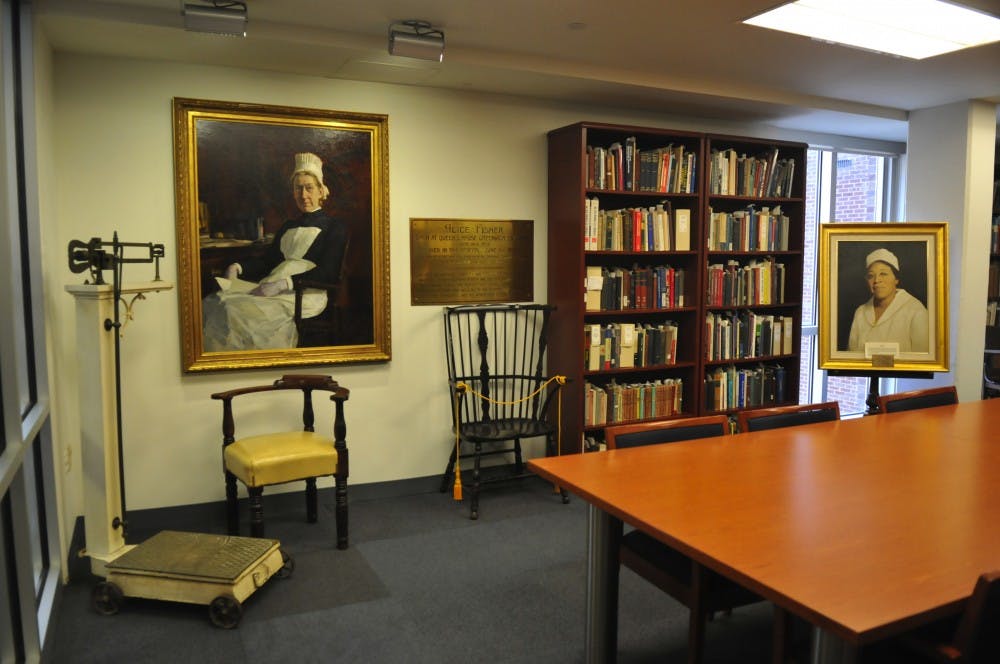
Black-and-white photographs, class notes and portraits from the 19th century are just some of the many artifacts housed at Penn’s Barbara Bates Center for the Study of the History of Nursing.
This year, the Bates Center — which, according to center coordinator Tiffany Collier, possesses the largest collection of primary and secondary materials on the history of nursing in the world — is celebrating its 25th anniversary.
Housed in a small, nondescript office suite in the School of Nursing’s Claire M. Fagin Hall, the center plays host to artifacts documenting the evolution of nursing studies at Penn and throughout the world.
“It creates a physical place for the history of nursing and nursing historians to meet,” said Nursing graduate Amanda Mahoney, who conducts research at the center. “This center preserves primary documents — from midwifery in the 17th century to blood poisoning in Baltimore in the 1990s — and organizes them into archives available to scholars.”
Currently, most Penn-related historical artifacts are kept at the University Archives on 3401 Market Street. However, the Nursing School chose to create an independent center to chronicle its history 25 years ago because, according to Nursing assistant professor and assistant director of the center Jean Whelan, “no one recognized the nurse at the bedside.”
According to Mahoney, “there are only two centers in the world that exclusively hold materials on the history of nursing — Penn and the University of Virginia. This is the only place where you receive support and guidance from nursing historians at the top of their field.”
To commemorate its 25th anniversary, the center is holding a symposium on April 14 to honor one of its three founders, Joan Lynaugh.
Among other things, some of the center’s most prominent artifacts include records from the Mercy-Douglass School of Nursing — one of the most prominent African-American nursing training facilities in history.
The artifacts around the center, such as a grandfather clock and a movie poster — Warner Bros. Pictures The Nurse’s Secret —“make undergraduates who otherwise wouldn’t be interested in history start conversations and propose questions in their history classes,” Mahoney said.
“The study of the history of nursing is important because nursing is a predominantly women’s profession,” Whelan said. “This is the history of women and women’s work.”
Mahoney’s interest in the study of the history of nursing began during her senior year of her Bachelor of Science in Nursing studies at Penn, during which she took a closer look at Thomas Eakins’ painting “The Agnew Clinic” — an 1889 depiction of a partial mastectomy in a medical amphitheater at the Hospital of the University of Pennsylvania.
The only female in the portrait, other than the patient, is Mary Clymer, whose notes from when she was a nursing student are housed at the Bates Center.
“I had no idea you could be a historian of nursing before that,” Mahoney said.
“You don’t know what nurses really do until you really need them,” Whelan added. “Nursing is thought of as an invisible profession, but through the creation of this center, you make it more visible.”
This story has been updated to clarify Whelan’s title. She an assistant professor and assistant director of the center, not a professor or the the director of the center.

