

Chances are you've done it before.
You take your seat and scan the room to size up the competition - the annoying girl in the front row, the seemingly clueless guy who says nothing all semester but invariably aces the test - until your eyes stop on the mass of muscle in the back, decked out in his team-issued hoodie and athletic pants.
Fighting every liberal-minded instinct in your being, you can't help but come to the same cruel and bigoted conclusion: That, you think, has got to be good for the curve.
* * *
Indeed, the "jock" remains the most derided academic archetype around.
But as the Class of 2009 scours an increasingly brutal economic landscape in search of job leads, Penn's athletes may boast a decided leg up on their application adversaries.
"They have the kind of qualities that employers are looking for - things like teamwork, commitment, motivation, determination," said Helen Cheung, associate director of Career Services for the College of Arts and Sciences. "This is the thing we tell [them] all the time: Brag about it."
According to Cheung, companies with large human resource departments - banks, consulting firms, larger corporations - are typically the most demonstrative in their pursuit of athletes, often holding separate on-campus recruitment initiatives just for them.
Of course, for some candidates, the varsity letter can be rendered obsolete fairly early in the application process.
"In finance, if you can't do the math, you can't do the math," said Scott Rosner, associate director of the Wharton Sports Business Initiative. "But the skills that you take away from the intercollegiate athletic experience really are transferable to any team-based system," like consulting or marketing.
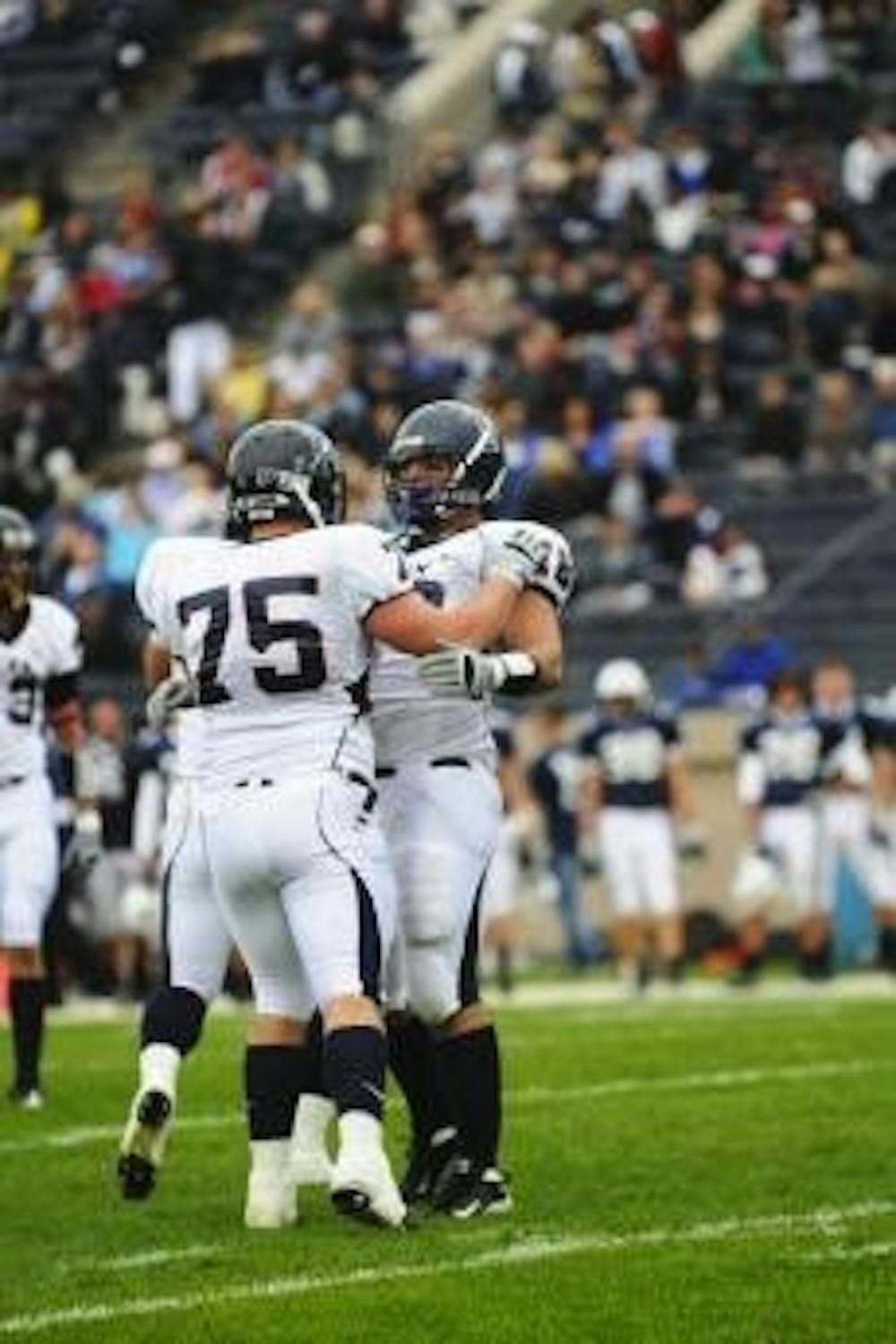
Seniors Guillermo Ruffolo and Jay Colabella, both defensive anchors of the football team, are among those looking to make the jump from Franklin Field to the financial field. Both have lined up post-graduate gigs at UBS after spending the past two summers interning there together.
"In all my interviews, that's the first thing they brought up," Ruffolo said of his ball-hawking background. "Afterwards, you try to move on and say, 'I've got other things to offer, too.'"
Ruffolo also noted the benefit of the team's alumni network, a lynchpin of any graduating athlete's job-search gameplan.
Former players, he said, are "very eager and willing" to put in a good word for current team members - if students have the grades to justify their good will.
"Usually, a 3.0 [GPA] is that cutoff," Ruffolo estimated. "At 3.0, if you know the right people and people are willing to help you, you can compete with students who are maybe at 3.8, 3.9."
For those athletes whose GPAs are less than stellar, Cheung and her cohorts at Career Services have some advice, delivered periodically at a workshop called "Managing the Skeletons in Your Closet" - held near Franklin Field with an evening start time amenable to most varsity practice schedules.
"You want to own up to it," Cheung said of some students' GPA woes. "An employer realizes that they spend 50 hours a week in practice or in competition. They realize that this person doesn't have as much time to study or to join other clubs."
Ruffolo, of course, is quick to echo the sentiment.
"It is a huge commitment," he said. "It's like a job."
There is, it seems, no better work experience to have.

