

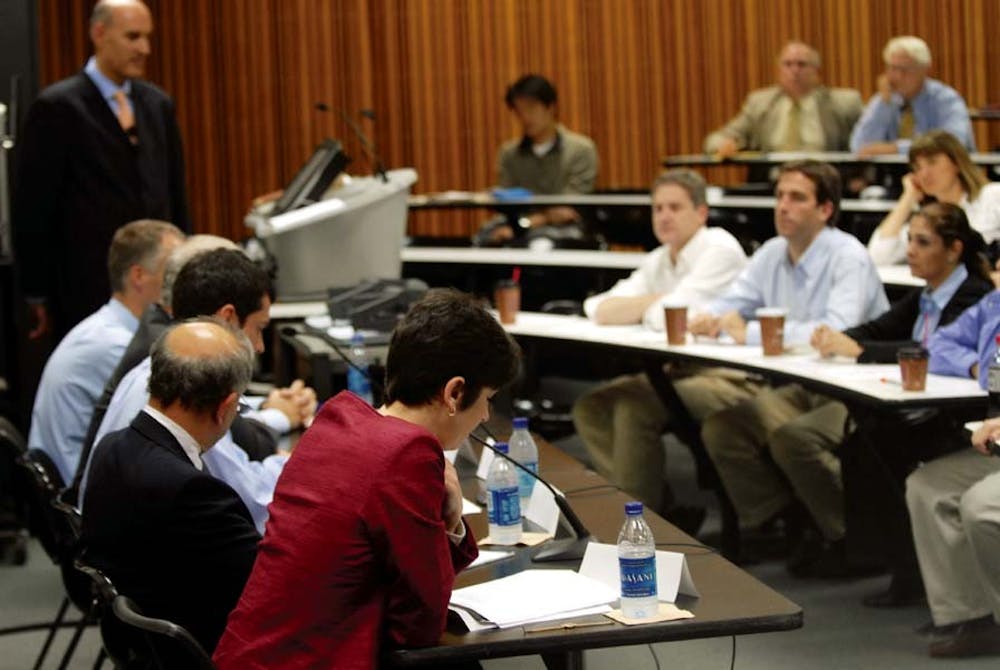
With the current bleak economic situation on the forefront of many peoples' minds, last night a panel of Penn professors turned to similar situations abroad to brainstorm potential financial solutions.
Members of the panel, which was held at Steinberg-Deitrich Hall, included Wharton professors Luzi Hail, Bulent Gultekin and Marshall Meyer and Political Science professors Jennifer Amyx and Heiner Schulz.
Commentary began with Amyx, author of Japan's Financial Crisis, who asserted that "the most relevant lesson from Japan is that financial crises are ultimately political."
She noticed that when Japan's financial crisis began in 1997, it took a "new set of actors" in the Japanese form of Congress to draft legislation that would be effective.
She noted that in the United States' current financial crisis, Congress has not yet proposed new ideas, but has rather thrown around money without "changing the rules of the game."
Hail, an expert on international accounting and financial disclosure, continued by pointing to three lessons she learned from a former Swiss financial crisis.
"Crises can serve a great role as an accelerator of change.private solutions can work [and] exceedingly large banks can continue to be mismanaged after the crisis has passed, like UBS and Credit Suisse," she said.
Looking toward the east, Meyer, a board member of the Hong Kong Trade Development Council, said that because Chinese banks have easy access to money via the Chinese government, it is harder to compare their situation to that of the United States.
Gultekin drew from his experience as the former governor of the Central Bank of Turkey and said bank failures are often the result of politicians who "don't pay much attention to regulations" and governors of national banks who don't know how to say no to financial companies.
Next, Schulz analyzed the 1994 situation of a nation closer to home -- Mexico.
Based on this crisis, Schulz argued that the proposed U.S. bailout will cost more than expected, noting that Mexico spent 15 percent of its gross domestic product, equivalent to two trillion dollars for the United States, working to fix the situation over a 10-year span.
He claimed that our real economy will take a severe hit, and that the only reason why Mexico's didn't was because its financial institutions made up only 22 percent of economic activity. In the United States, he said, the degree of financialization is substantially more.
Many international students attended the event.
College freshman Jose Varela said he liked hearing about "how other countries managed their situations."
College freshman Juan Carlos Ibarra agreed, but he said the panelists "should've talked more about how to solve it."

