

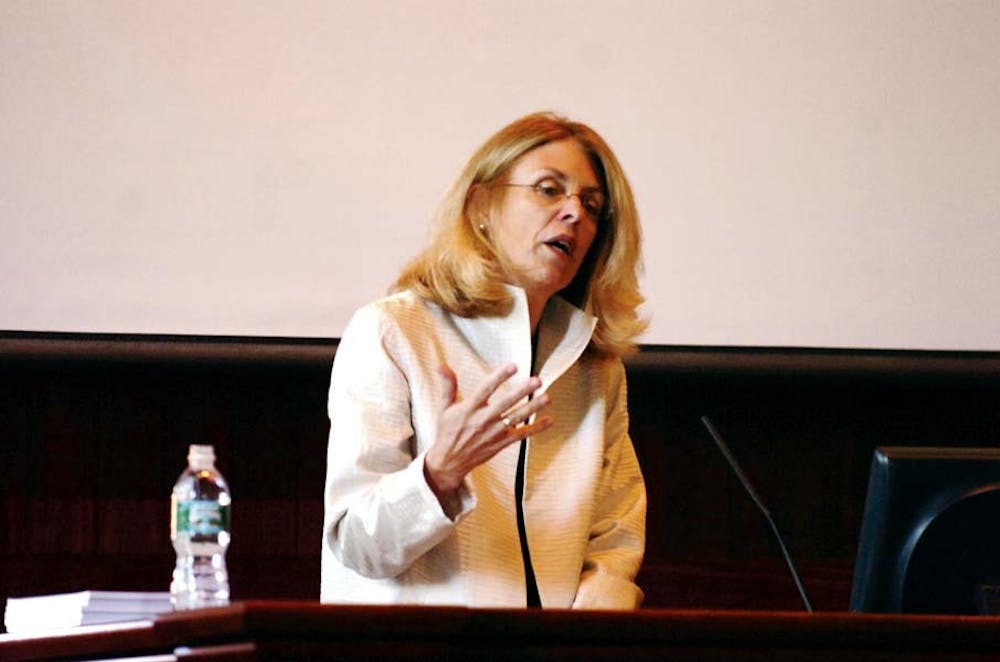
From the sexing of fossils to horses' harems, Stanford history of science professor Londa Schiebinger spoke on gender in science and engineering in College Hall.
The largely female audience heard Schiebinger's manifesto for the sciences. She began with the relative lack of women in science - "the woman problem" - by noting that past solutions focused on teaching women to act more like men and "left the man's world unchanged."
Drawing on sociological evidence and children's drawings, she demonstrated how the situation was changing. She added that it has improved, but not much. The crux of her argument was that "women will not become equal participants in science until we fix the gender-in-knowledge problem."
Quintessential cases of gender bias in science include drug trials that were conducted with solely male participants, but whose results were generalized for both sexes. She noted that not only is this "bad science" but dangerous: drugs that can cure men can sometimes kill women.
Concerned with the practical and not the philosophical, Schiebinger focused on gender bias in research and how this can be identified and solved.
She stated that gender awareness in research needs to be learned explicitly and proposed that undergraduates, graduates and researchers alike should be formally trained in identifying the role of gender in their work. She hoped this could be formalized by the National Institutes of Health, as it is under the European Union.
Furthermore, since women are more likely than men to have partners in equal status positions, this limits their career mobility. She called upon institutions to streamline applications from couples to alleviate this issue.
History and Sociology of Science professor Henrika Kuklick said that Schiebinger "did as good a job as is possible in a short period of time" to summarize the issue, reflecting the speaker's need to keep her 'pitch' short since "people want faster answers" in the natural rather than the social sciences.
Mara Taylor, a graduate student and Rita Barnard, the director of Women's Studies at Penn, concurred that the audience was mixed and not just supporters of Schiebinger's ideas. Taylor said she thought the speech was suited for a variety of audiences while Barnard specifically said "this was not [just] an 'in group' thing" and that there were many "disciplinary intersections" present.

