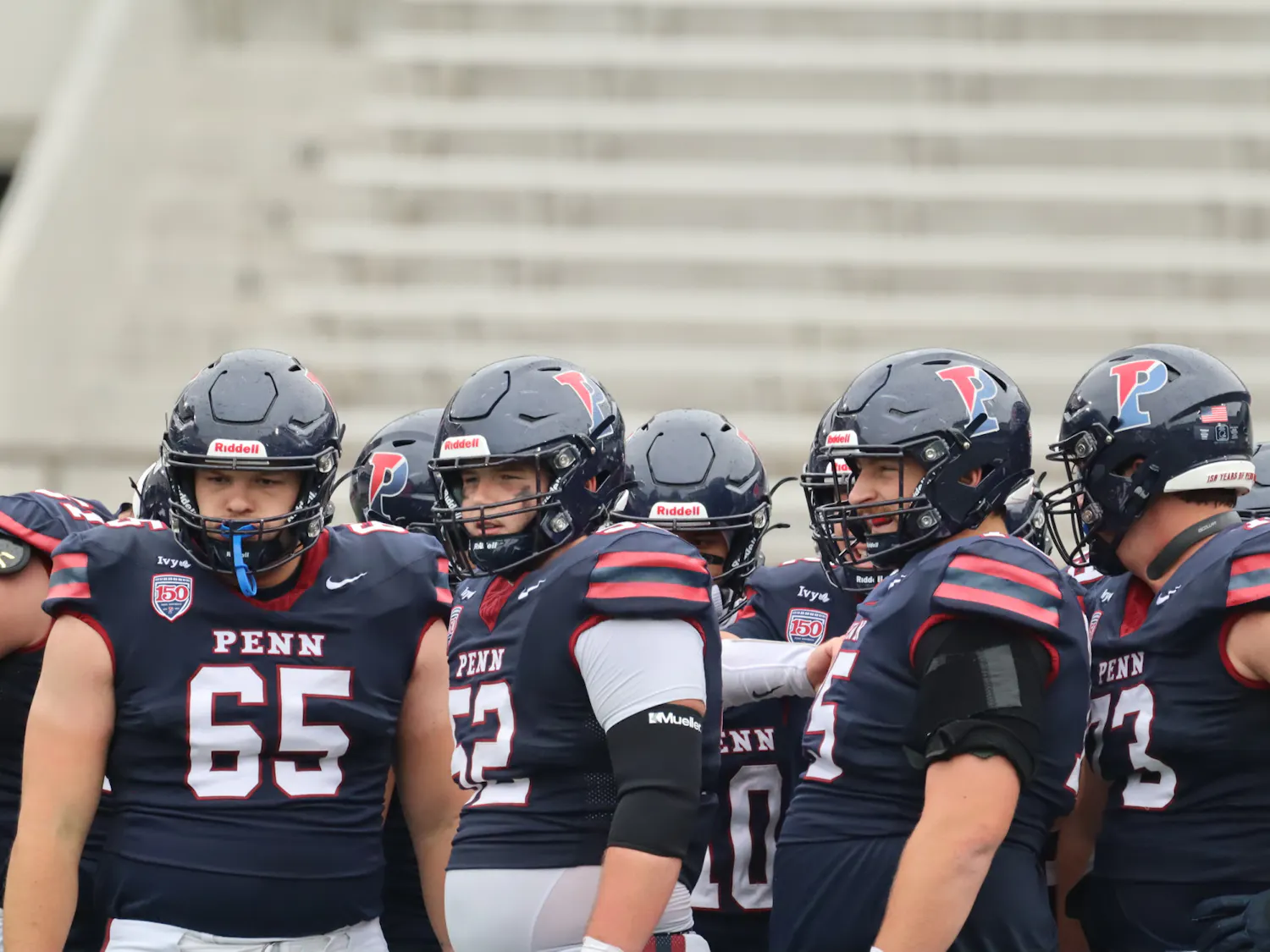
While Ivy League teams are currently showing their skills on the national platform of NCAA championship tournaments in volleyball and soccer, the Penn football players are reminiscing about their undefeated season at home.
Though the Quakers have not lost an Ivy League football game since 2001, they were not allowed to test their abilities in the Division I-AA national tournament this year due to an Ivy League ban.
The Council of Ivy Group Presidents set the rule forbidding any Ancient Eight school to take part in the national playoff tournament.
This ban has been in effect since the NCAA broke up Division I into two sections in 1979.
The University administration cited academic reasons, as the playoffs could potentially conflict with finals, if the Quakers were to advance multiple rounds.
"We'd prefer our students not engage in formal athletic competition during finals," Penn President Judith Rodin said earlier in the year.
The concern over this rule spreads beyond the confines of West Philadelphia.
Other prominent Division I-AA football programs, with and without ties to the Ivy League, cited the importance of maintaining the highest possible level of quality of play in the tournament.
"There are very good teams in the Ivy League," Colgate coach Dick Biddle said. "It's a pretty good tournament as it is, but I know there's some good teams in the Ivy League that would do very well in the tournament, but they're not there."
The Red Raiders, who already defeated Massachusetts in the first round of the tournament, played four Ivy League teams during their regular season.
While they beat Dartmouth and Princeton by over 20 points each, they only defeated Yale by 12 for their Homecoming game, and just barely squeezed past Cornell, 27-24.
Penn has had much success against non-Ivy teams in recent years, most strikingly beating then-No. 4 Lehigh in its 2002 home opener.
"I'm sorry about [the Ivy League] not being in it," Biddle said.
Biddle said that Colgate's Patriot League once had a similar rule in place, and its reason was "probably academics" like the Ivies.
UMass has even closer connections to the Ivy League, as coach Mark Whipple coached for Brown from 1994-1997.
Whipple, this year's Atlantic 10 coach of the year, said he was given no real explanation of the rule while at Brown, even when the Bears were turning in second-place league finishes.
"When I was the head coach at Brown, it came up all the time, but they never really gave a reason [for the ban] besides it was just the Ivy League," he said.
While Massachusetts has not played any Ivy League teams in recent years, Whipple said that he still follows the league and keeps in touch with Brown athletic staff members. He believes that the Ivy League would provide comparable competition to his Atlantic 10 division rivals.
Skill level aside, if the Ivy League were to enter the field of competition in this tournament, logistical changes would be necessary.
There are currently 16 teams in the tournament, eight of which enter through automatic bids for winning their respective conferences. Automatic bids go to what the NCAA selection committee considers to be the division's eight strongest conferences.
Currently there are nine conferences which participate in the I-AA playoffs, however, letting the Ivy champion play would add a 10th, thus adding another conference which would not receive an automatic bid.
While this move could frustrate some programs whose main avenue into the tournament is an at-large bid, most coaches agreed that the change would be worth it if the competition remained intense.
Montana coach Bobby Hauck, who has reached the playoffs via at-large bids the past two years, felt "it would only affect one team a year... if the Ivy champion can move in and do a good job, it would be a sound change. But if they couldn't compete, it would be too bad."
"I think people like [the tournament] the way it is, but maybe I'm just out of the loop."
Whipple said when he was at Brown, it was mainly the players who questioned the decision and not the coaches, but the double standards of the ban were obvious.
"I think that they should [be allowed to play] or they should not let any teams participate in the postseason tournament," he said. "Everyone wants to say that football is the same, but it's not treated that way."
"Actions speak louder than words."