[Western aesthetic] is dedicated to the validation of itself. Its task is to move humans by means of achieving mastery in content, technique, feeling. Western art is always whole and always, 'in power.'" -- Gloria Anzaldua
The overarching aesthetic of Penn has changed physically over the past couple of years. Under the presidency of Judith Rodin, Penn has infused a boatload of cash into refurbishing academic buildings, Houston Hall and dormitories. But has Penn's style changed at the expense of substance, of the goals Benjamin Franklin set out when he created this school in 1740?
On the University's Web site, its purpose is stated: Penn carries on the principles and spirit of its founder, Benjamin Franklin: entrepreneurship, innovation, invention, outreach and a pragmatic love of knowledge. Franklin's practical outlook has remained a driving force in the University's development.
Penn is a scenic campus, with Locust Walk lit up day and night and brick buildings lining University City. The substance of Penn comes from what it does -- namely what its scholars and students do. We students and scholars are here studying, learning and teaching in disciplines which we might follow to gain a set of job skills. We hope to improve on our knowledge over the period of our education and lifetime, finding gainful employment in any number of arenas.
But are we addressing all of Franklin's tenets today?
There is no question that some of Penn's scholars and students are innovators, judging from the fact that we have Nobel Laureates, as well as Fulbright, Gates and Marshall Scholars. Penn uses these scholars as badges of honor, saying, "Look, I got some trophies piling up on my desk!"
In entrepreneurship, there is no question that Penn produces many people who can organize, manage and assume the risks of business and enterprise. Each of our schools, Wharton in particular, teaches us how to be strong entrepreneurs.
But what kind of student is Penn putting on a pedestal? Is it the kid who works on an economics project on health care disparities in rural Southern towns? Or is it a kid who works on a project addressing loopholes in American tax law?
More often than not, the latter is placed on the pedestal at Penn. Why? Because a tax law specialist is going to have a higher starting salary.
We worship the dollar at Penn and in America -- more power to the person who wants to pursue the almighty buck, because it is his right. This education does cost a lot of money, and we need to see returns so that we're not in debt in our old age.
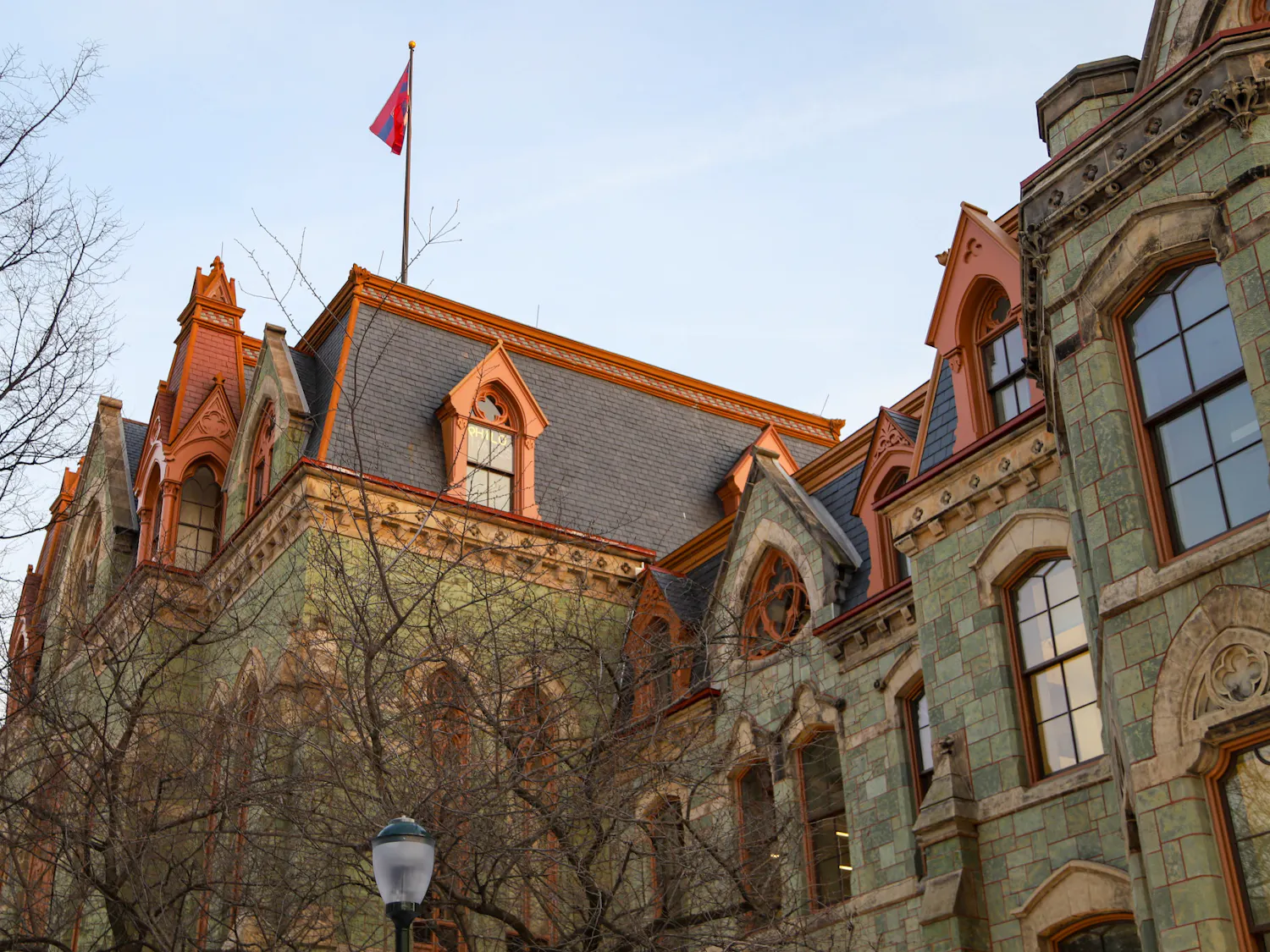
Penn's aesthetic is embodied in people's style of clothing, in their ability to travel to far-off places and the personas they carry in public. Our spiritual center at Penn is not College Hall, or the Center for Community Partnerships. Our spirit lies in the cavernous, leather-clad hallways of Huntsman Hall, the anchor of entrepreneurship.
Wharton has been built anew after a seven-year fundraising campaign that has collected $445 million in donations to help with its growth and expansion. Have the College, Engineering or Nursing schools even touched the pocket change that Wharton collected in the last month?
But where is outreach and love of knowledge on Penn's priority list? Penn has outreach with area schools, but for the most part, not only is our interaction with the West Philadelphia community very limited, but we as a Penn community are divided. There is a great deal of resentment you see under the surface, as well as up front, when students from different schools interact. There is an unspoken hierarchy that students feel and talk about, but have trouble addressing.
Do we thirst for knowledge? Maybe some of us do, but the values that exist here, mainly the accumulation of wealth, can become acidic to that thirst.
What can Penn do to address this? Instead of having me complain, let's start a plan to re-evaluate our educational practices. Create individual reviews within each of the major schools, and find out where the holes are.
We should have a review and expansion of the Penn Fund as well. Penn Fund finds the money that we need to fund the growth and development of academic and civic programming -- the items that are most vital in addressing Franklin's last two tenets. We need to connect all our schools, professional and liberal arts, to the community. By creating a service and learning requirement in all the schools, we can reinforce the larger priority of our educations: to contribute as individuals to society's growth at large.
Creating a generation of scholars and workers focused solely on the accumulation of wealth doesn't help society progress. What Penn can do as a model for education in America is lead the way in truly endowing the entrepreneur, innovator, worker and scholar with the skills that can create an equal and united society.
Nicolas Rodriquez is a senior Political Science major from Sanger, Calif.