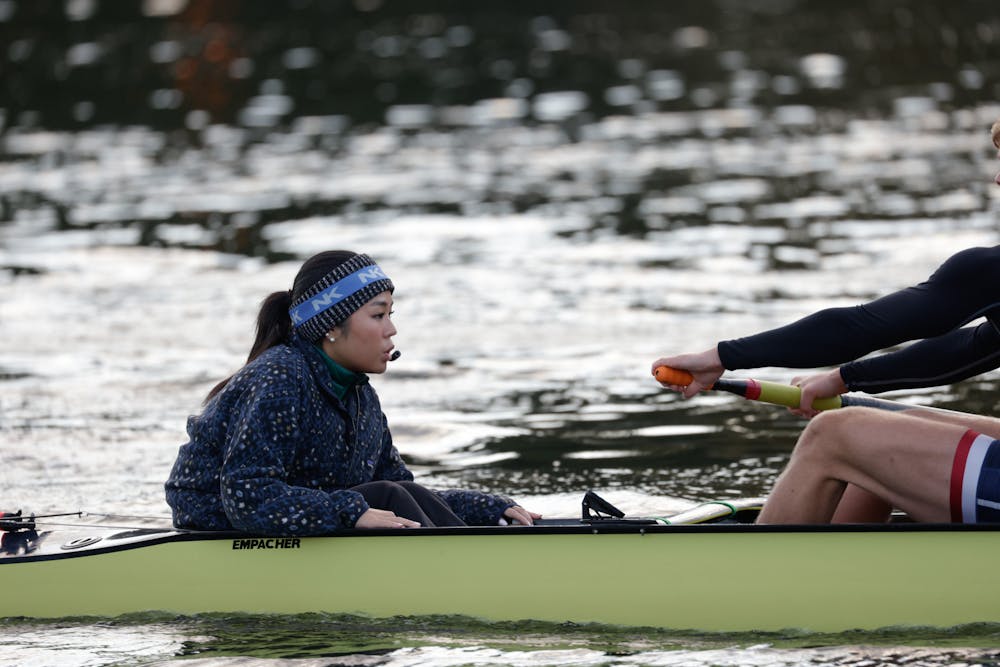
Then-senior coxswain Hailey Kim bides her time.
Blades slashing the water, Penn and Yale’s heavyweight varsity boats are straining to cross the finish line. Facing the rowers, Kim is the only one in the boat who can see beyond the boat. With the Blackwell Cup on the line, there are only 150-200 meters to go, and Penn is still around two seats down.
That’s when she calls it: “We’re running out of room! Cut the back! Legs, arms now!”
At her command, all eight rowers start their last sprint to the line, shortening their swing into full “lifting mode.” Kim knows the last 10 strokes are a “dogfight.” She knows they are exhausted from rowing nearly 2000 meters in sync and at pace already. She knows because she used to row herself.
“When I started calling that sprint, I had full faith that we were gonna make it,” she said. “I was yelling my guts out to the guys, but inside I’m like, ‘I know we’re gonna do this.’”
She was right. Penn finished 0.4 seconds ahead of the Bulldogs.
That confidence was hard-won. As the middle child, Kim often felt overshadowed by her siblings. It wasn’t until her “pivotal” move across the world to attend Tabor Academy in Mass. that Kim found the freedom to define herself by her own terms.
Growing up on Jeju Island off the coast of South Korea, Kim was naturally drawn to aquatic sports in high school. She rowed nearly all four years before switching to coxswain her senior spring.
RELATED:
Penn lightweight rowing secures historic V4+ finish, heavyweight grabs 10th at IRA Nationals
Heavyweight, lightweight rowing finish third in combined team points at EARC Sprints
At Penn, Kim kept up her momentum, walking onto the men’s heavyweight rowing team as a coxswain. Still, her freshman year with the team turned out more difficult than anticipated.
“I was honestly just scared to talk in the boat,” she said. “It was a huge transition coming from Tabor — where all the guys were like my height essentially — to a team where everyone’s like 6’5”.”
Fall 2022 was Coach Al Monte’s first season at the helm of the program, and Kim spent most of her time “learning from the launch.”
“I was so bad that I felt bad about even representing myself as a Penn rower,” she said. “I wouldn’t wear any team gear … . I just isolated myself.”
When she came back to campus for her sophomore year, Kim understood that she had to find “the right way to be part of the team.”
“I obviously feel the difference being a girl on the guy’s team, but also, what people sometimes forget is that the guys also feel that difference,” she said. “They’re not gonna be able to give me feedback in the same way they do with the guys. They can be more direct with the guy coxswains.”
Kim fought back against that “nice-ness,” willing to be seen as aggressive and even arrogant if it meant she would be a better athlete.
“Just treat me as an athlete, as a rower,” she said. “I don’t need all of this sugar coating. If I suck, tell me I suck.”
When it comes to the technicalities of rowing, Kim has it down. Seeing the rowers on the boat, feeling the smoothness or bumps of the ride as the oars dip into the water, Kim can tell when they’re not together.
She also uses a telemetry tool, which shows the acceleration curve of the boat and how many watts each person is putting down.
“I can see whether we’re picking up the boat well and at the right time or if we’re being a little hesitant at the catch,” Kim added.
That work ethic eventually led to her coxing the varsity boat in her final year with the program — the 2025-26 season — which teammate, friend, and then-senior captain Cole Riedinger appreciated.
“She runs a great practice,” Riedinger said. “When you’re in the boat with her, she has a very high level of professionalism and will constantly be on you.”
Riedinger said Kim’s technicality and effort were “exactly” what the team needed. He also noticed how Kim treated others, recalling how she once invited the group for karaoke at her house. While Riedinger “wouldn’t necessarily anticipate it to be fun,” he said Kim “brought us out of our comfort zones.”
Another time, Kim and another coxswain cooked for around 40 people on the team, preparing a “great blend of food” like focaccia, pancakes, and croissants. According to Riedinger, this was “just normal for Hailey,” who would often bring treats like banana bread or cookies to the bus.
Although Riedinger immediately remembered the breakfast when asked about his favorite memory of Kim, his answer was really the “small things” about being her teammate.
“She’s grown to be one of our favorite teammates,” he said. “I think that’s the way we all see her.”
Falling into place on the team, in the end, came from trusting herself both as an athlete and person.
“You never know who’s gonna become the leader,” Kim said. “If you asked me, freshman Hailey, ‘Do you think you’re gonna be in the varsity your senior year?’ I would have said, ‘Absolutely not.’”