Believe it or not, there are a few things more important than winning.
For Penn fencing, or “Penncing” as they refer to themselves, one is Mongolian BBQ.
Specifically, Chen’s Mongolian Buffet near Penn State, which senior sabre Simon Kushkov said doesn’t “even know if it makes a hole-in-the-wall status.” As of Oct. 14, the restaurant is listed as “permanently closed” on Google Maps.
“It was a rite of passage [for] the Penn team,” Kushkov said, “Half the team is out the next day because they ate something bad.”
Last year, junior sabre Leah Blum paid the price. She couldn’t fence the next morning because of what she “assume[d] [was] food poisoning.” The food itself seemed to be fine, but the “environment” and kitchen weren’t the most sanitary.
“It’s just a bonding experience … you just have to do it,” Blum echoed Kushkov’s thoughts. Even if that means you can’t fence against Penn State the next morning.
The team always eats at Chen’s the day before their tournament at Penn State at the coaches’ insistence.
“I think they like that it’s a good price,” Kushkov said. And at this point, it’s become a “staple” for Penn fencing. It’s a part of their tradition. But it’s far from their only one.
Every Labor Day weekend, the team goes to Atlantic City, N.J., and, for one day, switches their usual metal strip for a sandy one. They practice footwork and “combat action” in a series of exercises and drills on the beach.
The team organizes in rows, performing the same synchronized motions. They then play relay games before a mile and a half run from one pier to the next while the coaches tan.
RELATED:
But the afternoon is where the team really lets loose. Some people swim, others play volleyball or spikeball. This year, some of the fencers played football with the coaches. Some other beachgoers asked to join, to which Kushkov couldn’t blame them because “it looked really fun.”
Needless to say, it’s an active day on the beach.
“I think there’s still sand in one of my backpacks that I use,” Blum said, “I don’t really use that one very much [anymore].”
But the loss of a backpack and a sandy ride home is worth it, especially for the freshmen. The day at the beach allows new team members to get to know each other in a stress-free environment, Blum pointed out.
It’s not only fencing that tries to find ways to shake things up.
Penn women’s tennis, for example, holds an annual practice session during the first week of classes at the Philadelphia Art Museum steps. At 6 a.m., the team runs from Penn’s campus all the way to Boathouse Row and then to the museum, where the coaches — who drove — await them.
At the museum, they sprint up and down the steps like Rocky and then sprint again on the grass in front of the museum before jogging back to the tennis courts to stretch.
Unlike their usual practices which consist of tennis drills or rallies, this session is more about physical exertion to get the team back in shape after a long summer. It may not be as cinematic as running along the beach, but the team bonds in the pain of sweating on a late August morning as the sun rises. Whether any fun is mixed in depends “on if you find running fun,” according to sophomore Sarah Wang.
But sometimes these traditions in Penn sports teams are less about the sport itself and more about team camaraderie.
Women’s fencing makes bracelets every year, and one of the upperclassmen who lives off campus hosts the event at her home. With Sabrina Carpenter playing in the background and homemade cookies in the oven, the team makes bracelets from a kit that has been passed down for years.
It’s a rare moment for the women to get together “and not have to think about competing the next day,” according to Blum.
Though for now it’s only a tradition for women’s fencing, Blum thinks “it would be something that [men’s fencing] would benefit from. I don’t know if they have anything similar to that.”
“We’ll think about it. Maybe some hair-braiding stuff,” Kushkov joked.
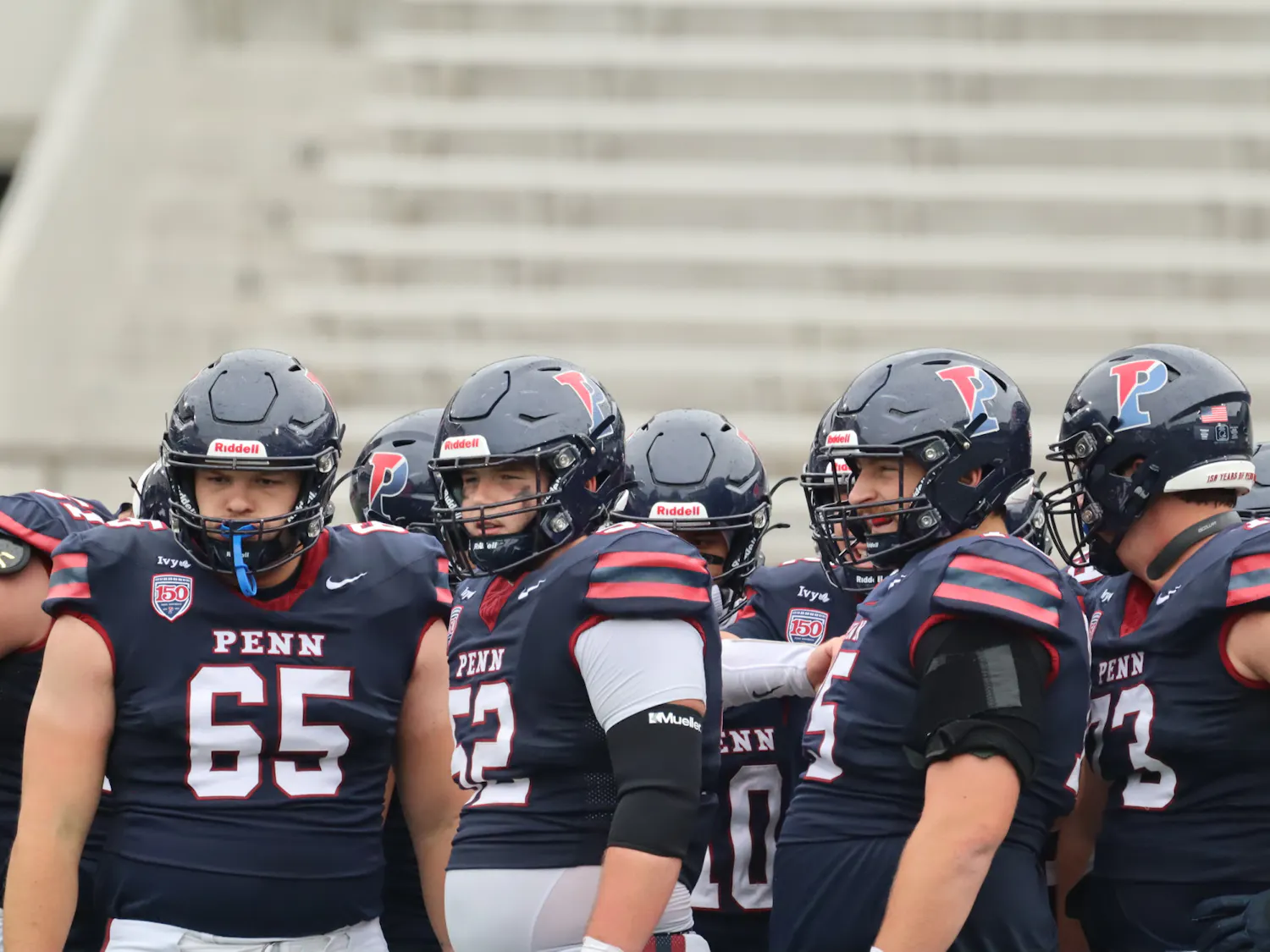
When it comes to hair, Penn football has taken up the call. The week that the team faces Harvard, some players get what is called the “Harvard Cut.”
“[It’s] any cut that you can think of — or not even that you can think of — any crazy cut that you can’t imagine a person having. That’s what a Harvard Cut is,” senior wide receiver Jared Richardson said.
Some examples include tiger- or cheetah-print hair, a bowl cut, mohawks, and buzz cuts. Sometimes players with long hair who never braided it suddenly came to practice with braids or cornrows. Richardson remembers someone with blonde hair dyeing it a “royalish blue.”
Previously, 2025 College graduate and former running back Jacob “Cis” Cisneros was the barber on the team.
“Some people were like, ‘Ah, do whatever you want,’” Richardson said. “And he did whatever he wanted. But he was a good barber. He’d give a crazy haircut, but it didn’t look bad if that makes sense. It still looked kinda sharp.”
With Cisneros graduated, those who want to participate in the cut will have to get creative. Richardson clarified that he would “not be volunteering.” He himself has never tried anything crazy with his hair.
“I just don’t want my hair looking like a mess. … I take my appearance very seriously.” Richardson said.
In regards to these crazy haircuts actually affecting their football, Richardson said it didn’t, but then elaborated.
“I mean the last three years we played Harvard, we lost. … Maybe we shouldn’t do the Harvard Cut,” he joked.
Penn men’s heavyweight rowing, like any team, may not win every year, but having nicknames on the team is “something that has lived, I swear, since the beginning of Penn rowing,” according to senior Cole Riedinger.
Nicknames are formed from playing around with a teammate’s actual name or in reference to something they did or said. Rowing-specific nicknames sometimes come from fruits or vegetables. When a rower is not performing well, the team will put a fruit or vegetable in his seat to see if his performance improves. Due to this tradition, some guys on the team are nicknamed “Peach” or “Cantaloupe.”
Rowing, America’s first collegiate sport, has many traditions besides nicknames, the most famous one being betting shirts. In rowing, each boat has eight seats and a coxswain, with each seat having a specific role to ensure the boat glides as smoothly as possible. And each school has its own distinctive shirt. Penn’s rowing shirt has a blue “P” at the upper-left corner with an oar crossing diagonally through it, and then two red stripes running across the shirt.
At the end of each race, the winning boat is given the shirts of all the other teams, with each rower taking the shirt of the competitor in the corresponding seat. In this way, the shirts, in that way, are a wager. The idea is that if you lose, you will give me your shirt. But if I win, you have to give your shirt to me.
“If you hypothetically never lose,” Reidinger said, “you’re supposed to never wear your shirt again and it goes in a fryer. But we haven’t done that yet.”
“We’re working on it,” junior RJ Sylak added.
It is not uncommon to see rowers wearing other schools’ rowing shirts. It’s a garment of pride, and having more shirts is a symbol of status. This is true for college rowing outside the Ivy League and even internationally. Some of Penn’s rowers who were on the United States national team will show up to practice wearing Australian or Swedish uniforms.
These betting shirts are not usually worn during the race itself. But Reidinger has one unforgettable experience: during a race his freshman year, he saw that the corresponding seat on the other team was Rhett Burns, an experienced rower who had been on the U23 national team.
“I was like, ‘This guy’s insane,’” Reidinger said. “Oh this guy’s gonna kill me.”
Penn did end up losing, and in his freshman naïveté, Reidinger had decided to wear his betting shirt that race. “It was soaked, drenched,” he said. “The colors were dripping … it’s not the greatest-quality shirt … I remember I gave it to him. I was like, ‘Hey dude, you probably got four of these sitting in your basement. This one’s a little dirty, I’m sorry.’ And he was like, ‘I get it, man. It’s all good.’”
Losing and receiving betting shirts is a universal rowing experience, and one that will continue once Reidinger and Sylak finish their rowing careers. The teammates have met former Penn rowers back home, through work, or at alumni gatherings, and have experienced the instant connection due to the traditions the team carries on.
“We might be separated a lot in time, but at the end of the day, it’s such a unifying thing,” Sylak said. “We’ve all shared this experience and I think you realize that it’s something bigger than yourself.”
Even if they never wear the shirts — after all, they’re cheap cotton shirts — it’s not about the shirt itself. It’s knowing that when you give or take a shirt, you’re taking part in something rowers from years past have done.
“I value them a lot. … I’ll wear maybe one the day after the race, but after that I just store ‘em away in my little collection,” Reidinger said.
“He’s gonna show ‘em to his kids,” Sylak said.
“I’m definitely going to show ‘em,” Reidinger added.