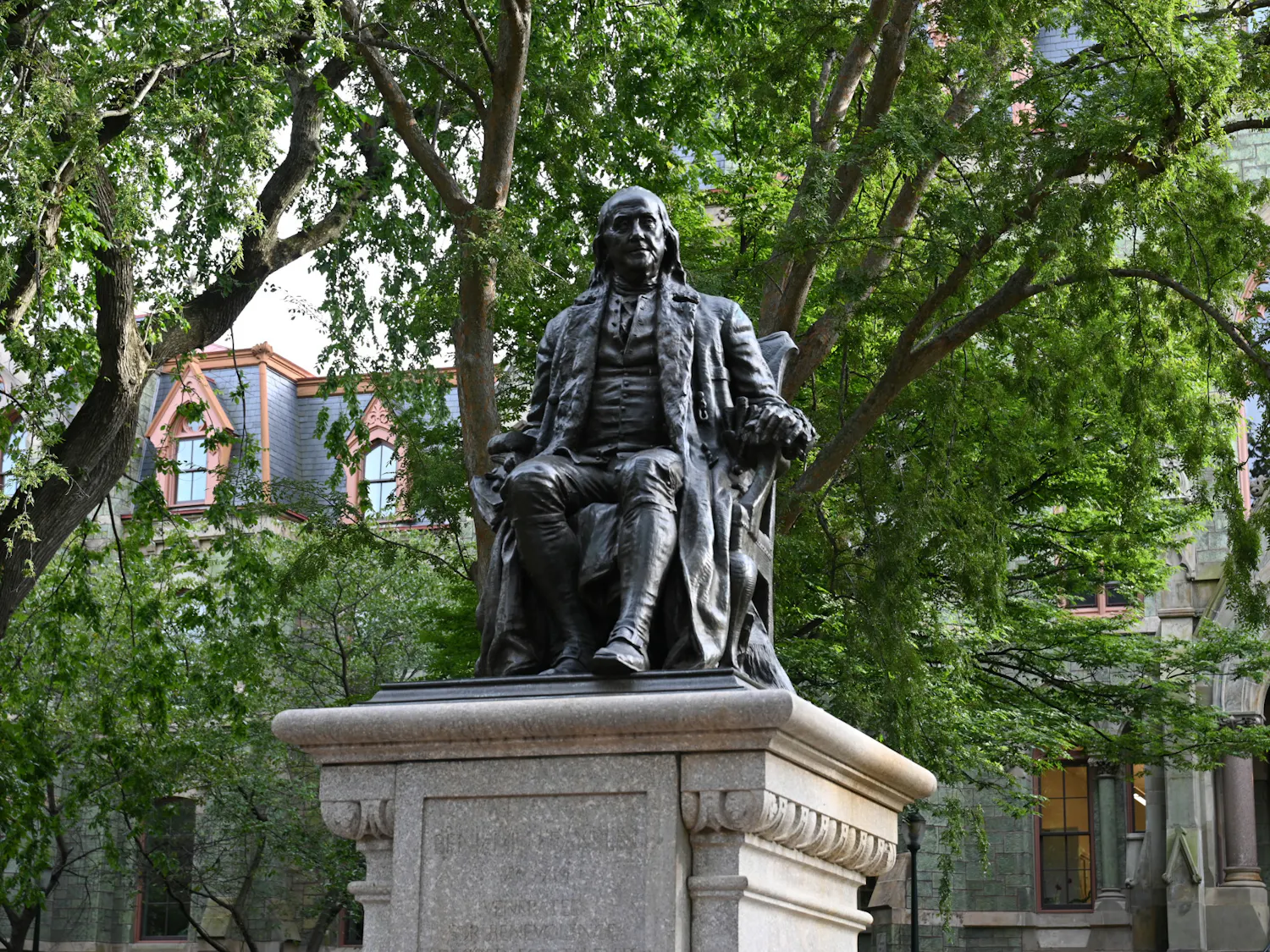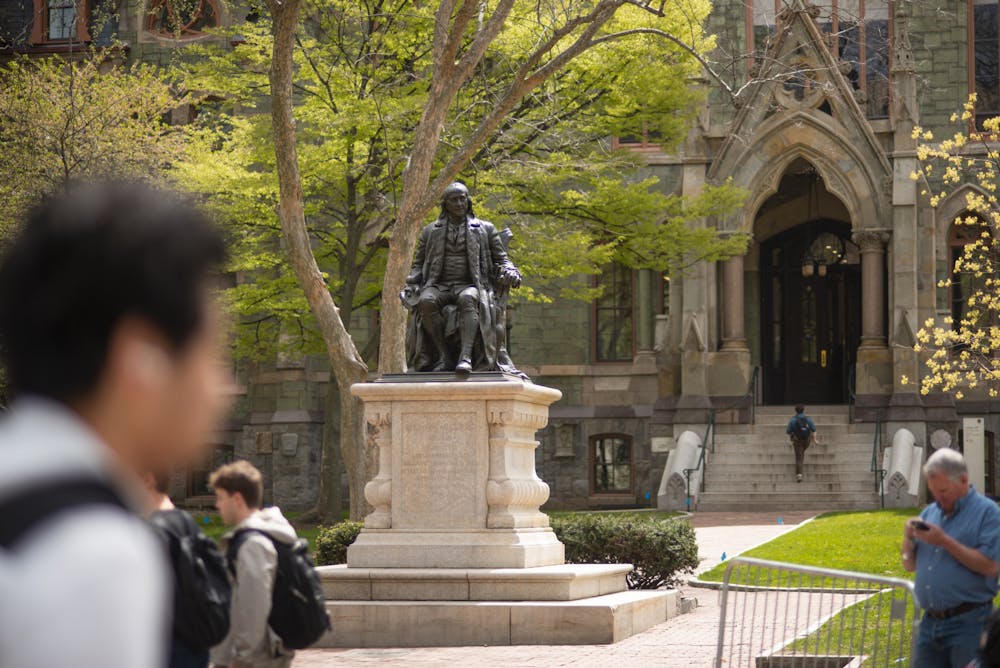
As Penn celebrates its 285th anniversary, The Daily Pennsylvanian spoke with scholars to understand the extent of Benjamin Franklin's involvement in the University and how his vision has shaped its legacy.
Penn’s campus, websites, and media are populated with frequent references to Franklin’s prominent role in its founding. Archivists, historians, and faculty members spoke to the principles that have endured since Penn's inception in 1740, and the conflicting narratives surrounding the University's educational ethos.
Page Talbott, who received a Ph.D. from the School of Arts and Sciences and currently serves as Director of Museum Outreach at Drexel University, noted that Franklin’s educational vision was significantly shaped by his early life experiences. He grew up with minimal formal education and was largely self-taught. However, his experience as an apprentice for his brother’s printing press during his teens instilled a love for learning and writing throughout the rest of his life.
“He was a reader on all subjects, and I think he regretted the fact that he wasn't able to stay in school and have the kind of education that would expose him to a broad range of subjects,” Talbott said.
For most of his life, Franklin worked as a successful tradesman while also making key scientific discoveries and inventions — most notably with his famous kite experiment. These experiences instilled a deep belief in the importance of technical skills, something he wanted reflected in higher education.
In 1749, Franklin published his essay "Proposals Relating to the Education of Youth in Pensilvania," which listed his desires for a practical-based education rather than the traditional Latin and Greek classical education that focused on producing ministers and members of the clergy. Additionally, Franklin's vision for a school centered around creating opportunities for working-class students. This stood in contrast with the most prominent colonial colleges at the time, like Harvard College and Yale College, which were focused on educating the children of upper-class elites.
“Franklin was always sympathetic to people with that kind of background — apprentices, people sort of working their way up, people self-educating, ” John Pollack, a curator of research services at Penn's Kislak Center for Special Collections, Rare Books and Manuscripts, said.
This desire became the precursor that led Franklin and other local academics to open the Academy of Philadelphia in 1749 and then the College of Philadelphia in 1755.
Belmont University professor David Curtis wrote in a statement to the DP that Franklin’s vision centered around a diverse curriculum, which included writing, science, and foreign language. Additionally, practical skills such as mechanics and agriculture were also emphasized. Curtis added that Franklin prioritized creating a “society of educated people who were committed to progress and civility."
Jonathan Zimmerman, a history of education professor at Penn, similarly remarked that Franklin’s original curriculum emphasized application to the worlds of civics, government, and business.
“Why do we have to learn Greek and Latin? Why do we have to memorize all these passages and languages that we're never going to use? What Franklin wanted was an education he called practical,” Zimmerman said.
Penn fellow George Boudreau notes that this approach was “absolutely radical” for the time.
“He didn’t believe in teaching letters by writing obscure tracks based on sermons. He believed in the ability to write a business letter,” Boudreau said.
However, the nature of Franklin’s vision caused him significant difficulties as he navigated Penn’s founding years.
“Like any educational enterprise with more than one person involved, politics got in the way almost immediately. Franklin's ideas weren't universally approved, and some of the principal actors were actively hostile to him,” Curtis wrote.
One such person was William Smith, the first provost of the College of Philadelphia. Smith, who had been an Anglican minister at the time of his hiring, initially expressed interest in Franklin's ideas. However, Smith quickly reverted back to embracing the traditional, classically focused curriculum taught by other colleges.
Further complicating their relationship was Smith’s decision to cater to elite political and public figures who aligned with Anglican and classical-leaning ideals. He was able to get these figures onto the Board of Trustees for the College, and they quickly moved away from Franklin’s vision, believing that a rich clientele would only patronize the school if it resembled the education of other colleges.
These disagreements ultimately led to Franklin being “pushed out” from the board and the College.
“He was still technically a member of the board. He would show up, but he wasn't the president. He knew he was outnumbered, and obviously decided he had other battles to fight,” Assistant University Archivist Jim Duffin said.
Eventually, Franklin became largely uninvolved with the responsibilities of the University, which by that time had fully returned to the classical education shared by the other colleges.
“It's ironic that we imagine Franklin as the central figure in [Penn’s] story. Of course, in many ways, he is, but what we forget is that in his own lifetime, he didn't get what he wanted,” Zimmerman said.
Pollack added that at the end of his life, Franklin wrote a "document about how he wasn't happy with what the school had become." He added that the question remains whether the University as it exists today is "Franklin's school."
“It’s not the story you get [from] admissions,” Duffin added.
Following Franklin’s death in 1790, the College of Philadelphia merged with the Academy of Philadelphia to become the University of Pennsylvania in 1791.
The merger ousted Smith as provost, but his desires for a classical education remained in place. Events during the 19th and 20th centuries, however, started Penn’s transition towards an institution more aligned with Franklin’s vision.
The rise of the Industrial Revolution in the late 1800s, coupled with the demands for medical, technical, and practical training during the Civil War, rapidly accelerated Penn’s investment in diversifying its curriculum. The early versions of both the School of Engineering and Applied Science and the Wharton School were established in this period, marking the creation of one of the country's first engineering schools and the country's first business school.
By the turn of the century, Penn was a key leader across several professional fields, including law, business, dentistry, veterinary medicine, and engineering.
The notion of who college education should be available to began to change as well. The inclusion of non-whites in the late 1800s was followed by enrollment for women in graduate, then undergraduate courses during the late 1800s and early 1900s. By the mid-1970s, Penn had become fully co-educational and integrated.
“By the 1960s, there [became] a whole sense of we need to serve a much bigger population. A lot of schools rethought ‘Hey, maybe this isn't just for a bunch of rich white men. We need other members of the world,’” Pollack said.
Zimmerman similarly said that the University’s more recent commitments to creating opportunities for working-class students through programs like the Quaker Commitment and Penn First Plus were aligned with Franklin’s vision.
While Penn has seen significant success in integrating Franklin’s vision of a more diverse student body, experts disagree on whether the current state of Penn’s professional schools reflects what Franklin imagined for the university.
“His vision included sort of what the Wharton School became, because he was really concerned with training people for business, being merchants, and so forth,” Duffin said.
Talbott added that the University’s focus on training people for leadership in business, government, and public service, as well as the inclusion of practical skills, is aligned with Franklin’s desires.
However, Curtis says that Franklin would have been “shocked” by the lack of real writing instruction current students receive and the ways in which college-educated people express themselves. He also wrote that Franklin would likely be disappointed with the lack of emphasis on public service in higher education.
“He would understand the importance of colleges providing practical education, but he would also think it meant little if students left college without the desire to aim their abilities toward the public good,” Curtis wrote.
Zimmerman echoed these remarks, citing the strong “pre-professional” environment at Penn and the heavy student focus on finance and consulting.
“Franklin would be rolling over in his grave if he heard people invoking him for this pre-professional ethos,” Zimmerman said.
Despite these challenges, Pollack believes that Franklin considered the school to be a “big part” of his legacy at the time of his death, referencing the success of the medical school as fulfilling his desire for training towards public service.
“Franklin's vision would eventually become ours, but not during his lifetime, because he lost that battle, even though ultimately he would win that war,” Zimmerman said.
Staff reporter Sameeksha Panda covers science and health and can be reached at panda@thedp.com. At Penn, she studies chemistry.