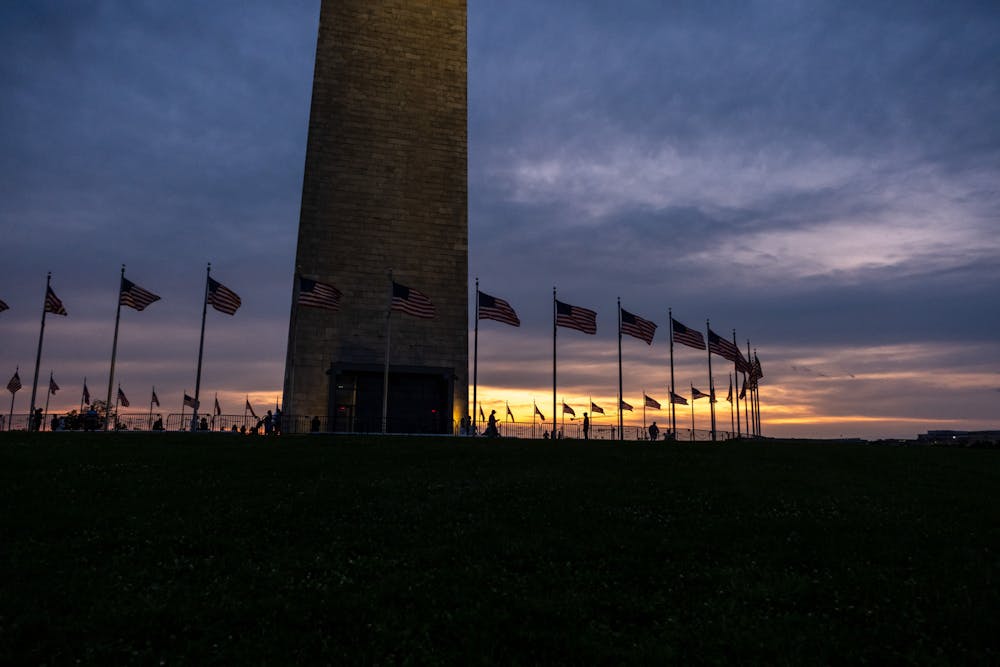
The more Fourth of Julys that I live through, the more I question what our celebrations say about us. Many Americans seem certain about their varying stances on the nation that day — some celebrate with crazed nationalist fervor, some acknowledge our lows but believe in celebrating our highs, and others are equally as steadfast in not caring and simply wanting to watch fireworks.
Though there are good intentions behind some of these conclusions, any unquestioned belief in national goodness ultimately does a profound disservice, stopping you from reaching new truths for fear of upsetting America. Thus, the only way to truly celebrate America is to interrogate it — and find home in the tension between good and bad.
As a student of American history, I often find myself struggling between the absolutes of pride and shame. Simply chalking it up to a mix of both emotions is too easy an answer for a question as complex as the United States. If the current political moment reveals anything, it’s that there has to be a more creative and meaningful way to evaluate the spirit of this nation — aside from simply placing it on some spectrum of goodness and badness. If your conclusion about the character of this country has to be recalibrated every time the Supreme Court makes a new decision or an administrative turnover occurs, it may simply be futile.
Every July Fourth, we have this incessant need to chart our emotions on that scale of good and bad, leading to a variety of attitudes. The aforementioned positions, which constitute the American majority, hinge on various iterations of the same basic assumption: that the American project retains some unique goodness worth celebrating despite a complex past.
Blindly nationalist and patriotic celebrations certainly refute the ideas that the nation’s atrocities were committed, should be questioned, and must be understood by America. This is void of logical consistency because, as author and journalist Ta-Nehisi Coates writes, that kind of exceptionalism puts America on a pedestal, and then flinches when we actually test that self-imposed high standard by asking tough questions. How dare we ask the nation that prides itself on universal suffrage about voter suppression? How dare we ask the nation that believes in sovereignty above all else why it dismantles foreign governments to preserve oil interests? By discouraging questioning altogether, we don’t allow polishing and maintenance of the American edifice. Thus, cracks begin to show. Small scratches of curiosity, when unattended, become large wounds of anger.
To add nuance, or perhaps in an effort to avoid the blatant ignorance associated with zealous patriots, others pick and choose the America they want to celebrate. You hear it often in the phrases we emphasize: “all men are created equal,” “there’s nothing more American than protest,” “we, the people.” The list goes on. People don’t often point out that “all men are created equal” was only written into the Declaration of Independence, which had no technical legal weight. The mainstream is only now barely explicitly wondering who “we the people” even are.
But picking and choosing with an unreasoned optimistic twist can be nearly as dangerous as blind nationalism. When you choose only the redemptive parts of a story to build a narrative that makes you feel at peace, you lose the full picture of things. After all, many of the most valorizing moments in this nation’s history have been necessitated by conditions of incredible distress and moral squalor.
What does it mean, then, that some of this nation’s best moments have been its people saving it from itself? It means that picking the parts of America that seem the most comforting — despite good intentions of resilience and national hope — still severs the inextricable bond between good and bad. In doing so, it ultimately depletes the meaning of the most valuable parts of American history.
SEE MORE FROM ARSHIYA PANT:
If academic freedom is dying, we can’t go down without a fight
The Holmesburg Prison experiment survivors deserve better from Penn
The silent insistence that the underlying honesty and goodness of the American project cannot be denied — despite all its flaws — only distances people from a meaningful understanding of American history. So many of the difficult questions that have been posed to me about American history by teachers throughout the years were quilted by a comforting implication that, ultimately, the national project was and is a good faith effort. This often seemed to hold us back when we were right at the door of new ideas or analyses, stopping one step short of questioning the nation’s intentions truly critically, as if we were afraid of offending America herself.
Another effect of avoiding uncomfortable questions about America is indifference. The mantra of “it’s not that deep” is heard each July Fourth. Of course, one ordinary person’s indifference does not define the entire nation’s attitude. But it is hypocritical to claim we’re separate from large social trends and political rhetoric while simultaneously being comfortable enough with this country to wear its flag like a family crest. The very fact that you can be indifferent — the very fact that national identity is so central to America that you can passively take on its ideology and spirit without once being intentional about it — should be something worth questioning.
Then there is the caveat of those who have come to an opposite definitive conclusion about the nation’s goodness, in that it lacks the quality completely. This approach takes more questioning and consideration than any active or passive acceptance of nationalism. Yet it misses the immensely important experience of allowing yourself to feel the simultaneous disgust and beauty in the fact that ordinary people have flourished and created change despite, and because of, American conditions. As historian Howard Zinn wrote, “I am supposing … that our future may be found in the past’s fugitive moments of compassion rather than in its solid centuries of warfare.” And those fugitive moments should not be ignored, but rather factored into the American equation.
I’m sure some would argue that committing oneself to a lack of conclusion is lazy or dispiriting. But if it ever feels lazy to avoid coming to a conclusion about American history, you’re doing it wrong. Of course, you must know which side you are on. But you cannot ever be satisfied with what you know. Continuing to ask questions is significantly more difficult and rewarding than the absorption of a narrative someone else manufactured. And perpetual critique is far from dispiriting; exhausting yourself for something you love is beyond fulfilling. James Baldwin once wrote that because he loves America more than any other country in the world, he insisted on the right to perpetually criticize it. I believe that about sums it up.
The moment this country falls apart is the moment we isolate our wins from our losses, pretending our best moments do not relate to our darkest. With endless ways to learn more at our fingertips, there’s no excuse for us to shy away from complexity.
So this July Fourth, I hope you asked America some tough questions. It doesn’t matter whether you wore red, white, and blue or not, so long as you took time to examine the inherent contradictions, complications, and tensions we commemorate. If the arc of history bends toward justice, it is only because the wrought iron of time has been hammered by the people’s tools of interrogation.
ARSHIYA PANT is a College junior studying history and law & society from Kansas City, Kansas. Her email is arshiyap@sas.upenn.edu.