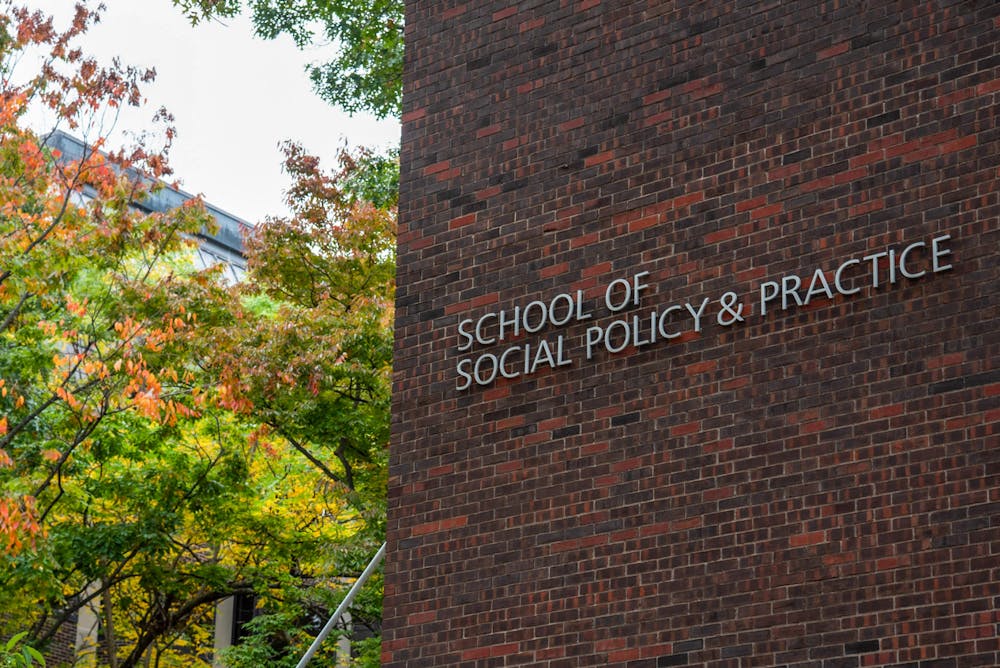
Students at Penn’s School of Social Policy & Practice expressed divided opinions on the potential reappointment of Sara Bachman as the school’s dean.
On May 13, Penn President Larry Jameson and Provost John Jackson Jr. announced the formation of an ad hoc consultative committee to review the reappointment of Bachman, featuring University faculty, one alumnus, and two staff members — and only two students. Bachman’s initial term is set to end on June 30, 2026.
The Daily Pennsylvanian spoke with three SP2 students regarding their opinions of Bachman and her tenure as school dean.
In a written statement to the DP, Stephanie Marchese — a third-year SP2 student in the school’s Doctorate in Clinical Social Work program — described “several reasons” for not supporting Bachman’s reappointment. Marchese noted an introductory meeting with Bachman, during which the dean “unanimously stated that she would never hire a DSW graduate for the [SP2] community.”
“This shows an antiquated view of the importance of direct clinical expertise combined with rigorous research,” Marchese wrote. “A DSW is not an inferior degree to a Ph.D., and, in fact, during these heightened political times, having the expertise of front-line mental health professionals is paramount to the [National Association of Social Workers] Code of Ethics and offers real-time information AND dissemination of important research breakthroughs and informs policy change.”
Marchese added that Dean Bachman “attempted to backtrack her off-hand comment,” but “the damage was done.”
“Her bias against clinical social workers is evident,” Marchese wrote. “SP2 needs a visionary leader who understands the powerful connection between front line clinical work combined with original research.”
Another SP2 student, who requested anonymity due to fear of retribution, offered a broader criticism of the school’s culture, writing in a statement to the DP that “SP2 doesn’t doesn’t put its commitment to social change fully to practice.”
RELATED:
BU prof. Sara 'Sally' Bachman named new dean of Penn's School of Social Policy & Practice
Deputy Provost Beth Winkelstein to depart Penn, named next provost at Northeastern
“Some of the faculty exhibit racism, micro aggressions, and other discriminatory actions,” the student wrote. “Although students have asked for changes to be made through various ways, structural change is slow or doesn’t occur.”
The student emphasized that Bachman “should be aware” of the school’s “lack of change,” and — if reappointed — “take bold steps to ensure SP2 lives up to its ideals of advancing social good within its own building.”
Hwiyoung Lee, a third-year SP2 student pursuing a Ph.D. in Social Welfare, shared a contrasting experience with SP2 and Bachman’s leadership. In a written statement to the DP, Lee noted that in several of his “informal one-on-one meetings” with Bachman — which ranged from discussing a column from The New York Times to the “personal weight” he felt “carrying the term ‘social justice’” in his research — he found the dean to embody “openness.”
“To be honest, we differ in very many ways — by position, generation, and cultural background,” Lee wrote. “There were moments when I struggled to understand some of the school’s decisions. And yet, what remained consistent, at least from my perspective, was her openness: a readiness to engage in conversation, even when it was just one student with a question or concern.”
Lee also described the “very existence” of a review process to be “a sign of institutional health.”
“Even if such processes may not wield direct administrative power, to someone who studied in institutions where deliberative structures like this were absent, it feels like stepping into a space where the air circulates freely,” Lee wrote. “There’s something vital in knowing that dialogue is not only possible but expected — that the windows are open, so to speak, and the institution is breathing.”
Lee wrote that the strength of a leader lies “less in perfection than in presence” but in the “willingness to stand amidst uncertainty and remain in conversation.”
“I’ve come to value that quiet labor: to lead by listening, by showing up, and by staying present,” Lee wrote. “It’s a quality I’m learning to seek in myself as a scholar at SP2, and one I believe I have witnessed in Dean Bachman.”
Other SP2 students declined requests for comment, citing limited involvement with the SP2 community or personal circumstances that could present a conflict of interest.
The review committee is chaired by Sarah Banet-Weiser, dean of Annenberg School for Communication and includes seven faculty members from across Penn, but primarily from SP2. The committee also includes Joann Mitchell, senior vice president for institutional affairs, as an ex officio member, along with two SP2 students, an alumni representative, and staff members.
According to University policy, a consultative committee must be formed whenever the reappointment of a dean is under consideration. All standing faculty in the dean’s school are invited to share confidential feedback directly with the president and provost.
Bachman assumed the role of SP2 dean in 2019, succeeding Jackson, who led the school for four years before becoming the University’s provost. Before coming to Penn, Bachman was the inaugural director of the Center for Innovation in Social Work and Health at Boston University.