

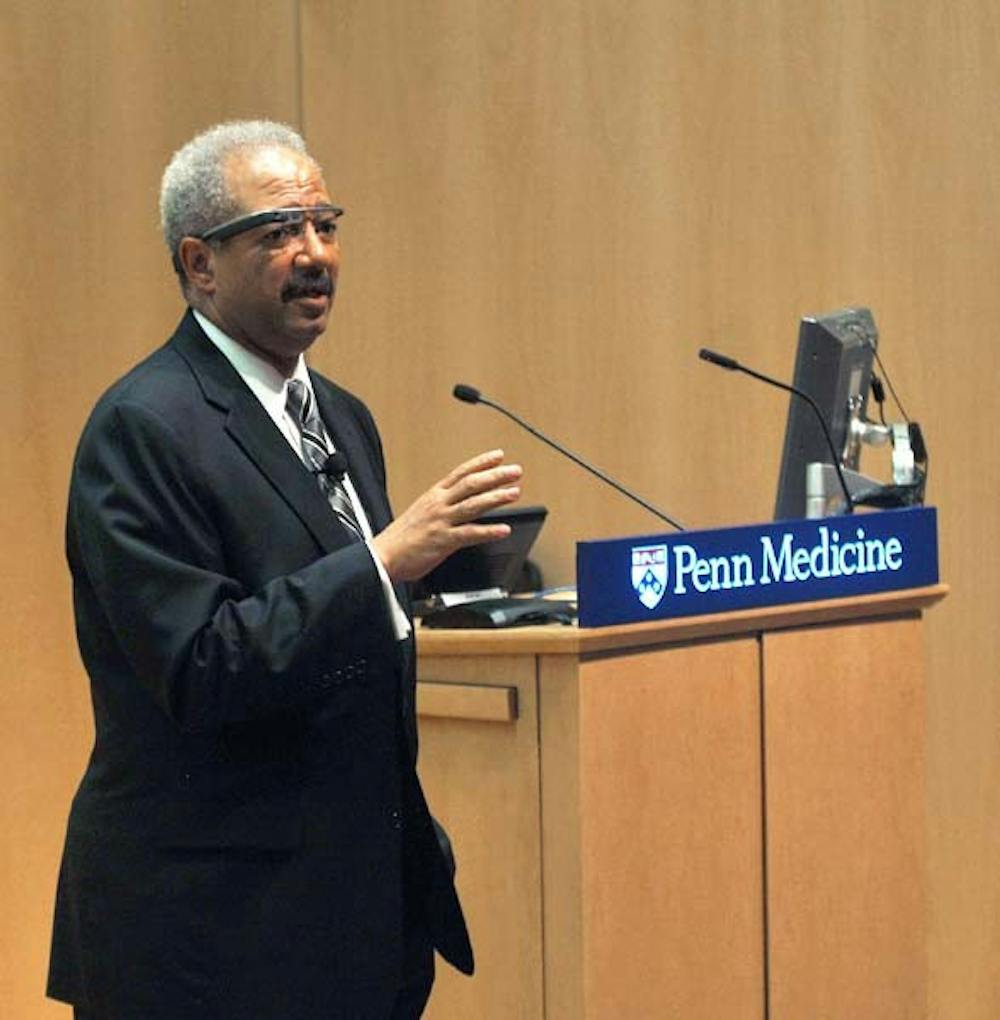
Rep. Chaka Fattah (D) represents Pennsylvania’s second district — which includes University City — in the United States Congress. As a supporter of scientific research, he gave the keynote address at the Neuroscience Graduate Group’s annual retreat on Friday, where he talked about the nation’s investment in neuroscience. The Daily Pennsylvanian sat down with the congressman after his speech. Below is an edited transcript of the interview.
The Daily Pennsylvanian: You talked about an announcement to get the EU to invest in the Philadelphia region. Can you elaborate on what that announcement will contain and how the process of negotiation went?
Chaka Fattah: I had a series of meetings with the science advisory for the EU for the last two years and it’s going to culminate in an event right here in University City on Sept. 20, which is going to lay out something called Horizon 2020, which is the EU’s … science investment initiative. It’s along six areas, the leading one being neuroscience.
What we’re going to be rolling out to an audience of innovators and the university community and laboratory leaders in our region — is laying out the opportunity for real partnerships with the EU on these projects. That’s all I can say about it at the moment, but my office will be making an announcement about it … after Labor Day.
Related: New research provost to focus on research funds
DP: In your speech, you mentioned an initiative you’re heading up to get more private investment in neuroscience research. But there are challenges in that much of the research is not directly translatable to the market. What steps can you take to increase private investments in research?
CF: What we would do is expand the period of exclusivity of the life of a patent on [intellectual property] in return for more investment. I know with a certainty that if we expanded that period for a year or three years or five years, it would make it more palatable for these companies to make the investments necessary as we go after epilepsy, or bipolar disease or any of these issues.
DP: There are a lot of researchers here who are very concerned by the lack of grants being awarded by the NIH and other agencies — some are even having to shut down research projects. Are lawmakers coming around on research funding?
CF: The cuts to the NIH and the National Science Foundation are not going to stand. Yes, they are in place now, but they’re not going to stand.
What you have is a growing storm in Washington. You have the need to pass the appropriation bills by Sept. 30. … The country will run out of money on Oct. 5 — our borrowing capacity will come to a conclusion and the debt ceiling has to be raised. You have the president’s insistence that … these [sequester] cuts be retreated from, along with the cuts to the Department of Defense … at a time when the country is saying maybe we’re getting ready to enter into another military engagement.
Related: Funding cuts damage research at Penn
This is what we call an action-forcing event. … Even though there’s 700 already-approved NIH grants that aren’t being funded, it is a temporary moment.
The need for advocacy is true, but I don’t believe we should be sending false messages to grad students that somehow the well is going to run dry on research dollars.
DP: How did you develop an interest in neuroscience?
CF: It’s my job. I am the lead appropriator in the Congress for my party on science. Say I was disinterested — I still have to do my job.
But the reasons I’ve made neuroscience singularly my most important priority is different from the fact that it’s my job. If you look at the entirety of my career, I’ve been in elected office for 30 years and there’s one constant — state House, state Senate, Congress — [and it’s] education. So my interest in education — and therefore my interest in brain development and cognition — is the reason why this is more important than any of the other things that are equally important.
DP: There’s been a lot of controversy around the school system in Philadelphia. Penn supports the Penn Alexander School, which itself has been no stranger to controversy. What are your thoughts on Penn’s impact on and relationship with West Philadelphia, University City and the city as a whole?
CF: Over the decades there’s been kind of an ebb and flow to the controversies. My belief, and it’s unequivocal, is that Penn is an extraordinary benefit to the city, that it is an anchor to the development of the city’s economic infrastructure.
‘Eds and meds’ is the term. Education and medicine are the future growth pillars for the city’s economy. Penn being the largest employer and … [its] medical and research facilities are very significant.
[But] there are more opportunities for Penn to participate with the community and I’m in an ongoing dialogue with Penn about what those things can be.
My number one principal interest is not in the meat and potatoes of the challenges that we face, but in the aspirations of the kids in Philadelphia. I’m very interested in trying to create a circumstance in which every kid in the city who graduates from high school can go to college. … We need to raise the aspirations of the young people in Philadelphia about what their future could be. And I think … Penn and our other universities can do more in that regard. … I think those aspirations exist, but we need to make them realistic early enough in the life cycle to make a difference.
DP: Penn is expanding its neuroscience investment, including expanding partnerships between schools. Have you been collaborating with or in communication with Penn on neuroscience initiatives?
CF: Very much so. This is the most important frontier for our country. That’s why Amy Gutmann was there when we announced the brain mapping initiative at the White House. Doug Smith, over at the brain repair center here at Penn, ran me through the traps early on. Marc Dichter, who’s the head of the [Mahoney Institute of Neurological Sciences] here, has consulted with me on a number of these issues.
Related: $16.3 million donation creates Neuroscience of Behavior Initiative
I think that Philadelphia is going to be poised to help lead the world — that’s why I’m going to be making this announcement I referred to on Sept. 20 right here. At my church they say all things work for good, so all of these things are working in kind of a synergy that I think is great.

