

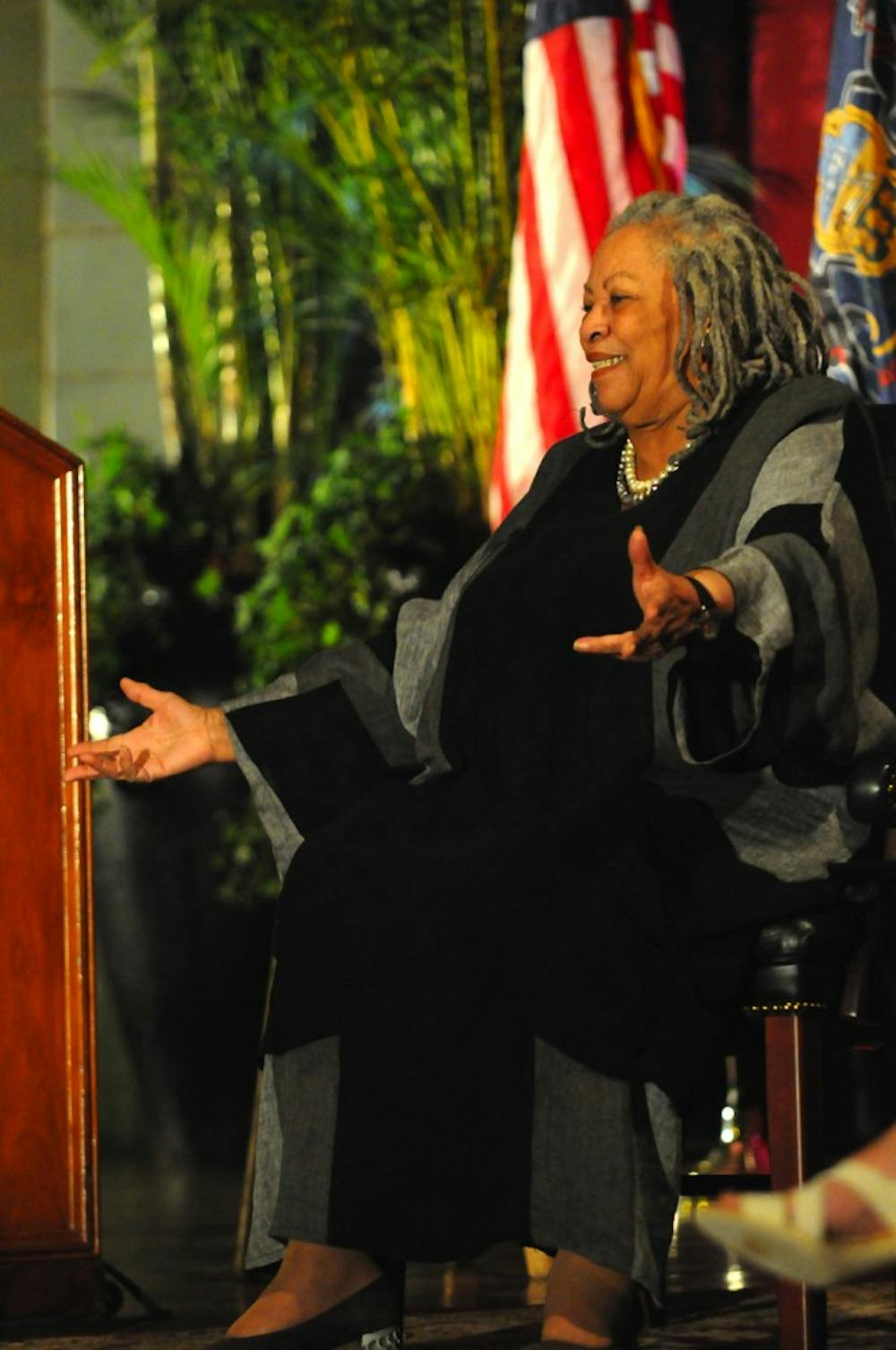
Clad in a color-blocked poncho the same shades of grey as her dread-locked hair, Toni Morrison looked out at a reverent crowd as four students read passages from her works.
“Maybe you believe love is how forces or nature or luck is benign to you,” read College sophomore Kalyne Coleman from Morrison’s novel Paradise. “Love is none of that … It is a learned application without reason or motive except that it is God.”
Readers and writers call Morrison’s work ingenious, but Morrison does not consider herself a genius. “Don’t use that word with me. You mean ‘good,’ ‘smart,’” Morrison said.
“It’s a kind of commercialization of what ought to be intelligence. We just rank people constantly, and the process of that ranking annoys me a lot,” she continued.
Morrison, the first black woman to receive the Nobel Prize for Literature, was honored at the Trustee’s Council of Penn Women’s 25th anniversary celebration on Thursday afternoon in Harrison Auditorium.
President Gutmann presented the prolific writer the Beacon Award, which is presented to individuals who demonstrate exceptional commitment to women’s issues. “We’ve only given the award 10 times in our 25-year history. Toni Morrison getting the award was the 11th time,” said TCPW Chair Leslie Myers. Past recipients include then First Lady Hillary Clinton, former Supreme Court Justice Sandra Day O’Connor, as well as President Gutmann. “The common thread is that they all care about women and have stood up for the rights of women in whatever field it is they have pursued,” she said.
According to Myers, the council chose to give Morrison the award because “her writing touches everyone in a very different way, but for women it touches them in a special way.”
College senior DeAnna Supplee read an excerpt from Song of Solomon in which a character questions her identity during a tumultuous relationship. “I selected the excerpt because it captures beautifully relationships and the likelihood of becoming dependent,” Supplee said. “It speaks to the beauty of the relationship with yourself as a woman and not having to be identified by a man.”
Related
ACLU banned-books reading celebrates free speech
Nobel Prize-winning economist discusses human intuition
Profs discuss effect of Nobel Prize on human rights in China
Morrison is a strong advocate for women, but she is hesitant to accept the label “feminist.” “‘Feminist’ has a long history in my mind,” said Morrison. “I began to associate rather closely with what Alice Walker was willing to call it, which was ‘womanist.’”
Morrison does not consider herself an African-American writer, a woman writer, nor some combination of the two. “I don’t recognize any of those things. I chose as a subject matter the world of African-Americans because it’s fascinating, it’s powerful, it’s wonderful and it’s mostly hidden,” she said. “I just take the position of Tolstoy. He wrote about Russians because he was Russian and he was not writing for little black girls in Ohio.”
Morrison’s next work, Home, is about a Korean War veteran’s experiences upon returning to the United States.
“The point was to take the creamy sloppy icing off of the 50’s. We think about the 50’s as some happy ‘Leave it to Beaver,’ Doris Day era. I wanted to write about what it was really like,” Morrison said. “I was sort of annoyed by the nostalgia that had gripped this country … after World War II. Everybody was making money, and they were building houses and fulfilling this so-called dream. But nothing is that pure.”
Whether Morrison is fond of the label “genius” or not, one title she can’t avoid is “inspiration.” Said College senior Lindsey Todd, “She writes some of the most beautiful prose I’ve ever read in my life. She is an inspiration for black women, for authors, for poets and [it] has been an amazing honor to meet her.”

