Jeremy Lin is not the only Harvard Athletics graduate who had a great week last week.
On the same day that Lin signed with the Golden State Warriors, Crimson swimmer Alex Meyer won the 25K event at the World Open Water Swimming Championships in Roberval, Quebec, Canada.
Yes, Meyer — along with 19 other swimmers from around the world — swam over 15 miles in the 72-degree Lac St-Jean.
And he beat the top international competitors hailing from Italy, Bulgaria, and nine other countries.
Meyer’s five-and-a-half-hour race hardly compares to a pool swim’s longest event —1500 meters — where spectators will often leave the pool area and grab a snack in the middle of the approximately 30-minute race.
But open water swimming is a sport independent from pool swimming. It was declared an official Olympic sport in 2008 in Beijing.
And though the two sports share the same basic premise — swimming through the water from start to finish as fast as possible — they have more differences than one might think.
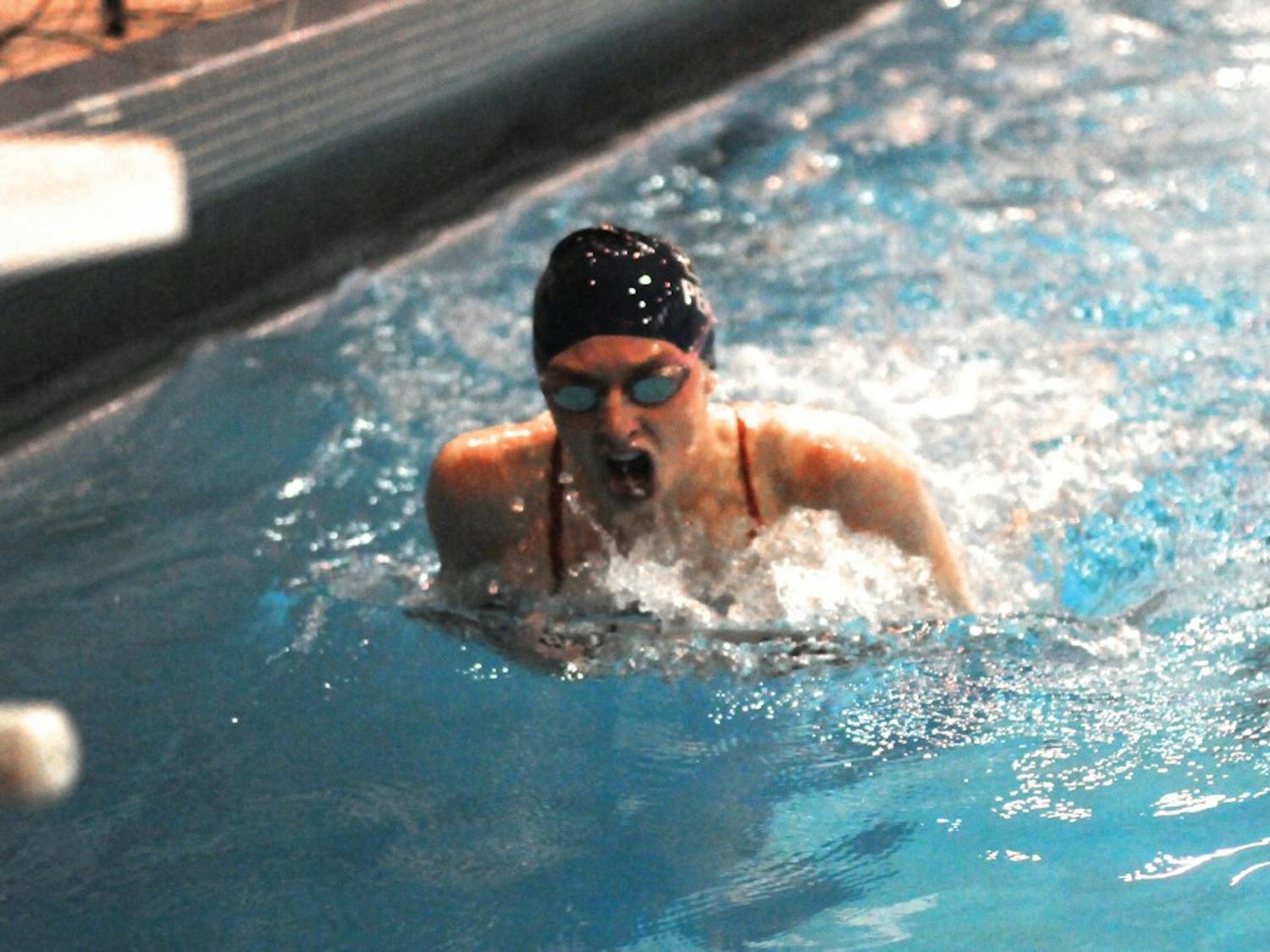
Pool swimmers, separated from their competitors by lane ropes and given several feet of space to themselves in a lane, never swim against more than seven competitors at once. Pool conditions are always known and rarely change significantly from one pool to another. Each lap is the same distance and swimmers follow a black line at the bottom of the pool to stay straight. Teammates gather on the side of the pool to cheer and signal speed. They swim their own race.
There is no element of surprise.
But open water swimmers must expect the unexpected.
Like Meyer, who was disqualified in last year’s meet after a wave knocked him on top of another swimmer.
Aside from the waves and unclear water, nothing separates the swimmers from each other. Rather, the competition swims in packs — dangerous and aggressive packs. Punches are thrown, goggles are ripped off and backs are clawed.
It’s a vicious sport. Who would want to grab a snack in the middle of that race?
The swimmers do.
In a race that takes more than five hours to complete, the swimmers stop at docks to reenergize. Coaches and volunteers hold out feeding sticks and the competitors swim up and grab food.
The swimmers have several opportunities to visit the feeding docks — and plan those visits strategically, as the 25K race is usually swum as loops of a given distance. The Roberval course was 10 laps of a 2.5K course.
The 25K was the longest race of the meet. Men and women competed in the 5K and 10K races as well. Conshohocken, PA. native Fran Crippen placed third in the 5K.
For Meyer, his victory came from behind.
At the 10K mark, Meyer was in 8th place. By the 15K, he was in the middle of the lead group.
“It is a tight pack and no one is giving an inch or a centimeter,” U.S. National Head Coach Mike Gobrecht reported on Twitter.
But with just over 4K remaining, Meyer pulled ahead of the pack and gained the lead, finishing one second ahead of 2009 champion, Italian Valerio Cleri.
“My plan for the first 10 or 15K or so was to hang in the back and draft really well, pick my feeds really well, kind of lay low and just try to relax,” Meyer said. “But that’s pretty much everyone’s plan.”
Despite the length of the race, watching renowned swimmers go stroke-for-stroke while kicking each other under the water adds drama to the sport.
Though Meyer was the only Ivy Leaguer to participate in the World Championships, Penn’s James Fee and Stephanie Nerby have swam in charity races in Massachusettes, according to Penn coach Mike Schnur.
It is common for distance pool swimmers to transition to the open water, making it possible that the fast-growing sport could soon lead more Quakers to dip their toes into the open water.