

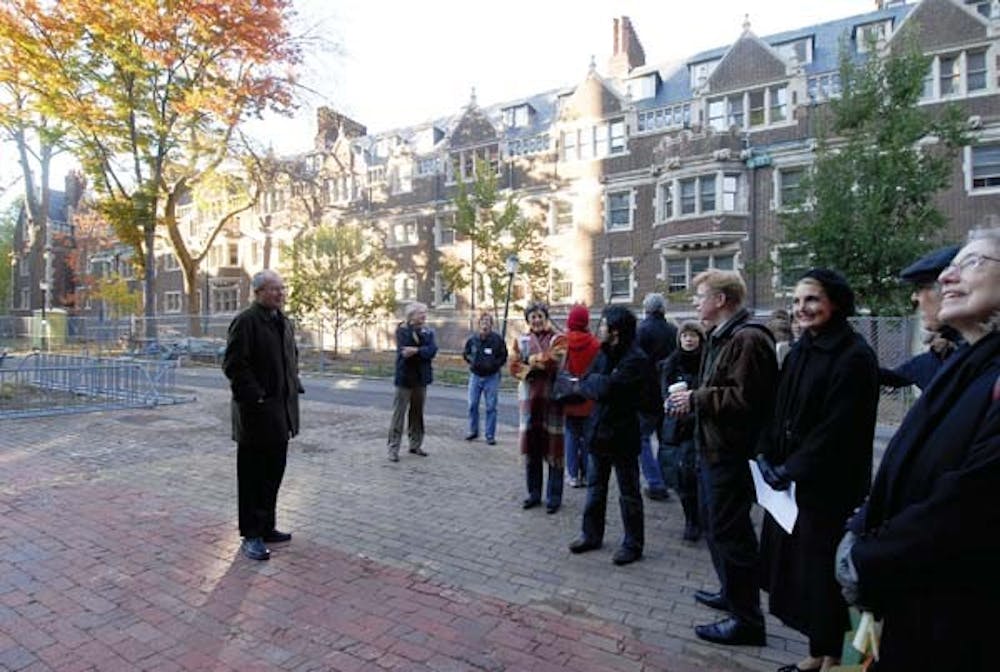
Penn students walk past the Richards Laboratories every day on Hamilton Walk.
Few realize, however, that the building between the Quad and the biopond is a potential national historic landmark.
Historical preservation organization Save Our Sites sponsored a tour of the building complex yesterday. The tour was complemented by talks by Louis Kahn's daughter, Sue Ann Kahn and Michael Lewis, professor of architecture at Williams College.
With all the prospective construction set in Penn's future, SOS wants to make sure that the Richards Laboratory buildings remain standing.
"We would like to see the University restore it," said SOS President John Dowlin. If the building achieves landmark status, that hope is more likely to be a reality.
Built by Kahn in 1961, the laboratory building complex tucked behind the Quad on Hamilton walk represents an iconic treasure in modern architecture. It is "the perfect unity of appearance, reality and space," Lewis said.
Architects who worked with Kahn and other close relations joined architectural students and Kahn enthusiasts in a tour of his famous structure that, according to David Traub, architect and treasurer of SOS, is "the building of 1961."
The tour not only highlighted the uniqueness and beauty of the building but discussed Kahn in general. Lewis spoke about how the structure of Richards fit in harmoniously with Kahn's theory of "served and servers."
The architectural concept of "served and servers" separates the mechanical and functional aspects of a building, like the air-conditioning vents and stairwells, from the main usage rooms.
Lewis discussed how Kahn embodied this style in his work, eloquently describing Kahn's success in creating "an idealism to suggest man and man working on their ideas in a structure."
Commissioned by the University in the 1950s to build a 200-foot laboratory and office space for five science departments, Kahn, according to Lewis, succeeded in the "Philadelphia way of solving discrete problems with discrete structures."
"The world discovered me after Richards Towers," Kahn said. His choice to prominently display the recast concrete that holds the structure together, according to Lewis, "changed modern architecture."
Sue Ann Kahn said that its architectural historical importance and fame should result in the structure's refurbishment and immunity from pending destruction.

