

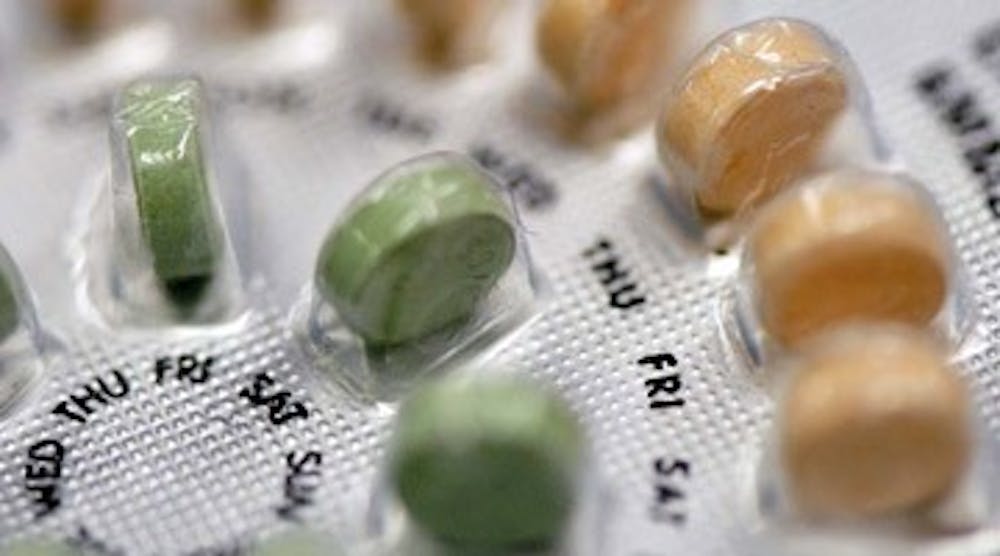
One daily routine for many college women recently became much more expensive.
Many drug companies are no longer offering universities discounts on birth control because of government legislation.
The Deficit Reduction Act, signed by President Bush last year, limits the types of organizations that can receive medical discounts and diminishes the incentives for drug companies to provide discounts for university students.
Penn felt an impact in January, when Student Health Service's monthly price of birth control pills rose $7 and the monthly price of the NuvaRing increased to $35, but many campuses are only feeling the impact now.
Schools across the country stocked up on these items before their prices rose, but as that supply dwindles, they are now forced to raise prices in response to the bill.
According to the American College Health Association, 40 percent of sexually active college women use a form of prescription birth control, and two-thirds of college students reported having had at least one sexual partner during the 2005-06 school year.
ACHA spokeswoman Mary Hoban said the organization is still trying to push toward a legislative correction of the Senate Finance Committee's "unintentional oversight."
"Some campuses can't afford to offer contraceptives to students at all," she said.
Though Penn's Office of Health Education offers free condoms to students, other forms of birth control, like Ortho Tri-Cyclen Lo, are no longer available on campus at all.
College senior Jessica Haralson has expressed concerns about the issue on her blog, particularly about the availability of oral contraceptives and the high-failure rate of condoms, which many turn to if they can't afford a pill.
"College women should have the option to take oral contraceptives without putting themselves in financial jeopardy," Haralson wrote in an e-mail.
She noted that "some Penn students in financial need are considering visiting Planned Parenthood, which offers a sliding scale for oral contraceptives."
Another College junior - who asked to remain anonymous because of the sensitivity of the issue - was using Ortho Tri-Cyclen Lo before SHS stopped its distribution. She now goes to CVS to fill her prescription because the other options at SHS are "a lot more expensive."
These changes are also raising serious concern among various health care professionals.
"This is an idiotic, moronic rule that really is forcing a lot of young women to switch for no good medical reason," said Lee Schulman, chairman of the Association of Reproductive Health Professionals, a Washington D.C.-based organization that provides information about reproductive and sexual health.
Schulman added that "when people are forced to switch birth control not for medical reasons, there is increased likelihood of a variety of side effects, such as breast tenderness and increased unscheduled bleeding."

