

Think about a time and place in which you feel the most comfortable. Now imagine being taken out of this comfort zone for four years. Don't like it? Well, unfortunately, that's how many African American students say they often feel at predominantly white colleges.
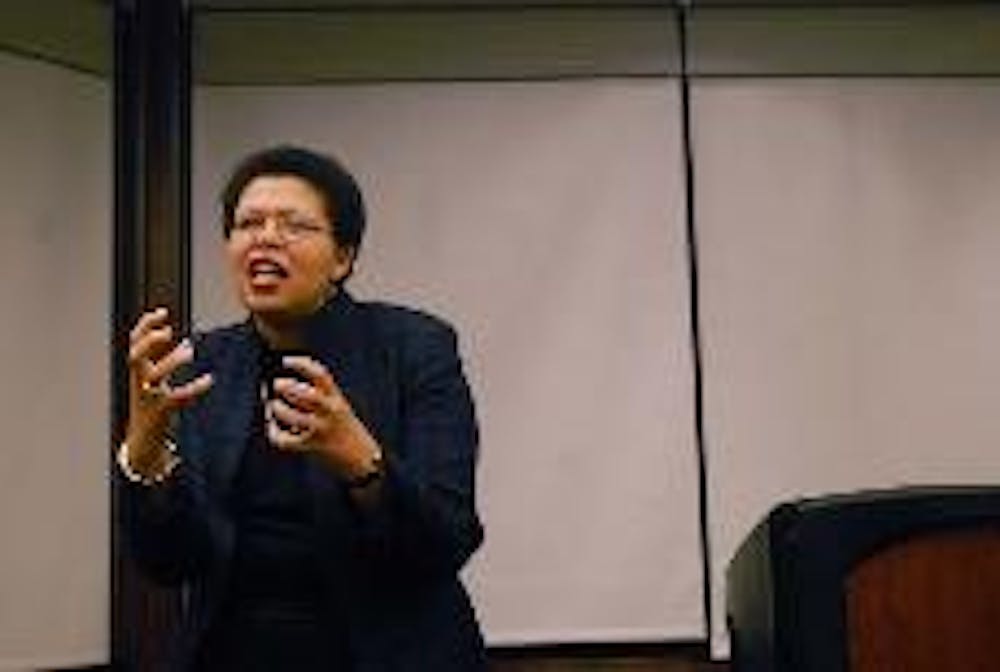
Last night, Sarah Willie, the head of the black studies program at Swarthmore College, discussed her book, Acting Black: College, Identity and the Performance of Race, with a small and enthusiastic audience in Houston Hall.
Willie's book focuses on African American students' experiences attending college, during which some feel the need to "act black" - the notion of having to perform one's identity.
"We walk into the roles that have already been set up for us," she said.
For her book, Willie interviewed 55 college-educated African Americans who had attended either the historically black Howard University in Washington, D.C., or the predominantly white Northwestern University in Evanston, Ill.
"I wondered why some African Americans chose mostly white colleges and others chose historically black ones," she said. "I wondered if the racial sense African Americans had of themselves was influenced by the college they attended."
Willie discovered that most students chose a college not along race lines, but based on financial-aid packages or the prestige of the university.
Northwestern graduates, though, expressed feelings of isolation and unhappiness because the school "did not reinforce positive self-image for blacks," Willie said.
She added that Howard graduates felt they had missed out on a more culturally diverse education.
As long as an informal inequality still exists, Willie said, students should become more aware of such issues.
She suggested all students take courses that will educate them on major acts of oppression in the U.S.
Wharton senior Stefanie Thomas said she came to the event to expand her cultural awareness of inequality on college campuses.
"Our curriculum [at Wharton] is so narrow . [that] when I heard about this event I got really interested because I wanted to see how people find themselves in their experiences," she said. "It was an eye-opening discussion."

