From Margo Shea's "The Revolution Will Not Be Televised," Fall '92 But as I prepare to leave Penn, I can't help but think of the one who left us too early. · I move on in pursuit of my dreams. On December 30, 1989, Bear's dreams exploded in a pool of his blood. His presence on our freshman floor brought laughter and color, and for most of us, a subtle exposure to a world very difference from the one's we'd come from. When he didn't return after that first Christmas break, it wasn't just Tyrone Robertson that was stolen away -- we were also forced to abandon the false hope that access to our dreams was equal for all. Our Resident Advisor tried to call him Tyrone. Once. "I'm Bear." Sometimes I wonder if others wanted to say what I did at first glance -- "You certainly are." He was huge and round, so big that he would slow down and turn a little bit sideways if you were walking towards him, through those slim hallways in English House. But the similarilarity didn't end there. His mom had called him "Sugar Bear" from the time he was born, a name he earned for his sweet, serene smile as well as for his formidable size and dark-chocolate colored skin. He was a favorite personality on our floor, the gathering place for an eclectic -- and often unlikely --Ecrowd. While Liz's mom worked in the engineering department and Liz brought he laundry home to wash, Alp called Istanbul home; Ashish hailed from India; Desha, from Kentucky; Sara, from New Hampshire. Bear was from Chester, Pennsylvania, which some have called "the wrong place at the wrong time." Like most of my first-year friends, I was not well-versed in the world that Chester represented. Just as we were curious about the mysteries of Turkey and India, we also were cautiously questioning about Bear's home, a place where violence, drugs and houses aflame are more prevalent than sweet-hearted young men with Ivy League degrees. When the phone rang that New Year's Eve, my roommate valiantly bore the news of a late night murder and a dead classmate, of a dark street, an angry gun and a killer disappearing into the city. Bear's world came home to me, to all of us who knew him. When I returned to Philadelphia a few days later, I saw the city with new eyes. No longer a passive spectator of the urban drama, I had been pulled onstage by Bear's unexpected death. The moment that bullet found its target in his gut, Philadelphia ceased to be the backdrop on which my life at Penn played itself out. Street violence -- one of the many problems in urban life -- added Bear's name to its long list of casualties. And it taught those of us who knew him a hard lesson. We could no longer turn our backs. With one gunshot, urban problems became our problems. Inner city death didn't stay where it was supposed to, out of sight of those who could afford to live elsewhere. It reached deep into our safe world, and splattered its blood all over our dreams. Our friend had relinquished his future, his opportunity to pursue his goals. The one that died was not caught in the crossfire of Indian rebels. He was not the victim of a terrorist attack while aboard a 747. He was one of us. He was an American and he died in America. Urban America is not exotic. And as must as we would like to believe otherwise, it is not another culture, another world. It is a part of who we are -- as a nation, as a society. The problems, the sorrows and the horrors which all too often come with the turf in our cities affect every single one of us. As Martin Luther King, Jr., said: "I can never be what I ought to be until you are what you ought to be. This is the way our world is made. No individual or nation can stand out boasting of being independent. We are interdependent." I have spent the last three years trying to make sense of Bear's death, to learn something from it, and to carry that with me. Lots of young men die in our cities every night. But few of them ever arrive at the Ivy League fortresses. Few of them are given the opportunity to touch our lives. And, when they do join the ranks of students at Penn, they an other blacks still face obstacles. In a recent issue of The Vision, Maceo Grant, a senior Communications major, expressed his frustration: "Not even at an Ivy League institution can Blacks get any respect. And as I have said before, we are no different than the brothers and the sisters in the ghettos and 'hoods' of America? "If anything, the looks may be altered, but the creature underneath is the same. It seems that no matter where a Black person goes in America, there is still prejudice and lack of respect. "In essence, it is the same old song." Kaplan Mobray, the newly elected president of the Black Student League, also speaks of a passage through Penn made tougher by racism. "When one of us doesn't graduate?it's a step backward for all of us." Perhaps Kaplan was speaking only for blacks at Penn. But I cannot face another step backwards. I cannot stand back and watch the Bears of the world die. Bear is gone. All the words in the world will not bring him back. But they can speak to the mysteries, the pain, the process of letting go but not forgetting. They can remind us that if we all word -- in our own ways -- toward a society that nurtures all its children's dreams?then maybe, just maybe, Bear would not have died in vain. Penn, America, it's time for a new song: "We who believe in freedom cannot rest, We who believe in freedom cannot rest until it comes. Until the killing of black men, black mothers' sons, Is as important as the killing of white men, white mother's sons. Oh, we who believe in freedom cannot rest." -- Holly Near Margo Shea is a senior Urban Studies major from Meriden, Connecticut. "The Revolution Will Not Be Televised" appeared alternate Thursdays.
The Daily Pennsylvanian is an independent, student-run newspaper. Please consider making a donation to support the coverage that shapes the University. Your generosity ensures a future of strong journalism at Penn.
DonateMore Like This

A history of the Penn presidency
By
Aidan Shaughnessy
·
9 hours ago

No — AI will not wipe out humanity by 2030, Penn experts say
By
Addison Saji
·
9 hours ago

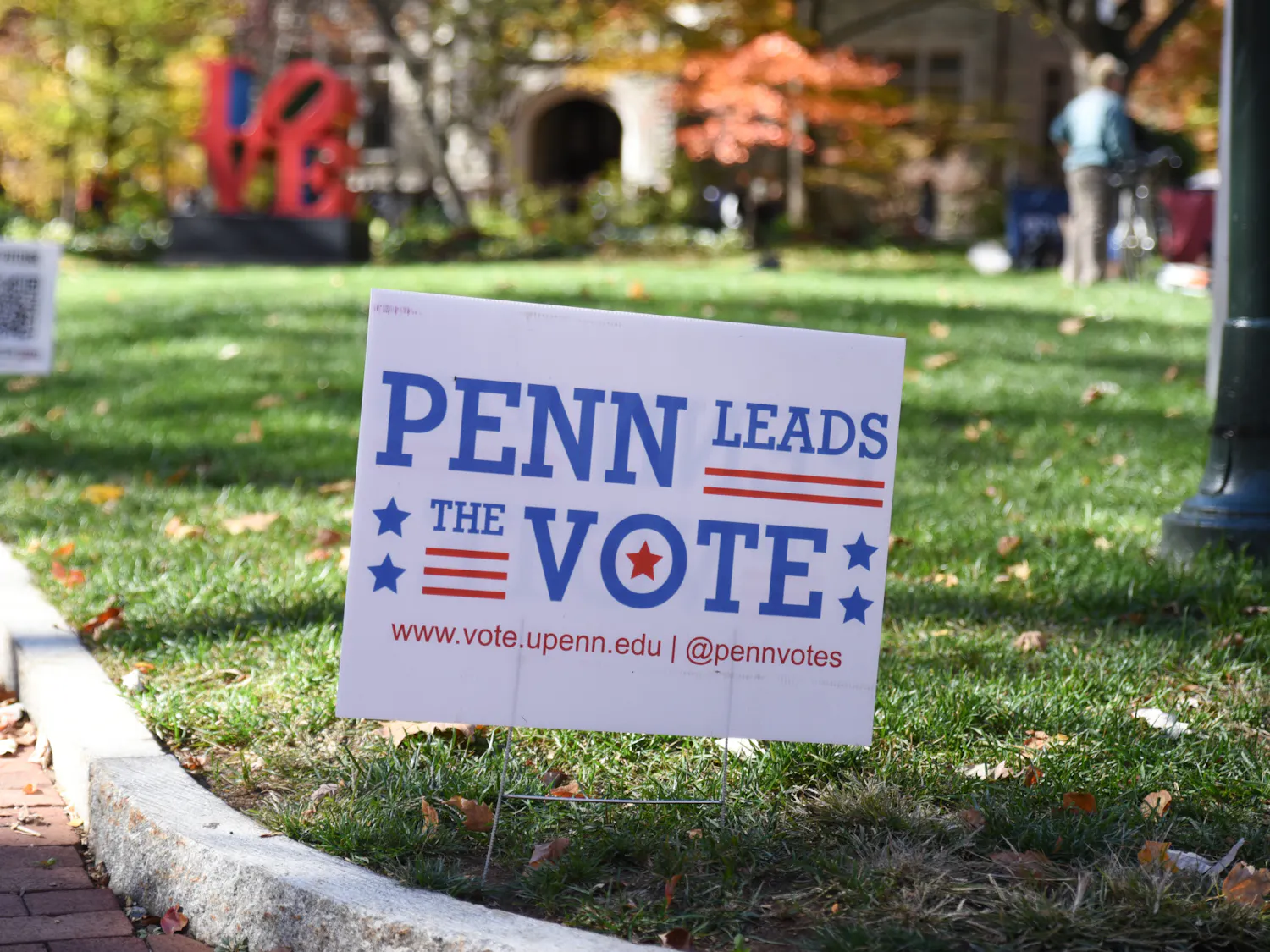
Penn student groups promote voter registration on Locust Walk
By
Mara Flores
·
9 hours ago