From Brian Newberry's "A Thousand Words," Fall '92 -- John Donne · Arlen Specter insulted Anita Hill. Lynn Yeakel failed to pay her taxes. Bill Clinton cheated on his wife. George Bush lied to the nation about his role in the Iran-Contra affair. Only 50 percent of eligible voters went to the polls in the 1988 presidential election. Many of those who did not vote cited their dislike of the candidates, and an even larger percentage felt that their vote didn't matter -- that who was President didn't really have an effect on their lives. Unfortunately, this kind of thinking is flat-out wrong. A vote for a presidential candidate is more than a vote for one individual. It is a vote for thousands of judges, cabinet officers and government bureaucrats -- people who really do affect other's lives. Even more important is what Teddy Roosevelt called "the bully pulpit." The President sets the tone for the entire government, and hence the nation. The President determines through his appointees, speeches and policies what issues are addressed and what are forgotten. He determines what problems are solved and which are ignored. On the simplest level, the President creates an atmosphere in which everyone must live. To understand this, one need only look at the difference -- for better or for worse -- in the nation's spirit under Jimmy Carter and under Ronald Reagan. Or, on a smaller scale, closer to home, look at Philadelphia under mayors Wilson Goode and Ed Rendell. So yes, who is President does have a major impact on people's lives. Unfortunately, when it comes to voting, too many people are not sure who to cast their ballot for, because none of the candidates fulfills all of their expectations. As a result, they end up basing their decision on non-issues or trivial matters, only to regret it later. We live in a political system comprised primarily of Republicans and Democrats. For four generations, members of my family have been contributors, fund-raisers and candidates for only one of these parties. I have continued this pattern. But I have never voted a straight party ticket, and perhaps I never will. In fact, this year I intend to split my presidential and senatorial votes in Pennsylvania, because I do not think one of my own party's candidates is a better alternative. Why? Why do I spend my time and energy supporting a political party? Both the Republicans and the Democrats have extremists in their ranks. Both parties also have good people who honestly think that their party's ideas are best for the nation. When it comes to actual issues, neither party has a monopoly on any position. There are pro-choice Republicans and pro-life Democrats. There are Democrats who support a capital-gains tax cut and there are Republicans who support a gas tax. No, the real difference between our two major parties lies not in policy arguments, but in attitude. Of all the challenges our nation faces today, I believe the greatest threat to our future is not the economy, important as it is, or some foreign power -- it is ourselves. America's guiding principle has always been one of acceptance and tolerance of those who are different from ourselves. Maybe not approval, but at least an acknowledgement that others do not have to be exactly like us to deserve the same rights and respect that we have. Of course, in practice, this principle has not always been followed -- particularly in the case of non-whites. Still, it is these ideas upon which our nation was founded. What strikes me as most appalling in our politics is the hypocrisy of many who do not follow this principle. When I see Patrick Buchannan, a man from the same Irish-Catholic background as myself, stand in front of a national audience and make a black Los Angeles neighborhood sound like a hostile foreign war zone, it makes my stomach churn. Very few people in this country, including whites, can say they come from an ethnic background whose members never experienced persecution or were looked down upon because they were different. For me to deny a man basic respect because he is a Muslim or a Jew, or because he is black or gay, is equivalent to me spitting on the grave of my Catholic grandmother who was once fired from a job because of her religion. Why do I support one political party over another? Because in this century one party has continuously attempted to divide this nation and polarize it along lines of race, class and ethnicity. One party has preached thinly-disguised intolerance, hatred, bigotry and distrust, in support of the votes of the ignorant and the bigoted. The party I support has certainly made its mistakes in the policy arena -- both parties have. But at its core, my party attempts to reach out to everyone, regardless of their background. It strives for inclusion based on our shared American heritage, rather than exclusion based on a litmus test of "values." America has always run the risk of becoming a Yugoslavia. In the United States, we place a secondary, but important, emphasis on being a "hyphenated"-American. What has held us together as a nation, however, is a central pride in being an American, period. If large numbers of people lose that pride because a governing political party won't allow them to feel welcome in this country, then we are all at risk. Ernest Hemingway wrote his greatest novel, For Whom the Bell Tolls, about the Spanish Civil War. It is a tale of a nation split so badly along cultural, political and religious lines that it virtually committed national suicide. The quote that appears at the beginning of this column was Hemingway's epigram to the book. It serves as a reminder that no matter who we are, we are all in this life together. Election day is in one week. When you enter that voting booth, consider this: George Bush and Bill Clinton have debated issues. They have discussed the merits of this particular tax policy and that particular social program. There is room for reasonable people to disagree about the merits of both men's ideas. Instead, ask yourself which candidate has a vision for America that you can agree with. Ask yourself if you want a nation led by a man and a party which reaches out to all people, or by a man who surrounds himself with fools and whose party preaches division and intolerance, splitting our nation into "us" and "them." Ask yourself which philosophy is more American. Brian Newberry is a senior Urban Studies and American History major from Wallingford, Connecticut. "A Thousand Words" appears alternate Tuesdays.
The Daily Pennsylvanian is an independent, student-run newspaper. Please consider making a donation to support the coverage that shapes the University. Your generosity ensures a future of strong journalism at Penn.
DonateMore Like This

A history of the Penn presidency
By
Aidan Shaughnessy
·
11 hours ago

No — AI will not wipe out humanity by 2030, Penn experts say
By
Addison Saji
·
11 hours ago

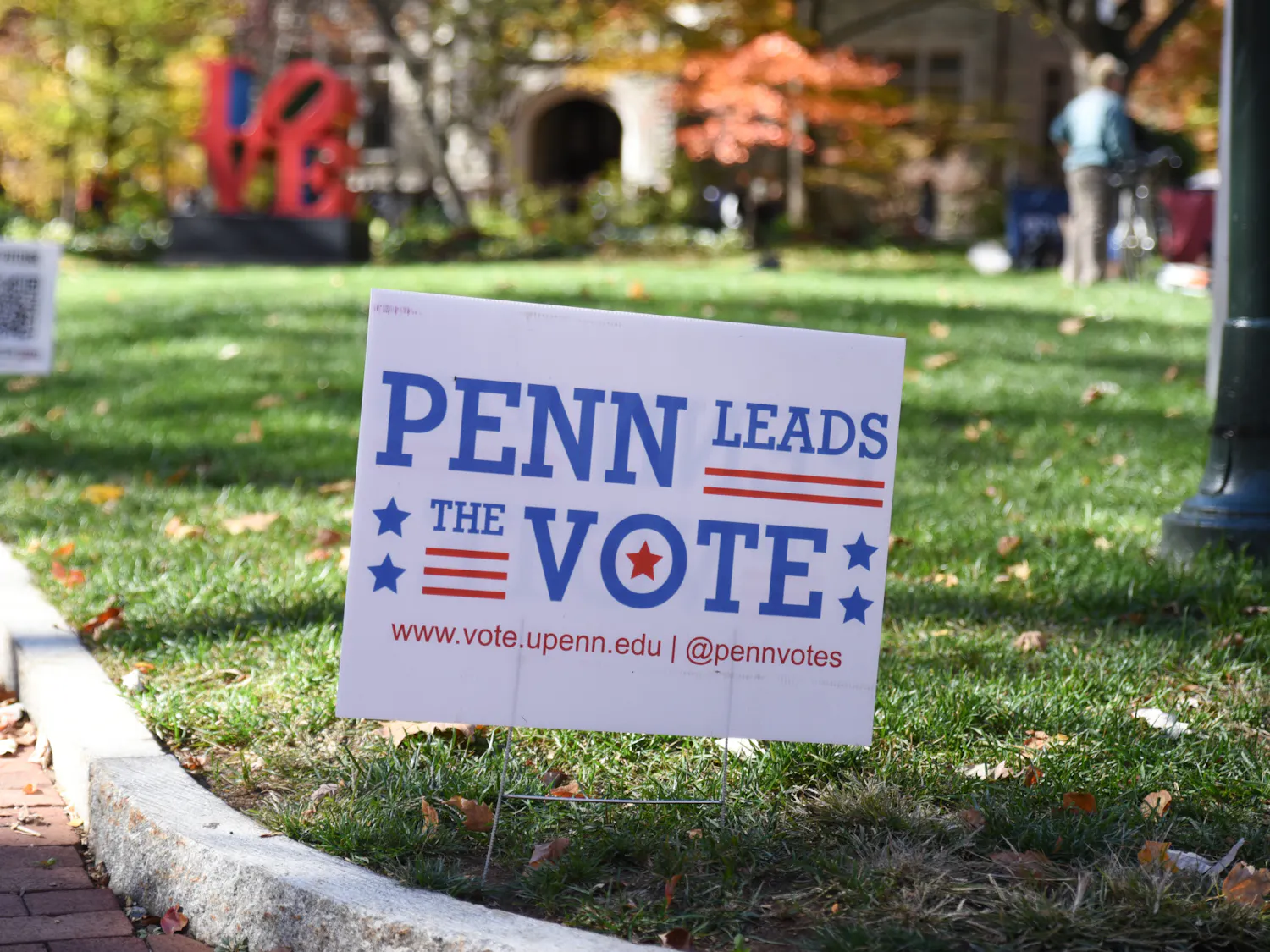
Penn student groups promote voter registration on Locust Walk
By
Mara Flores
·
11 hours ago