

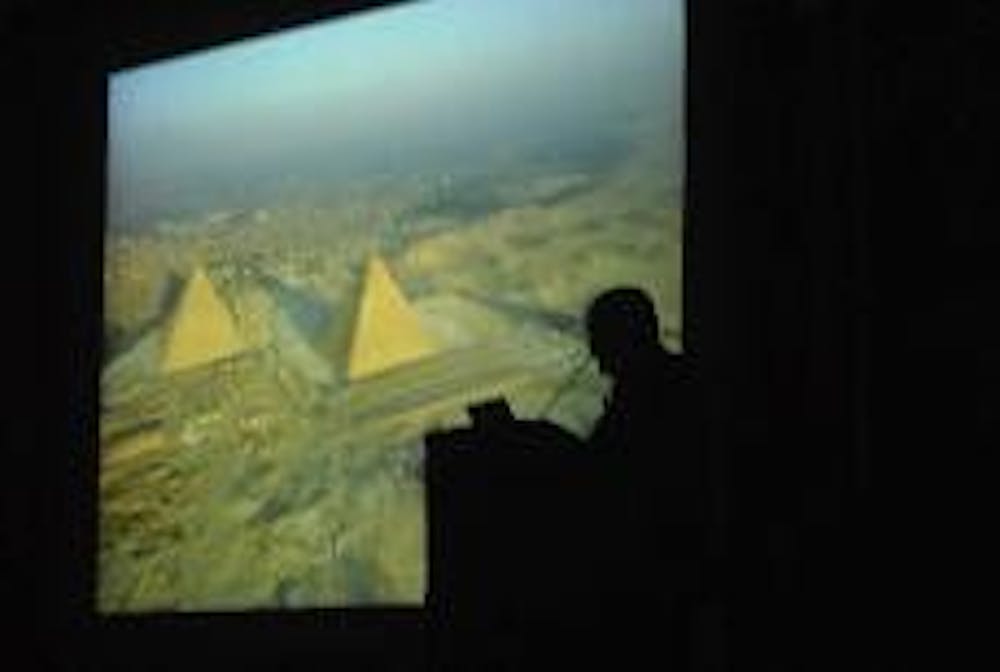
Penn's campus was graced by our very own Indiana Jones last night.
Zahi Hawass, who has been compared to the adventurer for his daring and often dangerous excavations in Egypt - and who even owns a Jones-esque whip - spoke to a sold-out crowd at the University of Pennsylvania Museum of Archaeology and Anthropology last night about his recent archaeological discoveries.
One of his proudest moments, he said, was when he came face-to-face with King Tutankhamun for the first time. He was the first person ever to perform a CT scan on the remains of King Tut, discovering that the ancient pharaoh was about 19 years old when he died, and that his death was not the result of foul play, as had been suspected.
He also found the remains of King Tut's penis, which broke off when his remains were first excavated by Howard Carter.
Another one of Hawass's more-infamous digs was at the Bahariya Oasis, where he found the famed Golden Mummies.
"It is like paradise," Hawass said. "I was able to understand the life of the people who lived in Bahariya."
Hawass was pleased to return to Penn, where he earned his M.A. in Egyptology and Syro-Palestinian Archaeology and his Ph.D in Egyptology. The Egyptian native described Philadelphia, where he lived for seven years, as his second home. "That's why," Hawass said, "I thought King Tutankhamun belonged at Philadelphia."
An exhibit featuring antiquities associated with King Tut is coming to the Franklin Institute Science Museum tomorrow and will remain through September.
Though the crowd contained few students, those that did attend enjoyed Hawass's speech.
College senior Michelle Leister attended the event because she has studied in Egypt and has an interest in Egyptian culture and history.
"I thought it was very interesting," Leister observed. "I wish I had his job."
According to Hawass, "Every explorer should have a dream." His is to excavate the interior of the Great Pyramid of Giza using robots - a technology that makes exploring the small tunnels within the pyramid more feasible.
Hawass's next project is a site thirty-five miles from Alexandria where he hopes to find the remains of Marc Anthony and Cleopatra.
"You never know what the sand of Egypt might hide," he said.
