

The Penn Museum and Wharton Community Engagement hosted a free festival to accompany Penn’s semiquincentennial programming on Saturday.
The event — called “Philly 250: A Celebration of Community, Culture, and Freedom” — combined the museum’s annual Juneteenth celebration with the Wellness Empowerment Project, a collaboration between the Wharton School and Penn Medicine. The “festive community celebration” included cultural performances, pop-up exhibitions, and health screenings, according to the press release.
Penn Museum marketing and communications intern Alyson Bostrom told The Daily Pennsylvanian in an interview that the event’s free nature “removed a barrier since there are usually museum admission prices.”
“It’s a great way to bring the community together and support a lot of local businesses as well,” Bostrom added.
In the release, Executive Director of Wharton Community Engagement Renita Miller wrote that the event “reflects a shared commitment to listening, collaborating, and aligning Penn’s resources with the priorities of our Philadelphia neighbors.”
“At its core, this day is about intentional collaboration that strengthens our community,” Miller added. “I am honored to help bring it to our Philadelphia neighbors.”
Tia Jackson, the Penn Museum’s director of staff and community engagement and Philly 250’s other co-organizer, wrote in the release that the event “truly embraces Penn’s interdisciplinary approach to community engagement by sharing the resources of the University with our neighbors.”
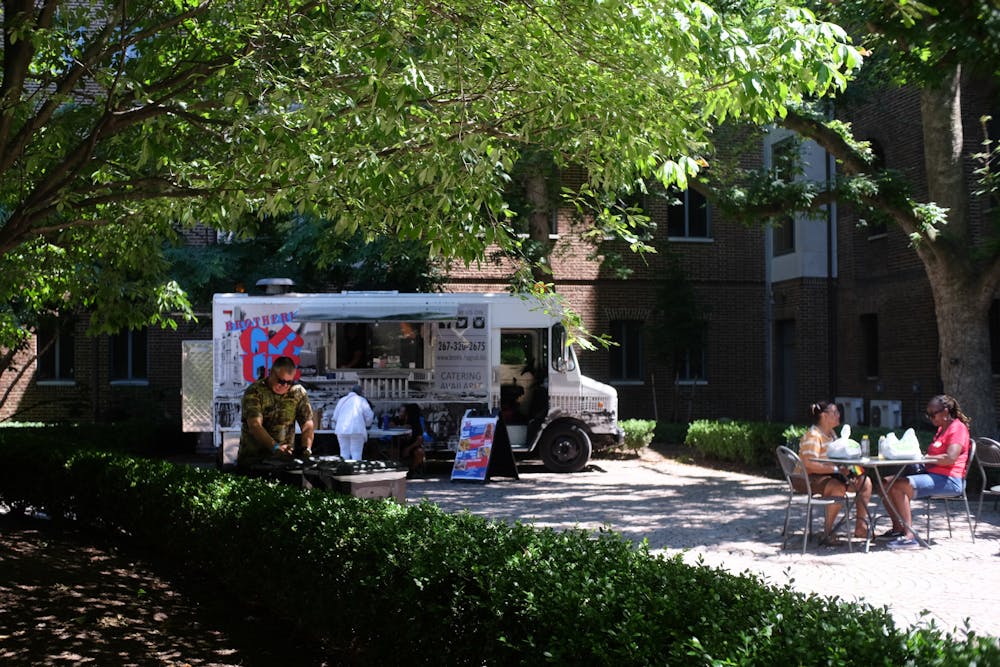
Local entrepreneurs showcased their work in stalls dotted around the garden, selling clothing, jewelry, and homeware. Food trucks parked inside Stoner Garden and the Penn Museum Café offered a themed menu.
A vendor at the event, Tiana Lucas spoke with the DP and noted that Penn allowed her “this opportunity to network for today and to be a part of their 250 celebration.” She said the Penn Museum provided “a safe, beautiful space” for her to sell her work.
The Juneteenth Freedom stage, located near the event entrance, featured performances designed to celebrate Black history and culture. The host of the event — who goes by the name Starfire — returned for the third consecutive year and led programming including performances from Philly Girls Jump and the West Powelton Steppers.
Jessica Young and her daughter Rita Lai were two of the community members attending the event. In an interview with the DP, Young praised Karen Smith’s drum performance and described the University as a whole as “so open” and “diverse.”
Nearby, attendees could visit a stand highlighting the Heritage West Project, which aims “to get community members involved in what archeology is,” Penn Museum Assistant Director of Academic Engagement Sarah Linn told the DP.
Linn, who graduated from the School of Arts and Sciences with a Ph.D. in 2018, emphasized the importance of studying historically Black neighborhoods in Philadelphia, saying that “even when we do archeology in Philadelphia, it tends to focus on mostly white spaces.”
The Penn Medicine Mobile Mammography Van was on site to offer health screenings, and attendees could also receive free blood pressure checks and nutritional education. Philabundance additionally partnered with the event to distribute fresh vegetables at no cost.
The all-ages activity zone in the Mosaic Garden provided families with hands-on activities, including face-painting, henna, and a sensory-friendly space. Inside the museum, attendees could browse various pop-up exhibits.
In the Rainey Auditorium, the Annenberg School for Communication presented a talk on media, democracy, and community. The conversation — facilitated by Annenberg lecturer Murali Balaji — featured Councilmember Jamie Gauthier, Annenberg School Dean Sarah Banet-Weiser, and WHYY Vice President of News and Civic Dialogue Sarah Glover.
Banet-Weiser told the DP about the importance of “doing more than just talking about community engagement but actually engaging with it.”
She also emphasized the value of celebrating Juneteenth.
“We must remember this history,” Banet-Weiser said. “We need to celebrate it in different ways and not just make it routine and mundane, but actually something that we understand what the history is.”


