

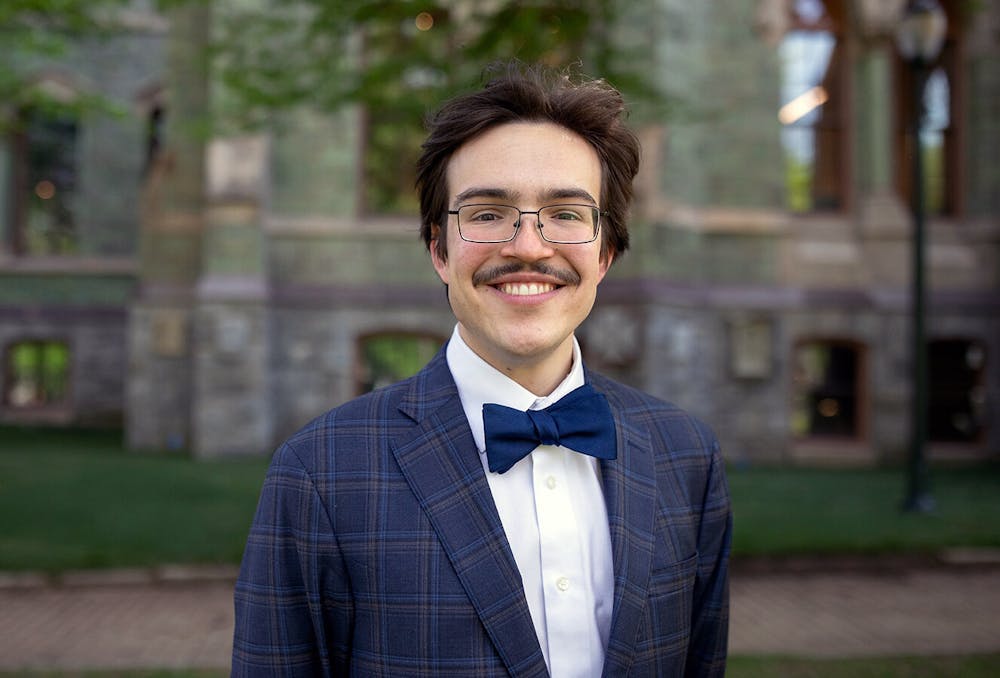
2025 College graduate Leo Solga reflected on his unsuccessful bid for the Pennsylvania House of Representatives in an interview with The Daily Pennsylvanian.
This spring, Solga ran in the Democratic primary for the 148th District — located just outside Philadelphia in southern Montgomery County — but ultimately lost. He told the DP that running for office is “easier than a lot of people think” but still “pretty darn inaccessible.”
Solga credited his experience in the Undergraduate Assembly — and specifically his time as speaker — as crucial to his understanding how to change public systems “for the better.”
“I got into the race because that’s what I wanted to do: to serve people via that process,” Solga said. “My time at Penn gave me the confidence to make the jump into the political theater at such a young age.”
Solga said he was inspired to pursue public service following his experience studying the magisterial district judicial system through the College House Undergraduate Research Program. That research led him to work with state Rep. Mary Jo Daley (D-148), who later announced her retirement ahead of the 2026 primary.
“I saw how state government could improve the lives of people,” he said. “I found the work very inspiring, and I authored some legislation with Mary Jo.”
Daley, a 1987 Wharton and 2001 Fels Institute of Government graduate, previously worked as a financial and administrative officer at Penn.
Going into election night, Solga said his campaign members were “confident” because they “had the strongest ground game” in a race he believed to be “very winnable.”
RELATED:
Penn alum, former UA speaker launches campaign for Pa. House of Representatives
Penn alum reflects on bid for state legislature seat as competitive primary race continues
On the evening of May 19, Solga was trailing in the vote count. In the end, he scored 14.24% of the vote, placing him in third ahead of Andrea Deutsch — but behind 2011 College graduate Jason Landau Goodman and Megan Griffin-Shelley, who won the Democratic nomination.
Daley endorsed Griffin-Shelley after previously telling the DP that she did not plan to endorse a candidate.
Solga said he could have handled his campaign differently: organizing earlier with “specific objectives,” spending money earlier in the race, and improving the internal structure of his “tremendous” all-volunteer team. However, he said he left the campaign “not having regrets.”
“You can’t change the past,” Solga said. “You just have to have the serenity to accept the things you cannot change.”
Solga — who recently returned to the University of Pennsylvania Carey Law School as a criminal justice researcher following a leave of absence for his campaign — told the DP that he does not have “specific plans” to run for office again but thinks “it’s quite likely” that he might in the future.
He did, however, tell the DP that he plans to revamp his website to include “general resources so that prospective candidates — particularly, young prospective candidates — can have a better understanding of what a campaign actually looks like.”
Solga said that resources such as Run for Something and the National Democratic Training Committee are “helpful in some regards” but “lacking in certain respects,” adding that he hopes his website can become a more “digestible, accessible resource for prospective candidates.”
“I’m so incredibly grateful for everyone that helped,” Solga said, citing the “many current Penn students and recent Penn alumni” who volunteered their time toward his campaign.
In the end, Solga said, “there’s love in the arena.”
RELATED:
Penn alum, former UA speaker launches campaign for Pa. House of Representatives
Penn alum reflects on bid for state legislature seat as competitive primary race continues
Staff reporter Luke Petersen covers politics and can be reached at petersen@thedp.com. At Penn, he studies philosophy, politics, and economics. Follow him on X @LukePetersen06.


