Bruce Dern, who starred opposite John Wayne in “The Cowboys,” was kicked off Penn’s track and field team in 1957. The reason: He refused to shave his sideburns.
The coach at the time, Kenneth Doherty, said a “better way to put it” was that Dern “preferred not to continue,” according to an article in The Virginian-Pilot. Doherty believed the hairstyle and fans’ chants of “Go, Elvis, Go” were making Dern stick out too much from the rest of the team.
Doherty went on to serve as the director of The Penn Relay Carnival, and his philosophy reflected a meet that cared less about spectacle than sport. Olympians run on the same track as elementary schoolers. English lords and college students are seen as equals. The event may be someone’s biggest stage and someone else’s stepping stone.
As it celebrates its 130th anniversary, the Penn Relays continues to be a place of opportunity.
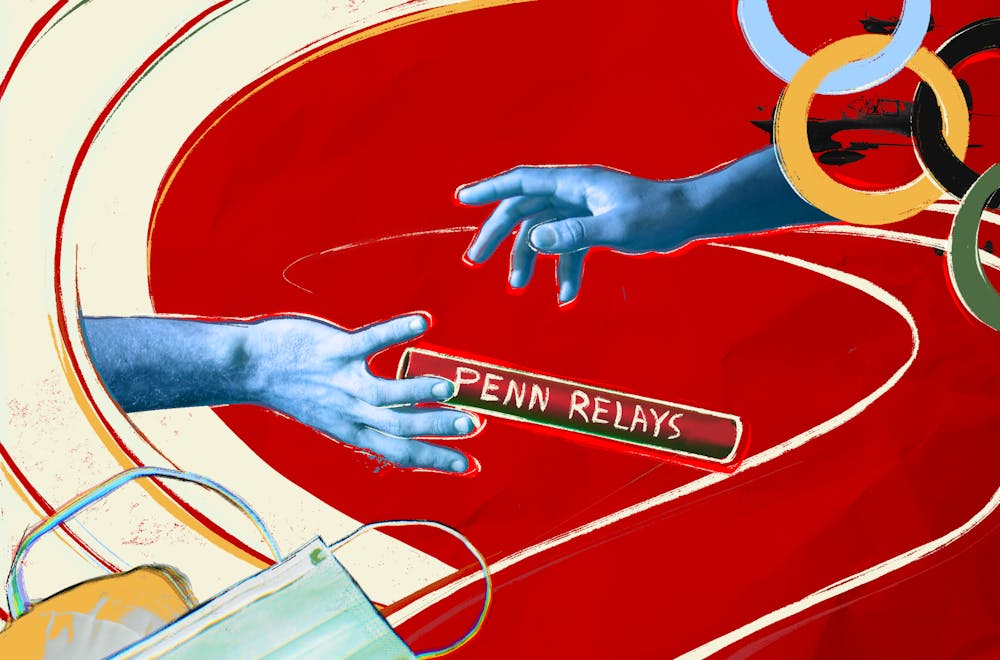
“[The Penn Relays is] not just a bunch of people running around the track. It’s that, by sharing the need to pass a baton, to all participate sequentially, each person has to do their part, and it becomes truly a team event,” Dave Johnson, director of the Penn Relays, said.
It seems Doherty believed the same. The Penn Relays was no place to rock Elvis Presley-style sideburns.
“Most American athletic invention”
In 1893, Frank B. Ellis, then chairman of Penn’s University Track Committee, sought to boost interest in the University’s spring handicap meet. The committee came up with the idea of a relay race where four men would each run a quarter-mile, inviting Princeton to compete with Penn. Princeton bested Penn the first year, but Penn won the next. Regardless of the winner, the races drew much interest.
Relay running, perhaps drawing inspiration from the old messaging system where news was passed from one horse rider to another, was disorganized and disjointed back then. Track and field as a sport was still trying to find its footing — there were barrel rolls, backwards 100-yard dashes, and “potato races.”
“Track and field was in such an infancy state. There hadn’t been a modern Olympics yet. All of those things were completely up in the air,” Penn Relays Associate Director Aaron Robison said. “And at that time track and field was more of a school field day, if you will.”
In a cacophony of diverse racing ideas, Ellis took the relay and standardized it for the sport. With its success, according to a 1956 issue of Franklin Field Illustrated, Ellis “knew he had the ‘most American athletic invention’ since Abner Doubleday laid out the first baseball diamond.”
In 1895, Ellis and the committee decided to inaugurate an official relay meet, which also served as the dedication ceremony for Franklin Field. Back then, the nation’s oldest collegiate football stadium was just a humble structure.
“Franklin Field contained only a quarter mile track and a wooden stand on the south side of the field,” 1901 Wharton graduate Edward R. Bushnell, who was also a Penn track and field alum, Olympian, and journalist, wrote in 1935. “There were so few accommodations for the visiting athletes that tents had to be erected around the track where the athletes could dress for their events.”
It was because of those tents that the official meet came to be called The Penn Relay Carnival.
“United States versus the world”
It would be deceptive to say that the Penn Relays, in its 130 years, has not been affected by global affairs. The history of the Penn Relays has been marked by its response to international events.
The first half of the 20th century proved difficult for the Penn Relays. World War I, the influenza epidemic from 1918-20, and World War II served as a string of extreme hardships that shook both the nation and the Penn Relays. While many schools — such as Yale and Harvard, which did not have track and field teams during World War II — canceled athletic programs, the Penn Relays persevered.
“Our French comrades are welcome because of the ancient friendship that has existed between the United States and France,” a 1921 issue of Franklin Field Illustrated read. “[B]ut even more so because of the heroic fight in the face of terrible odds that France made against Germany throughout the Great War.”
During World War II, the United States military organized recreational fitness programs to keep factory workers willing to manufacture uniforms, and many of these workers formed track teams that later competed at the Penn Relays.
“Everybody wanted to keep coming,” Johnson said. “They didn’t want the event to fall apart. They wanted to be here. It was their chance to shine and do something fun during those three or four years of the war.”
“There was a huge boom in sports in the ’50s and ’60s in the United States. All sports were extremely popular. It was postwar,” Robison added. “The country was as happy as it had ever been.”
One event fundamentally shocked the nature of the Penn Relays, as it did the world: the Sept. 11, 2001 terrorist attacks. While the Penn Relays had almost seven months to make necessary changes to the event after the attacks, the transition was nevertheless arduous. Spectator entrances, security inside and outside the stadium, and team transportation at airports were just a few of the many issues that needed to be addressed.
In 2013, the Boston Marathon bombing killed three people and injured over 500. Tensions were high, and fear was palpable among the running community. But two weeks later, Franklin Field still opened its gates for the Penn Relays.
Ultimately, how could one, everlasting event tackle the uncertainty of the world? The answer was simple: staying on track. Keeping their eyes on the world of track and field, Penn Relays’ administration has been able to overcome numerous obstacles, though COVID-19 proved to be an insurmountable hurdle.
“We knew very quickly when the end came for track and field,” Johnson said. “It was the Thursday before the NCAA Indoor Track championships that year, in mid-March, and I got a call from the coach at Duke University [describing how] the COVID outbreak was serious enough that we were not having the meet. We were being told [to] vacate the facility.”
For the first time since its uninterrupted inception in 1895, the Penn Relays was halted by the pandemic.
Despite these setbacks, the Penn Relays maintained its spirit of competition to a global audience. In the 2010 Relays, Johnson and other administrators introduced the “USA v. the World” initiative to pit U.S. teams against elite runners, such as Usain Bolt and Michael Johnson. Placing athletes in their national team uniforms was a catalyst for the success of the Penn Relays, as the meet’s reputation reached the international stage.
“More Olympian than the Olympics”
From as early as 1925, the Penn Relays has been called “a veritable Mecca for track and field athletes representing the university, college and scholastic world” and “America’s greatest international athletic meeting and the originator of relay racing.”
In a 1983 article from The Daily Pennsylvanian, then-University Chaplain Stanley Johnson was quoted as saying, “The relays are the world’s largest track gathering — it’s the highlight for anyone who ever was a track fan.”
More than 40 years later, the sentiment hasn’t changed.
“I think as far as track is concerned, it’s one of the No. 1 meets of the year,” Gail Zachary, assistant director of the Penn Relays, said.
Former Penn Relays director Jim Tuppeny, who had four daughters, added women’s events to the Penn Relays with the introduction of a female 100-yard dash in 1962.
Zachary said that the inclusion of women’s meets has “brought [women] into the limelight. … And I’ve seen a trend, especially in high school, where there seems to be sometimes more women entries than, well, men.”
Notably, the Penn Relays has been open to Black athletes since it first began, and the City of Brotherly Love becomes a paradigm of national Black excellence when Penn Relays starts each year.
This is not to say the Penn Relays was exempt from the nation’s battle with racial segregation. In the 1960s, Penn received a letter from a Southern University coach demanding that the University withdraw its invitation to a Black sprinter from a southern school; Penn Relays’ administrators responded with a revocation of Southern University’s team instead.
In times of racial inequality and discrimination, the Penn Relays has served as an opportunity for Black athletes, coaches, families, and friends to come together. In time, the Penn Relays transformed from a simple athletic event to a celebration of Black culture, including festivities such as the “Triple S” show.
“I was talking with an African American gentleman, and I had asked him how he had come to Penn Relays every year [as] he wasn’t an athlete,” Johnson said. “He just came because it was the thing to do. He was from Michigan. He said, ‘When spring break came, we didn’t go to Fort Lauderdale where all of the white kids would. We would have to drive through southern states that would not have looked kindly to us. So, instead, our big spring break trip would be to go to Philadelphia.’”
The Penn Relays also first introduced the exchange zone and use of the baton, rules adopted by the Olympics that are now considered standard in relay running.
Before the introduction of the baton, runners just “smacked hands,” Robison said. “But there’s something special about having that baton in your hand and handing it off to a teammate. You’re not running for yourself. … It’s the one time that track and field is truly a team sport.”
The Penn Relays has also welcomed Olympians, celebrities, and politicians. Olympic gold medalists Jesse Owens and Bolt, as well as basketball player Wilt Chamberlain and astronauts Ed White and Buzz Aldrin are among the public figures who have competed at the Penn Relays.
“‘The Penn Relays is more Olympian than the Olympics,’ boasted carnival director Jim Tuppeny at a press luncheon yesterday on the Penn campus,” Bob Savett wrote for The Bulletin in 1979. “‘We’ll have our Olympians … but we’re also helping people get started.’”
“Sport for the sake of sport”
Savett portrayed how the Penn Relays attracting professional and high school athletes is a key reason for its enduring success. While other team sports often have a limited number of competing athletes, Penn Relays sustains over 2,500 competitors within the first hours of the meet.
But the Penn Relays is more than an amalgamation of runners; it’s a common, core memory for many Philadelphians.
“All you have to do is start talking to someone in Philadelphia,” Johnson said. “If they didn’t run in the Penn Relays, they have a relative or neighbor who probably did.”
“It’s not just a track and field event. It’s not just a sporting event. It is so much more than that,” Robinson added. “It is a reunion of sorts. … It’s an opportunity to relive some of your earliest memories as a child when your grandfather brought you to the event.”
The Penn Relays connects Philadelphians with one another, Philadelphia with the country, Philadelphia with the rest of the world.
“Fortunately, my most exciting track memory is of a relay race in America, when four of us, each running a half mile, secured the world’s two-mile record for Oxford and Cambridge against the American universities.” South African Olympic champion Bevil Rudd — the star of the 1920 Oxford-Cambridge team that competed at the Penn Relays — wrote in 1931. “The meeting is the greatest and most popular event of the American athletic year.”
“Then came the race itself,” he continued, “the electric atmosphere of 40,000 excited human beings — ourselves the feared enemy and cynosure of every eye — and yet to us only a prayer that we should not disgrace ourselves.”
The competition, whether it is among high school students or Olympians, American or international collegiate athletes, was a common factor.
“Totally unlike the unfortunately jaded California fans who sit on their hands even while witnessing world champions, the Franklin Field spectators are alive,” Bert Nelson wrote in 1973 for Track & Field News. “They roar loudly and often for the unknown high schoolers and for the famous collegians. They like competition, recognize it when they see it, and respond to it with vigor throughout a long day.”
That remains the spirit of the Penn Relays today, as Frank Dolson, then-sports columnist of The Philadelphia Inquirer, wrote in 1986: “It’s Penn Relays week, a time to talk about the spirit of athletics.”
“You’ve never heard of the great majority of the young men and women who will be passing the batons at Franklin Field this week and, with a relative handful of exceptions, you never will hear of them,” he continued. “That’s what makes the Penn Relay Carnival so unique; the emphasis is on competition, sport for the sake of sport.”