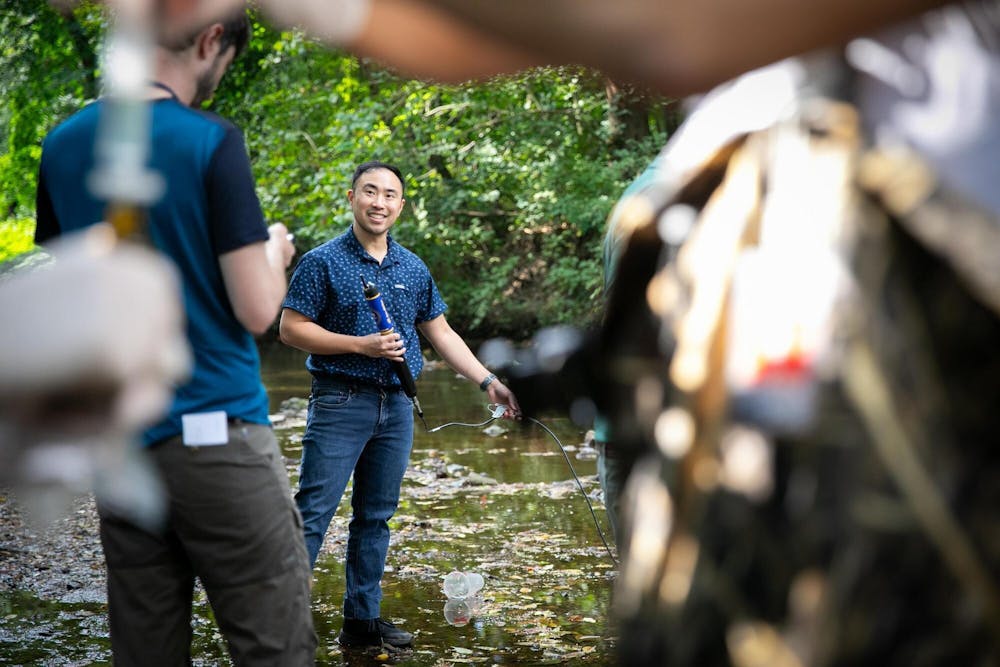
Postdoctoral fellow Derek Ho has been nominated for the Frontiers Planet Prize for his research on microplastic detection.
The Frontiers Planet Prize — awarded yearly to three international recipients — acknowledges “transformational research that shows the greatest potential to address the world’s most urgent environmental challenges.” Ho researched microplastic pollution at the McBride Lab in the School of Engineering and Applied Science, earning him the nickname “Dr. Microplastics” and a nomination for this year’s Prize.
Ho’s methodology involved staining microplastics with fluorescent dye using different excitation wavelengths and color optical filters, producing a variety of color dimensions that allow researchers to identify the specific microplastics present in a sample. Along with environmental science assistant professor Jon Hawkings, Ho has applied his findings to microplastic monitoring efforts at Cobbs Creek.
“This will ultimately be able to give us a lot of data on the spatial and temporal distribution of plastics, which can then be fed into bigger models to understand how pervasive microplastics are,” Ho said in an interview with The Daily Pennsylvanian.
Ho said that he had been interested in plastics ever since he was a kid — a curiosity which grew in his job as a Coast Guard officer, where he witnessed the effects of plastic pollution in the ocean firsthand. He also described how his work imaging small plastic particles intersected with his passion for astrophotography.
In addition to his research, Ho also engages in science outreach and education. He works with high school students on his Cobbs Creek monitoring project, and partnered with the Wisconsin Sea Grant to design an educational kit for teaching children about the environmental impacts of microplastics.
“Unfortunately, science isn’t done in isolation, and there's a lot of politics,” Ho said. “Science education seems to be the best way to bridge this level of ignorance. A lot of people are just misinformed, and frankly, there’s way too much information with conflicting views.”
Ho was chosen by the Penn Environmental Innovations Initiative to proceed to the national stage of the Frontiers Planet Prize selection process, where The National Academies of Sciences, Engineering, and Medicine will select its top three U.S. nominees by this spring. From there, an international jury selects a reigning national nominee who will be entered into the international pool of candidates, competing for a one million dollar prize.
RELATED:
Penn professor Carl June discusses medical innovation award, CAR-T cell research in DP interview
Penn Med, CHOP among 13 recipients of NIH funding for autism research collaboration
Ho said that if he were to win the prize money, he would seek to expand the scope of various microplastic monitoring efforts and also return to his original goal of remediating microplastic pollution.
In a written statement to the DP, Senior Research Coordinator for the Environmental Innovations Initiative Ximena Trujillo wrote that Ho’s “exceptional” application met the standards set by the Frontiers Research Foundation by addressing microplastic pollution, an issue “relevant to the planetary boundary of novel entities entering the environment.”
“The Environmental Innovations Initiative (EII) supported this nomination because of the potential positive impacts that advancements in detecting and quantifying microplastic pollution could have on improving environmental health both now and in the future,” Trujillo wrote.
RELATED:
Penn professor Carl June discusses medical innovation award, CAR-T cell research in DP interview
Penn Med, CHOP among 13 recipients of NIH funding for autism research collaboration
Senior reporter Norah Findley leads coverage of science and health and can be reached at findley@thedp.com. At Penn, she studies environmental studies. Follow her on X @NorahFindley_.