

In basketball, since the advent of the free throw, the term “free” has been associated with the idea of a guarantee. Free throws are important because the game stops, no time runs off the clock and points can still be scored.
It’s also a situation that never changes. The hoop is always at a fixed distance, and the shooter always has a straight shot.
That’s why, when watching women’s lacrosse for the first time, it’s easy to get confused about what free means.
After a foul, the referee blows the whistle and the ball-handler is provided with a free position.
Play stops, and to a first-time viewer, such an opportunity seems akin to the free throw. Once the whistle is blown, all players move four meters away from the player with possession, who can shoot, pass or run once play resumes.
Yet, there are plenty of differences between a free throw and a free position. When a foul is called, the ballhandler doesn’t move to a mark on the center of the field. Rather, wherever the foul is committed is where the free position is taken.
This distinction adds to the amount of work that goes into scoring on a free position.
“Some of it is just stepping up to the line, and that’s mental on your part too. You got to step up to the line and know you’re going to make it,” senior midfield Maddie Poplawski said. “Most of us are right-handed so we focus on driving to the left to create more space for us to shoot right-handed.”
SEE ALSO
Penn women’s lacrosse breaks out in second half to beat Lehigh
Penn women’s lacrosse juniors fight back from knee injuries
Penn has taken 41 free position shots so far this season, scoring on 22 of those opportunities. Those numbers are up there with the best in the country, as that 53 percent clip is in the same league as No. 1 Maryland’s 54 percent.
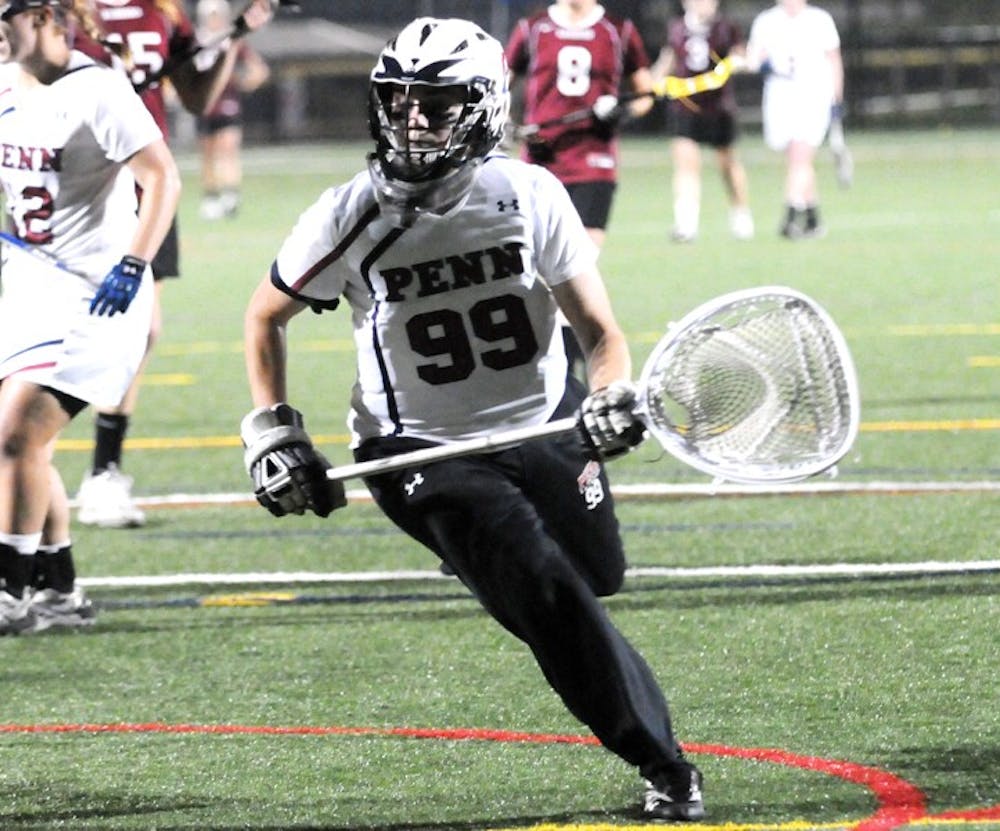
Not only is positioning vital to whether a player takes a shot or decides to swing the ball back out, but there’s also the little problem of a goalie standing in between ball and net, a goalkeeper who happens to have studied up.
“I just like to think about what the attackers’ tendencies are,” sophomore goalie Lucy Ferguson said. “A lot of the time they do the same thing, or have a certain type of shot that they like to take. It’s just doing your homework.”
In the same way that goalies work to study their opponents’ techniques, Penn works on dividing up the goal into six different sections in practice, helping shooters both on free positions and other situations, as they select spots depending on which areas the goalie best defends.
But just as often as it is mano-a-mano, there are many moments when there is simply no action other than restarting the offense.
One of the jarring aspects of the free position for a women’s lacrosse spectator is the speed with which a foul is called and the subsequent free position is taken. Most sports fans have grown used to stoppages after fouls, but the same doesn’t hold true in this sport.
The person taking the free position on the spot must make the decision whether to shoot, pass or run, and sometimes, confidence is the biggest factor.
“If you feel like you’re on fire, you’re thinking that you’re having a great shooting percentage for the day,” Poplawski said, “then you’re like, ‘Okay, why don’t I take it? Why don’t I go for it?’”
As the Quakers move deeper into the Ivy slate, they will likely find themselves entangled in close contests, just as they have been throughout the season.
Despite all the distinctions between the two, in the same way that free throws can decide a basketball contest, free positions can prove vital to a team’s success.
Penn puts away one more free position goal per game than its opponents and over the course of the season, those goals add up to pivotal victories.
SEE ALSO
Penn women’s lacrosse breaks out in second half to beat Lehigh
Penn women’s lacrosse juniors fight back from knee injuries

