

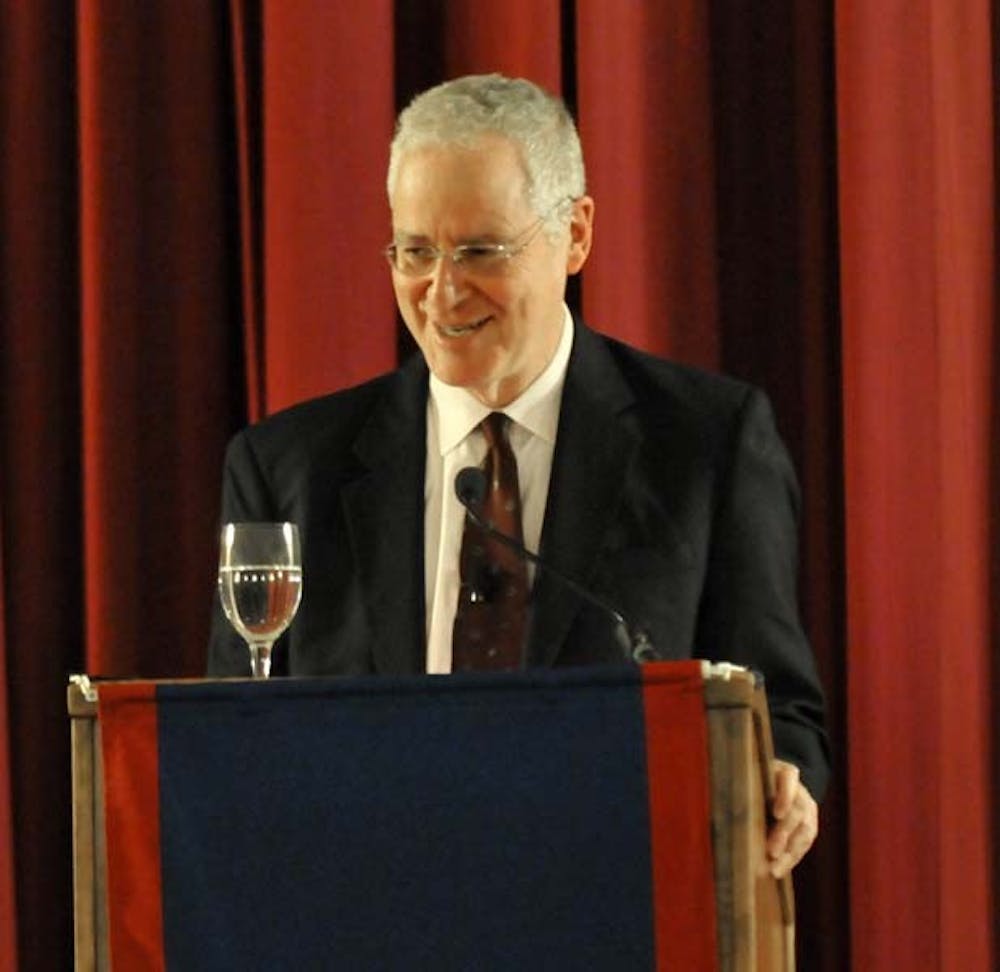
Two days after President’s Day, a celebrated biographer cast a new light on the man commonly known as the Father of Our Country.
On Wednesday afternoon, Ron Chernow, the Pulitzer Prize-winning author of “Washington: A Life,” spoke at Harrison Auditorium in the University of Pennsylvania Museum of Archaeology and Anthropology. Chernow’s talk was presented as part of the School of Arts and Sciences’ 2013 Levin Family Dean’s Forum.
Dean of SAS Rebecca Bushnell started off the event by honoring the Dean’s Scholars — extraordinary undergraduate, LPS and graduate students selected by the deans — before introducing Chernow.
Chernow began by describing the discrepancy between the public perception of Washington and how the first president acted in his private life. Chernow emphasized how the Washington commonly thought of today — stoic, impassive and “wooden” — could not possibly have been the Washington that led the Continental Army for eight years in rebellion against the British or presided over the Constitutional Convention.
“Revolutionaries are not made of such tame stuff,” he said.
In this vein, Chernow debunked many “myths” about Washington, including the famous cherry tree story that, despite its popularity with children, is false.
Chernow delved into Washington’s personal life, pointing out instances of how rudely Washington’s mother treated him after the death of his father. He also discussed the importance of Washington’s wife, Martha, describing their marriage as a “remarkable partnership.”
Washington had “[an] inspired simplicity of vision and fierce determination to see the job through” that served him well in government. He would often rise “above the fray” of constant argument during the Constitutional Convention as well as within his cabinet while he was president.
“He had outstanding judgment,” Chernow said.
Washington’s legacy as a president continues to the modern day. Precedents he set during his inauguration, such as taking the oath of office with one hand on the Bible, are still practiced to this day. In addition, Washington stepped down after eight years in office, establishing a tradition that became law when the 22nd Amendment was ratified in 1951.
While leading the fledgling American government, the president still had “a real humility … even an anxiety or insecurity of living up to his title,” Chernow explained.
regarding the divisive issue of slavery, Chewnow said Washington was “deeply conflicted,” and opposed it in theory, despite owning about 300 slaves. However, Washington ultimately freed all of his slaves at the end of his life, the only Founding Father to do so.
College freshman Justin Wong came to the event because he was in the middle of reading “Washington: A Life” and thought it was a “great opportunity” to listen to an author of a book he was reading.
Others, like Engineering freshman Dillon Weber, were already avid fans of Chernow. Weber has read both “Washington: A Life” and Chernow’s biography of Alexander Hamilton.
Weber noted that it was “beneficial” because Chernow “focused on themes he stressed in the book.”
At the end of his talk, Chernow linked his subject back to Penn and Philadelphia by discussing Washington’s relationship with Benjamin Franklin. “Washington had immense respect for Franklin,” he said.
Ultimately, George Washington still serves as the American hero venerated today.
“Washington, whatever his flaws, lives up to his reputation,” Chernow said.
An earlier version of this story misreported the date of George Washington’s birthday.

