

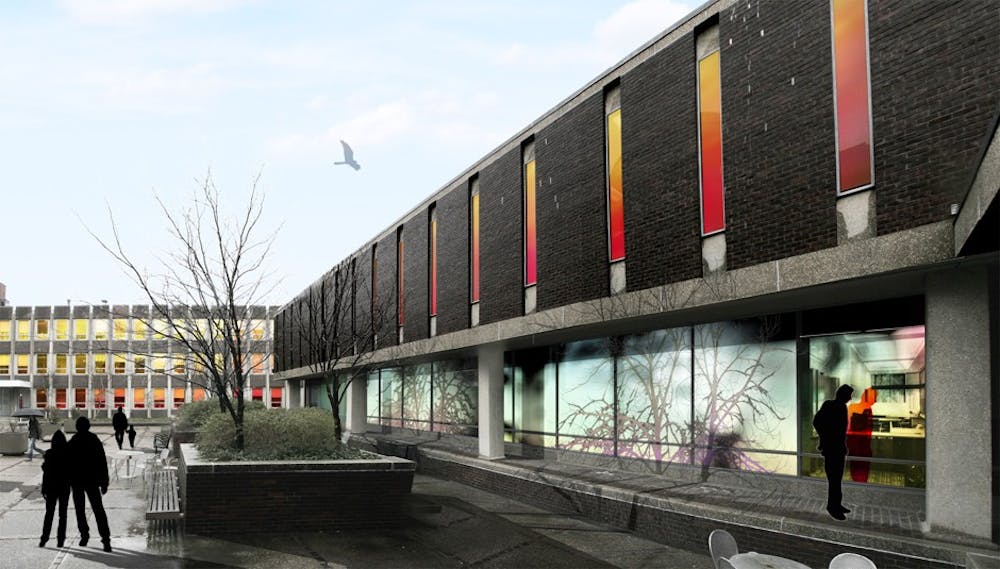
Thanks to six Penn researchers, a building that sounds straight out of a science-fiction novel may soon become a reality.
A research team led by Shu Yang, a School of Engineering and Applied Science professor, won an Emerging Frontiers in Research and Innovation grant from the National Science Foundation earlier this year.
Her team will design technology for a smart building — a structure that will respond to its environment in order to optimize comfort, energy efficiency and aesthetic appeal.
Yang will act as the principal investigator on the $2 million grant, working with four co-investigators: School of Design Professor Jenny Sabin, SEAS Professors Nader Engheta and Jan Van der Spiegel and Penn’s Institute for Medicine and Engineering faculty member Peter Lloyd Jones. Sabin’s PennDesign colleague Andrew Lucia will also work on the grant as senior personnel.
The plans for the building design have not yet been finalized, as the grant went into effect Sept. 1 and will last for four years. Still, Sabin said, the team has discussed “wish lists” of potential features for the structure, which may account for everything from temperature, humidity and light control to the accommodation of people’s individual decor preferences.
For example, Sabin and Van der Spiegel explained, they have considered devices that would change a room’s overall appearance based on whoever is occupying it.
“We have a concept of interactive, beautiful, communicative spaces that can serve as personalized architecture,” said Sabin, who specializes in computational design — an approach to architecture that incorporates digital modeling and a focus on the relationships within structures. Linda Sapochak, the NSF project director for the grant, said that some aspects of the proposed technology “can be potentially transformative for building science.”
In order to create the devices, the team members will have to draw on their experiences with interdisciplinary research.
Sabin and Lloyd have been collaborating for the past four years to integrate principles from cell biology — Lloyd’s speciality — into architectural design.
Van der Spiegel said he has also taken inspiration from biology in his research on sensors, which falls under his and Engheta’s broader speciality of electrical engineering, and Yang’s Materials Science lab involves different disciplines on a daily basis.
Van der Spiegel described the project as a constructive exchange of ideas that can foster creative approaches to sustainable living. His and Engheta’s knowledge of sensors, Lloyd’s understanding of cell biology and Yang’s work with nanodevices and surfaces can help inform the building design. The architectural models developed can shape applications in the other fields and facilitate more interdisciplinary discussion, Van der Spiegel said.
Although the grant was awarded to design a “skin” for a building, meaning a set of devices that can be attached to existing structures, it will likely evolve into a full-building design later on, Sabin said.
And every step of the project, Van der Spiegel hopes, will also transform the public perception of technology’s role in the interaction between people and their environment. “We hope people will say, ‘Wow! Technology can also look good, in addition to being efficient,’” he said.

