

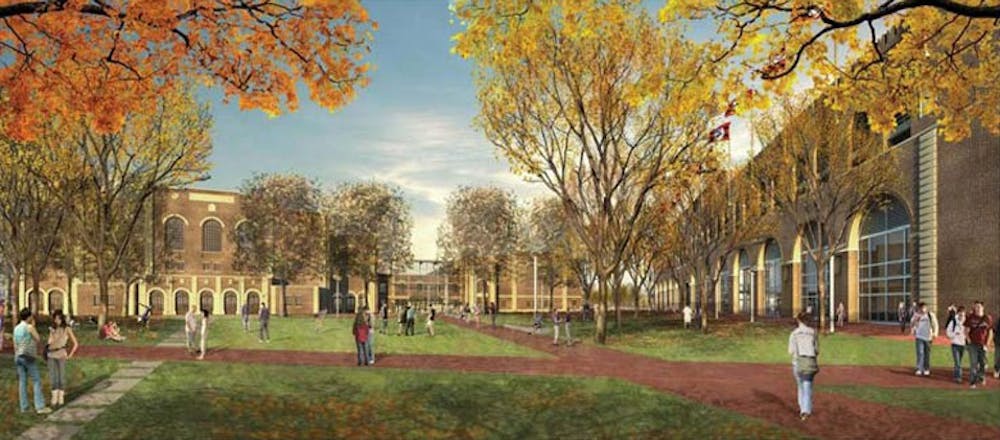
Penn students’ daily journeys to calculus class will soon include less gray and more green.
A project to construct a park on 33rd street — next to the David Rittenhouse Laboratory — by the fall of 2012 will be part of a Sustainable Sites pilot program to develop and test a rating system for green landscape.
The Shoemaker Green park will replace a current greyfield of tennis courts and will, among other things, “improve water quality and minimize runoff, reduce the effect of the urban heat island by greening large paved areas [and] restore biomass on site,” according to the Penn Connects website.
Project Manager Marc Cooper and University architect David Hollenberg said they envisioned Shoemaker Green as a commons with a role similar to that of College Green.
According to Hollenberg, with the school’s “active recreation moving east, it makes sense to make this site more passive.”
The University is “clearly characterized by wonderful open spaces,” said Hollenberg, who said he hoped that Shoemaker Green will enhance that characterization.
Sustainable Sites — a partnership of the American Society of Landscape Architects, the Lady Bird Johnson Wildflower Center and the U.S. Botanic Garden — will rate the park based on the organization’s “guiding principles,” which include designing with local cultural conditions in mind and maximizing the benefits of ecosystem services, according to their website.
The plans for the 3.75-acre space —made by Philadelphia-based architecture firm Andropogon Associated — were included the rating program after meeting numerous Sustainable Sites prerequisites taking into account environmental advantages for the site’s hydrology, soil and vegetation, materials selection and human health and well-being, according to a Penn press release.
Plans for the park will also transform storm water management to conform to new regulations imposed by the Philadelphia Water Department.
Water from the roofs of buildings around the green, including DRL and the Palestra, will be contained in underground storage basins to be used for purposes such as irrigation.
A new tennis center containing twelve courts will be built as part of the 24-acre Penn Park which will stretch from Walnut to South Street and is to be completed by 2011.
Hollenberg and Cooper also worked with the University’s event planning staff to make the park more useful during special events such as Penn Relays and Commencement.
“Being green at Penn certainly fosters more activity and energy in the student body and leads to more happiness,” College junior Kenny Guber said.
Guber added that he appreciates the parks around the Schuykill River and feels positive about the plans for the park for reasons other than its environmental benefits.

