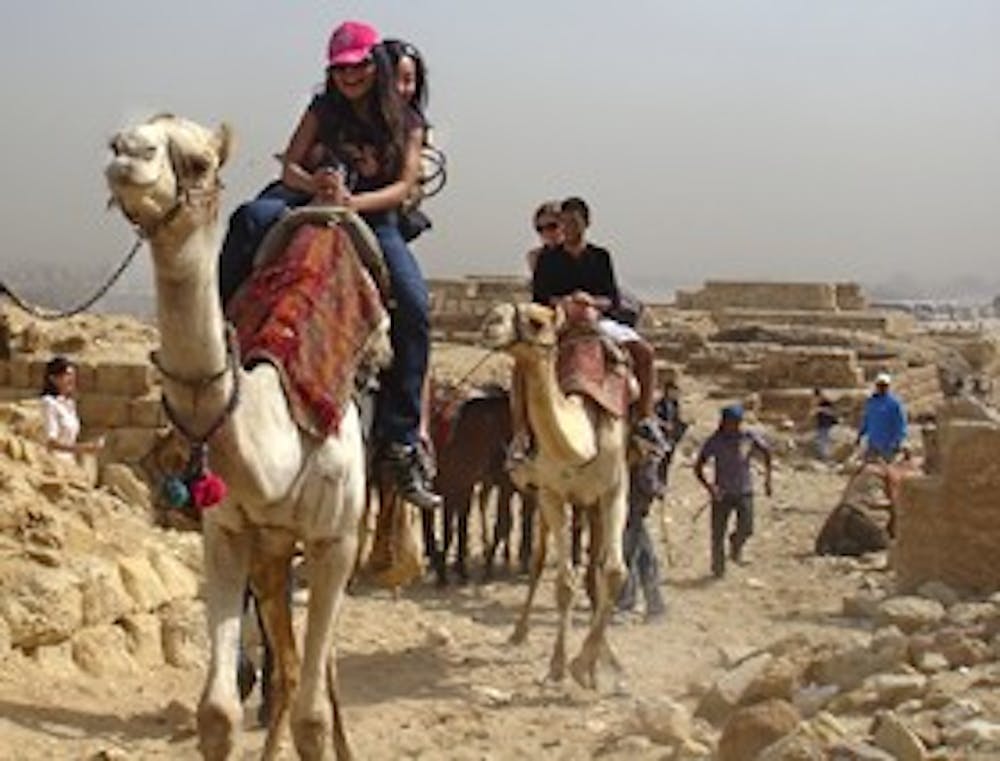
While Egypt is probably not the typical college-students spring-break destination, a group of 25 students, including myself, crossed the Atlantic Ocean to visit the country for spring break.
Organized by the Wharton Arabian Gulf Business Association, the aim of the trip was to experience both the cultural and the economic facets of Egypt.
Most members of the group wanted to experience a culture so foreign to our own, or make their own impressions of Egypt instead of “relying on the negative perceptions we normally get of the Middle East,” according to Wharton sophomore Christina Zima.
The group was comprised of students from across all four Penn schools who had expressed an interest in the region in their initial applications to attend.
Last year, WAGBA organized a trip to Dubai. Egypt was chosen this year because “it plays an important role in the Middle East,” Wharton senior and the trip’s main organizer Yousuf Saif said.
“Egypt is poor, but it has a growing economy,” he said.
With that in mind, WAGBA organized meetings with several important players in the Egyptian economy, including the Governor of the Central Bank Farouk El Okdah, Managing Director of Citadel Capital Aladdin El Afifi and the CEO of Beltone Aladdin Saba, all of whom are Wharton alumni.
These corporate visits included discussions of the Egyptian economy, and what we talked about was certainly visible as we traveled throughout Cairo, the capital city.
“Egypt is definitely a country in the midst of change,” College sophomore Sara Cannon said. “There are such huge differences between the shiny corporate buildings we visit and the crumbling buildings that most people live in, and that was what made our discussions about the Egyptian economy so interesting.”
After our corporate meetings each day, we would travel across Cairo to visit the popular tourist spots.
Our first day included a visit to the Cairo Museum and dinner on a boat on the Nile River. The next day, we saw a light and sound show that takes place every night in front of the three main pyramids in Giza.
As we often did not have enough time to go back to our hotel and change after the corporate visits, we sometimes found ourselves trekking across Cairo in our formal business wear, including the day we visited Old Cairo and the Coptic Museum — which meant we drew even more attention from the local Egyptians than most tourists.
The following days were a whirlwind of activity, including a visit to the American University in Cairo, a desert safari and a day trip to Alexandria, which Cannon described as “the most beautiful place on the Mediterranean” — a sentiment that most of the group shared.
“Trips like this broaden perspectives, especially if you’ve never visited a developing country,” Saif said at the end of our stay. “And I think everyone learned a lot, especially considering what a diverse group we had.”