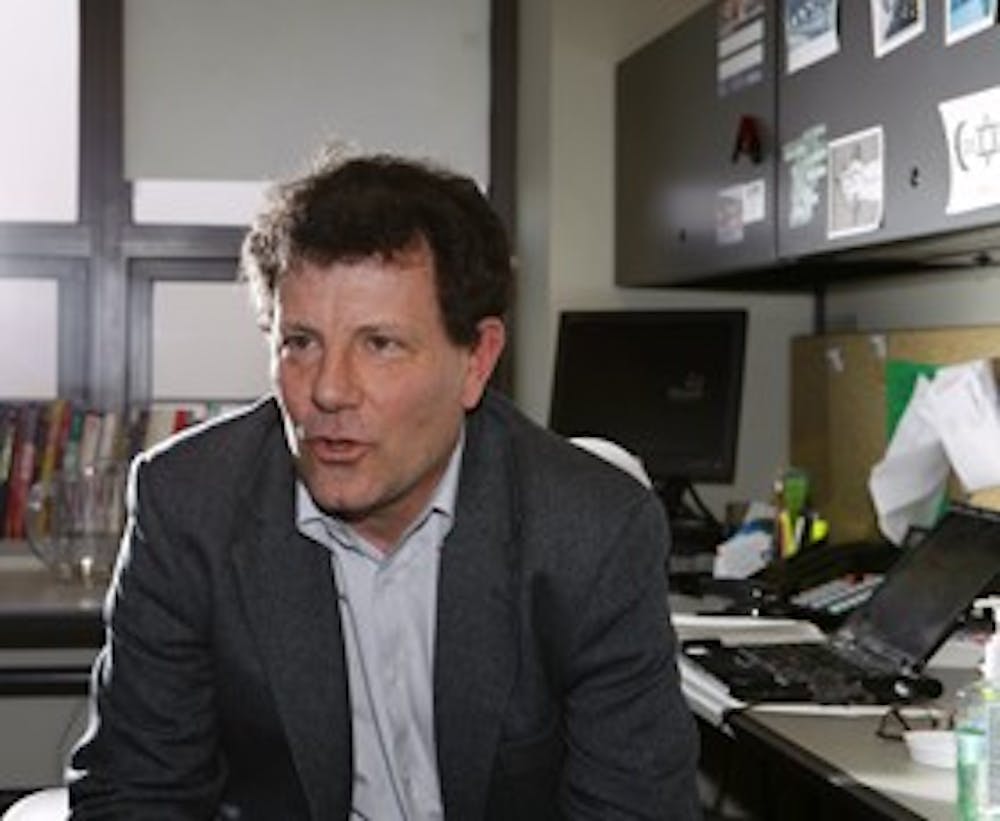
Nicholas Kristof is no ordinary journalist. Lauded as “the moral consciousness of our generation” by The New Yorker’s Jeffrey Toobin, Kristof has traveled to 140 countries to expose human rights issues such as the Darfur genocide and human trafficking.
Before his lecture Monday night, the two-time Pulitzer Prize winner and New York Times columnist sat down with The Daily Pennsylvanian to discuss his “addiction” to journalism, the power of the media and his obsession with Twitter.
The Daily Pennsylvanian: How did you decide that journalism was what you wanted to do?
Nicholas Kristof: I first became addicted to journalism when I was in high school and working for the local newspaper, and I just couldn’t believe someone was willing to pay me to run around, talk to interesting people and write about it. And the thrill of the byline was frankly part of the egotistical reward.
DP: What’s the most satisfying story you’ve ever written?
NK: There are a million — it's like choosing which of your children you love the most. I just in the last few minutes have been e-mailing a Pakistani woman, Mukhtaran Bibi, who I wrote about back in 2004. She was a rape survivor who then started an organization against rape and started a school, and I think my columns about her helped keep her alive.
DP: What do you think the power of journalists is today to shape global issues?
NK: People think that it’s the power to change minds on important issues, and frankly, it isn’t. Rather, it’s the power to shine a spotlight on some issue and thereby put it on the global agenda, to make people pay attention.
DP: You’ve said you prefer to tell the story of a place by the people in it. Why is this an effective method?
NK: The kind of reporting I do is so remote and distant and irrelevant that people tend to tune it out. And so I find that the most effective way to grab somebody by the lapel and get them involved is to focus on the individual and remind the reader that fundamentally, we’re all alike … I think basically, I’m in the same business as Homer was in 2,800 years ago ... storytelling. I’m kind of a minstrel.
DP: You’ve been recognized as one of the pioneers of the multimedia movement. You were one of the first New York Times columnists to have a blog, and I’ve gathered you have a Facebook and a Twitter, as well …
NK: Actually, when I [had] you wait for a moment, I was just posting something on Twitter. It’d be an exaggeration to say I’m a pioneer of multimedia, but among dinosaurs, I’m one of the most interested in evolving into mammalian form.
DP: If you could host a dinner party with any literary or historical figures, past or present, who would they be?
NK: It’d be a kind of an eclectic dinner party. I’d probably invite Buddha, maybe Jesus, Muhammad. I’d be interested in having Chairman Mao, I’d love to have Gandhi there, and maybe Martin Luther King, Freud, [philosopher] Isaiah Berlin, who was my intellectual hero … so that would be a start.
This article has been edited to correct the spelling of Gandhi.