

It’s 11 p.m. on a weeknight. And while many fraternity brothers have just begun their Thirsty Thursday festivities, junior Marty Borowsky is getting ready for bed.
After all, the vice president of Alpha Tau Omega — a fraternity that has traditionally been home to many Penn wrestlers — has to make an 8 a.m. workout in Hutchinson Gymnasium the next morning.
Like Borowsky, many Greek athletes at Penn are forced to make tradeoffs on a daily basis as they try to balance the heavy workloads that academic, athletic and Greek life bring.
Schedules get crowded, and attentive time management is a must.
“When you’re picking classes, you’ve got to be careful because you know 3:30 to 6, you can’t schedule anything — that’s wrestling,” Borowsky said.
While day-to-day life can be grueling, Penn athletes embrace Greek life as a complementary activity rather than a central focus.
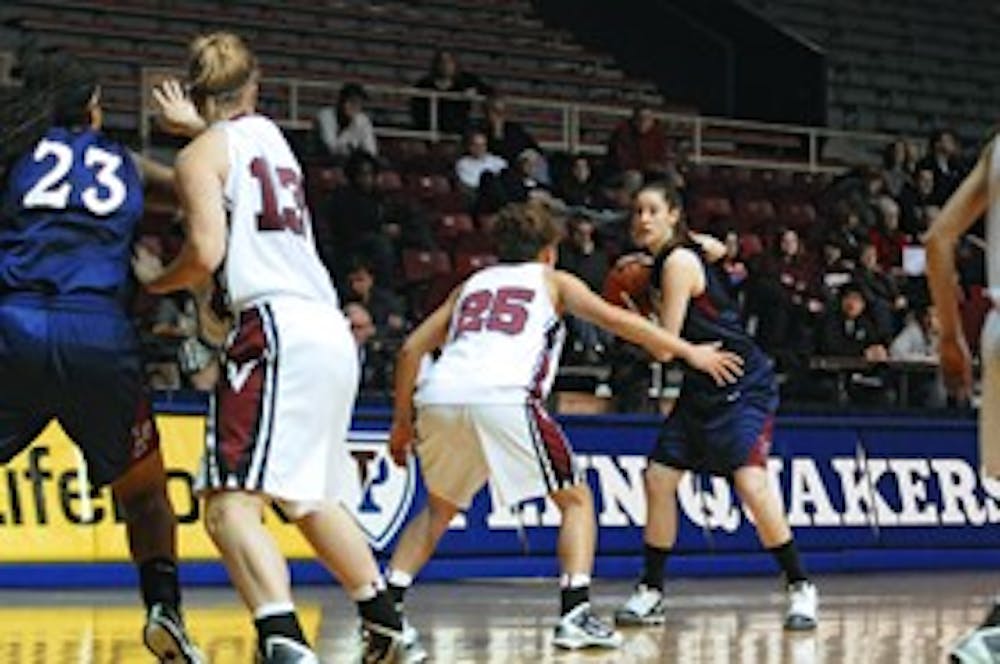
Basketball players Dan Monckton and Caroline Nicholson both said that athletics take precedent over Greek life because hoops drew them both to Penn.
Monckton, a Sigma Chi brother as of last spring, and Nicholson, a junior who rushed Alpha Phi last fall, also noted that chapter heads have been understanding when it comes to their athletic commitments.
“It’s actually been a lot easier than I thought,” Monckton, also a junior, said. “The guys in the house have been very, very lenient about it.”
“I don’t let the sorority life overtake me,” Nicholson added. “ I’m happy that I have two different atmospheres that I can be in.”
While Greek athletes enjoy a diverse experience through their dual commitments, Director of the Office of Fraternity and Sorority Affairs Scott Reikofski called the undertaking “probably the toughest balancing act” at Penn.
However, he also noticed a connection between the athletic and Greek communities.
“Both of these communities are coming together for a common purpose and common values,” Reikofski said. “The people who come out of college and who feel most tied to the institution or are most loyal to the institution are those that are either in fraternities or sororities or athletic teams.”
In the case of ATO — as well as Theta Xi, a fraternity predominantly comprised of rowers — the Greek and athletic experiences often overlap.
With about two-thirds of the upperclassmen wrestlers on the team living in the ATO house, the program uses fraternity life to demonstrate its sense of community in order to appeal to recruits.
“We promote the team as being a family,” wrestling coach Rob Eiter said. “The fact that they can not only train together and push each other on the mat but live together is pretty special.”
So when it’s the day before a big match, much of the Penn wrestling team can be found inside the friendly confines of the ATO house.
“We normally have matches Saturday, so [while] everybody else is out partying [Friday], we normally either go to the Bridge, watch a movie or we play video games together,” Borowsky said, adding:
“What better circumstances are there than living with your 20 best friends and your teammates?"

