

One of the major complaints about the required freshman meal plan is that there is nothing to do with the inevitable unused meals at the end of the semester.
Over the past few years, a handful of students have tried to get those leftovers to people who need them, like Philadelphia's homeless population. In January 2008, students advocated for Penn Dining Services to donate leftover meals to local charitable organizations, but hit a wall when they were told its budget system couldn't accommodate that.
Now, a handful of students are taking things into their own hands. Finding ways to work around these barriers and outside of formal organizations, they're coming up with innovative ways of helping - and interacting with - the homeless.
Wharton freshman Rick Oxenhandler and his roommate, College freshman Jake Werlin, have taken a proactive approach by donating their leftover meals to the homeless.
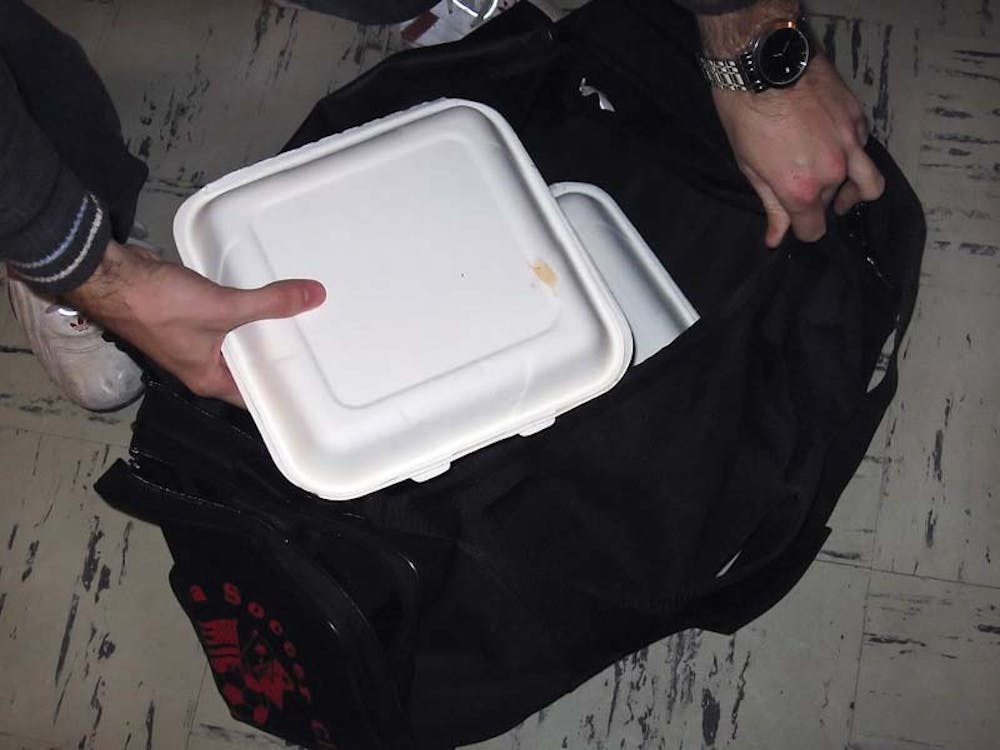
During Reading Days last fall, the two gathered as many friends and spare meals as possible and took to the streets, handing out take-out boxes of food to the homeless in an initiative they've dubbed "More Than Pennies."
Though Penn's dining plan terms and conditions state: "Contract meals are for the exclusive use of the contract holder and are not transferable," Oxenhandler and Werlin found that students are allowed to take out two to-go boxes at once, and that these restrictions apply primarily to those trying to use another person's PennCard.
"These meals are owed to us," said Oxenhandler. "What we do with them is our own issue."
Ed Speedling, community liaison for Project HOME - a Philadelphia nonprofit organization that provides housing and a variety of services for homeless people - explained that young people are instrumental in persuading homeless people to go to shelters and receive help.
"When a student reaches out, it closes the gap," he said.
Oxenhandler and Werlin, along with several friends, went to several SEPTA stations in downtown Philadelphia to hand out these to-go boxes generally filled with non-perishables such as rice and fruit. They carried the boxes in Wawa or duffel bags.
Werlin said they would enter SEPTA stations, where they had noticed homeless people in large groups, as though waiting for a bus. At a single stop, they found they could sometimes distribute as many as 40 meals, depending on how many they had brought.
This semester, the two made slightly more formal arrangements by calling different shelters and offering to deliver meals. The decision to distribute through shelters was made primarily for safety reasons, but also because there are far fewer people outside in the winter, Oxenhandler said.
He added that the decision was not based on concerns about the sobriety of the recipients, despite stigma surrounding homeless people not in shelters. "We originally thought that it doesn't make a difference," said Oxenhandler, "These people are still people, and they still need food."
During Reading Days last semester, the two asked for help from friends and acquaintances who had extra leftover meals. Oxenhandler noted that while many people acted positive and excited about the initiative, they wouldn't necessarily help out with it.
He added that many more people were more receptive about donating meals at the end of the semester rather than halfway through so they know how many they would have to spare.
Still, last week the two managed to distribute 60 meals at two shelters. They also enlisted the help of the brothers of Sigma Alpha Mu, where Oxenhandler is pledging.
"Right now it's just a student start-up," said Oxenhandler, though he someday hopes to make it an official SAM philanthropy.
Another student, College sophomore Mark Pan, an Undergraduate Assembly representative and Civic Scholar, hopes to create a refuge for homeless people on Penn's campus. Pan, who has been working with seven or eight other students over the past year, said a goal of the potential refuge is getting students to face and interact with homeless people.
"Students are really scared and have a fear of homeless people being dangerous, unproductive and unaesthetic," he said. But, he explained, shelters are very "military-like" in that they are incredibly regulated - for example, people in the shelter are forced to go to bed at the same time and to see counselors.
Homeless people living on the streets, however, show the "more rowdy side of homelessness." Pan added that they often have alcohol or drug addictions, and refuse treatment or counseling.
Pan noted that he hopes to veer away from the name "Penn Homeless Shelter," if he can create such a space because he pictures it being much more than just a place for homeless people to sleep. He envisions using the center to provide counseling and continual care, such as job placement services.
Pan said the biggest roadblocks to making the vision a reality are finding a location, grants and funding. But students involved are now making bigger strides by starting to meet regularly.
"It's becoming an unofficial, but really structured group," Pan said.

