

Transparency in politics and public policy isn't just figurative anymore.
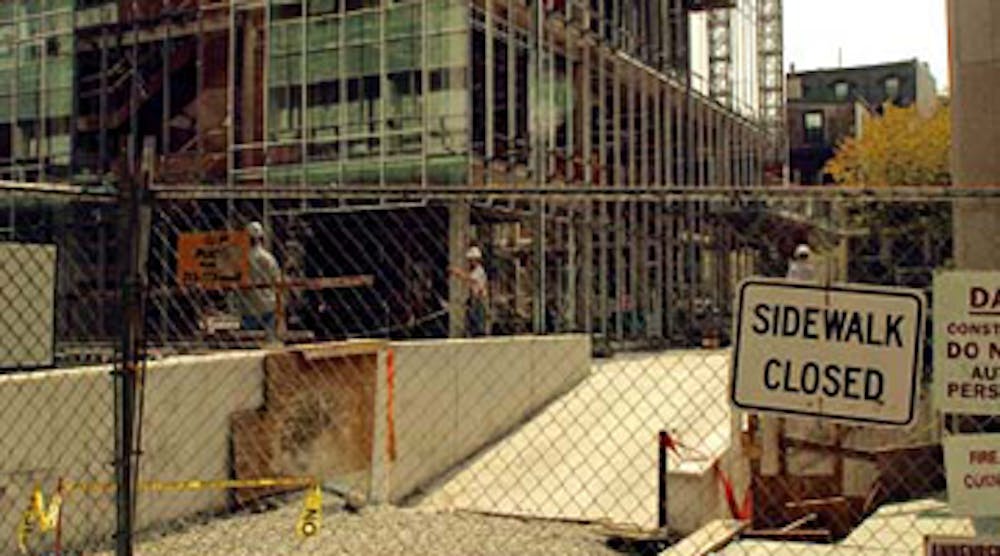
When construction is completed for the Annenberg Public Policy Center next summer, students will be able to see more clearly into what's going on inside - literally.
That's because the structure, located on 36th and Locust streets, is being built entirely out of glass.
Upon completion, the Center will consolidate the Annenberg School for Communication's staff, research facilities and programs like FactCheck.org, which are currently housed at 3535 Market St.
The $34.5 million facility is designed by Fumihiko Maki of Maki and Associates, a Tokyo-based architectural firm that is also designing World Trade Tower Center 4.
Kathleen Hall Jamieson, director of the Public Policy Center, said Maki's design was selected because it "integrates a contemporary building into that part of campus very well."
Though the Center will not be the first on campus to be created entirely from glass - that honor belongs to Levine Hall - the structure is one-of-a-kind in its sophistication.
"It's a living, breathing wall that minimizes energy use and maximizes functional use for its occupants," said University architect David Hollenberg.
Sliding wood panels behind the glass will triple function to provide air flow circulation, offer privacy and control lighting on sunny days. The curtain wall design will also allow the windows to open when the weather is temperate.
Inside, new facilities include a state of the art experimental lab and research space. Most anticipated is the agora - large public forum holding up to 200 people - that will be used for lectures and visible to outside passersby.
And though the design's symbolism was never an explicit reason for its selection, many have drawn a link between its glass structure and the Center's mission of promoting transparency in politics and public policy, especially with election season in full swing.
"The glass has symbolism in that the building is open to the campus and is intended to be welcoming," said Jamieson.
Hollenberg called the design a "good match between the aesthetic of the building and the function of the Center."
Associate Professor of Architecture Annette Fierro, whose book The Glass State explores the meaning of transparency in architecture, compared the center to monuments such as the Louvre Museum in Paris that use glass to show the institution belongs to the public.
Fierro said she is looking forward to seeing "whether the building will instigate communication between the campus and outside community."
"People walking by will be more inclined to go into the building," said College senior and architecture major Christina Marconi.
Fellow architecture major and senior Brad Gulick, who has class in neighboring Addams Fine Arts Hall, agreed, calling the use of glass an "obvious but wise choice."
"Glass is a very interesting medium to use because it's transparent but also embodies the qualities of reflection, so you're meshing in the public life of the streets," he said.

