

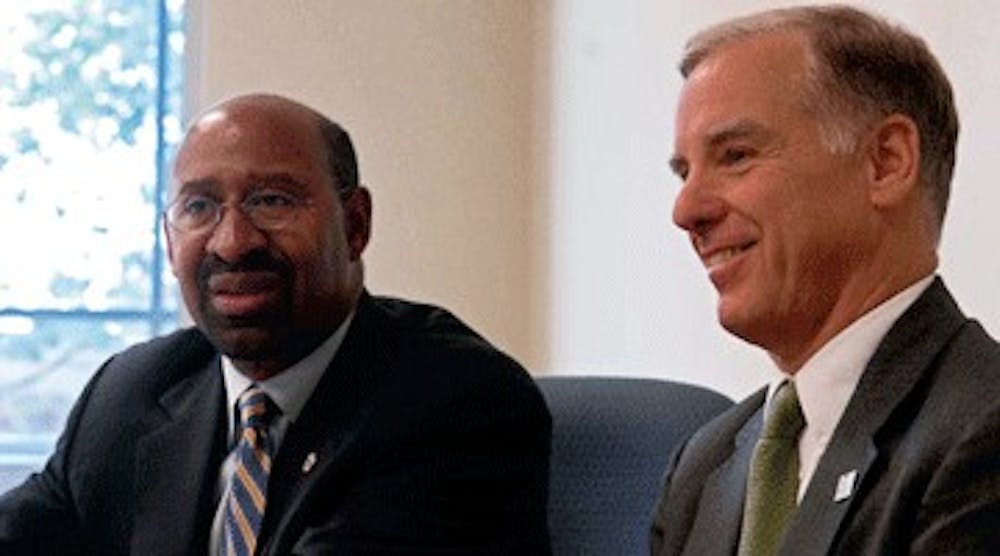
In the eyes Howard Dean, chairman of the Democratic National Committee, this election is more than just a presidential race - it's a generational transition.
Last Friday, The Daily Pennsylvanian sat down to discuss the role of young voters in the 2008 election with Dean and Philadelphia Mayor Michael Nutter.
Dean was in Philadelphia to attend a rally at Temple University, as Pennsylvania continues to be competitive between Democratic presidential nominee Sen. Barack Obama and his Republican opponent, Sen. John McCain.
The youth vote is seen by Dean, and others in the Democratic Party, as a key to victory this year for Obama.
DP: Gov. Dean, student registrations have been higher than ever. Students are getting involved at all levels of government. Young people are starting to really come out for Sen. Obama in this election. And across the board in every state of the primary, student registrations and participation are through the roof. What impact will all of this have on the future of the Democratic Party?
HD: This is your generation. This is the real activist generation. Sort of the baby boom echo. And I think, as I've said before, this is a generational transformation. A generational transition election year. Barack represents your generation even though he's 47. He speaks for your generation in many ways. He's different than my generation. And very much like the JFK election, this is a chance for your generation to begin assuming power.
DP: And what will this mean for future elections?
HD: Well, that already started. When I ran, that's what began the opening up of the Democratic Party. It's time for a new generation to come into the Democratic Party, and to reinvigorate the Democratic Party - which has happened. Your generation in 2006 voted 61 percent for the Democratic candidate for congress. So, it's a very diverse generation, it's a multicultural generation; and it's a generation that seeks to bring people together as opposed to driving people apart. Does that sound familiar to you?
DP: Do you think this spike in youth turnout is just linked to Sen. Obama, or do you think this is across the board, something we're going to see in the future for more students getting involved - blowing all those old records of student participation and youth turnout through the roof?
MN: Certainly, Sen. Obama has been inspirational in that regard, but as Gov. Dean indicated, some of that activity started in the last cycle. But now having these young people actively involved, and seeing what campaigns are about, not only what Democrats do but also listening to the non-sense from the Republicans. I think what you're going to see is continued infusion of youth into the Democratic Party. And when folks stick around, I mean at some point in time, the young people of today just getting involved in the Party, in a relatively short order, they're going to be helping to run the party.
HD: And I want to say one other thing about that: It's important that we make room. And if we don't, I encourage people to just do their own thing, and set up their own organizations. Because in every generational transition, there's always a struggle between those who have the power and those who want the power. We have to make room for these young folks, and I'm solidly on the younger generation's side on this one. And sometimes, if people aren't smart enough to make room, then it's time they did something else.
DP: Obviously, your major contribution since assuming your chairmanship over the Democratic Party has been this 50-state strategy. Where do young voters fit into that 50-state strategy, and is this a continued strategy for the future?
HD: I'll give you a graphic example. In Alabama this year, when both parties had a very vigorously contested primary, 60 percent of the people under 30 chose to vote in the Democratic primary. That's extraordinary in a conservative state like Alabama. Among evangelical Christians, there was an article in today's paper, that said that while older evangelical Christians were still all locked up by the Republican Party, younger evangelical Christians were up for grabs. They're not going to put up with the divisiveness, and they're like everyone else in your generation. They want to work together, not fight all the time about stuff that's polarizing. So, I think this is a national movement, and it's happening in every single constituency. Every single group that you can think of, whether it's an ethnic group, or whether it's a religious group. Whatever it is, the under-35s are really rising up to the top to assume their role in society.
DP: So do you think the 50-state strategy is something here to stay for the Democratic Party?
HD: Yeah, I definitely do because young people believe they can win any place.
MN: If we're smart. If we're smart, that'll stay in place, and continue to grow.
DP: With such significant Democratic registrations in the state, why would you say the polls are still so close in Pennsylvania. Why with all these registrations the polls aren't really shifting toward Obama?
MN: Traditional polling is generally calling people who first and foremost have land-line phones. And young people, increasingly, only have cell phones. To my knowledge, there's no national registry of cell phones. And so these pollsters are not talking to them, the candidates are not talking about them, and they're just out there. But they are paying attention to this election, and they're paying attention to Sen. Obama. So I just don't think you can place a lot of faith in those polls. Second, the Republicans have gone right up to the line .
HD: . and over it .
MN: . they've stepped over it, got chalk on their shoes and went right over the line in some of their tone and their language. It's not a secret in this election that one of the candidates is an African-American. So, there's the subtle, and sometimes less-than-subtle, issue of race. And so pollsters call asking the question about what are you doing and what's going on, and I think that people are all over the place because they're trying to figure out what's the 'right answer' to the question. So, as Gov. Dean mentioned and I've said in other places, this whole riff on community organizers, I mean, 'well you know, you're doing that as a community organizer, but so-and-so's over here with a real job and real responsibilities.' I mean that's insanity. It really is minimizing the great track record and history of Sen. Obama, and I think there's a little bit of code language going on. Look, there's only one poll that actually matters. That's the one that when we count up the votes at eight o'clock on the night of Nov. 4, and we'll see what the real polls say.
DP: What states are you pointing to that students are really going to be swinging this year? Where are the students really going to be that tipping point?
HD: Every state. Just plain every state. Virginia, particularly in the tidewater, there's four or five major colleges in the tidewater. Philadelphia has 12 higher-educational institutions. Michigan. Ohio. I don't think there's a state you can name that's close where the student vote doesn't matter a lot.
MN: If you look at Philadelphia and the region, we have 92 colleges and universities in our five-county region. You've got Penn State in Centre County. You've got a lot of student activity out in the west with Allegheny County and Pittsburgh. So students are all over the place. Pennsylvania is a great student state, and a part of our responsibility is to make sure that they're registered, ready and that they go to the polls on election day.
HD: Or vote absentee.
MN: Right.

