

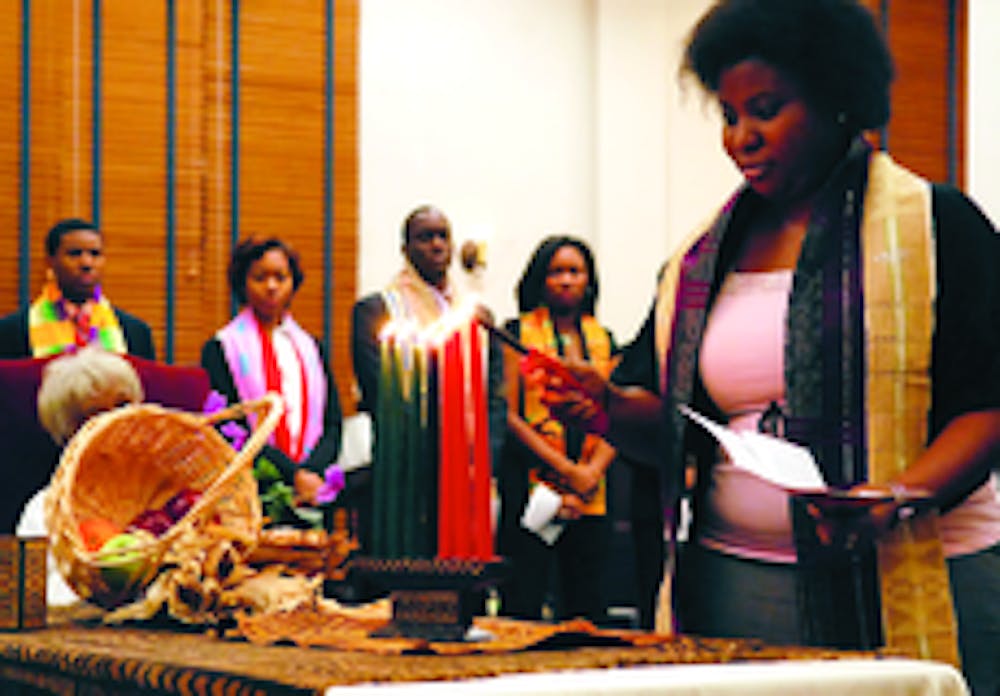
Festive African rhythms played throughout Houston Hall yesterday, welcoming all Kwanzaa observers.
Organized by UMOJA, yesterday's Kwanzaa feast emphasized the importance of unity and togetherness among members of the black community on campus.
Kwanzaa, as introduced at the event by Wharton alum Daina Richie, reflects the importance of "family, community and culture." Although Kwanzaa may be a young holiday, Richie says it's "necessary [as] a celebration of the past and collective futures."
The festivity welcomed not only speakers who introduced the meaning of Kwanzaa, but it also included a live band and a wide variety of catered foods.
Speakers included guests, staff and students, all of whom helped build a general explanation of the values of Kwanzaa and the meaning of the traditional libation, which is the lighting of the candles.
Speeches emphasized the importance of valuing heritage and the generations that brought the present community to the celebration.
Students leaders from organizations under UMOJA introduced the seven principles of Kwanzaa, which include unity, self-determination, collective work and responsibility, cooperative economics, purpose, creativity and faith. After students presented each principle, they would light a candle on the kinara, one of many important symbols of Kwanzaa.
For many, the Kwanzaa feast signifies an important cultural mark. Every year College junior Renelle Smith looks forward to reflecting on the past, especially when the names of those who have passed away are called out before the candle lighting.
"[It] is the part that I remember most," says Smith.
For others, the feast serves as more of a social function. College senior Jenna Slaughter describes Kwanzaa as a "coming together event," uniting people from many different organizations in a single room.
By the time opening introductions had been made, many generations of observers filled the room.
But there were newcomers too. Incited by curiosity, some students hoped to learn more about Kwanzaa by attending their first celebration.
Graduate student Meredith Mashner said, "I wanted to learn more about the holiday, enjoy the music and especially the food."
Ordinarily Kwanzaa celebrations begin Dec. 26 and end on New Years Day; however, the Kwanzaa event was scheduled to fall under UMOJA week, which ends today and employs the seven Kwanzaa principles to honor African culture on campus.

