

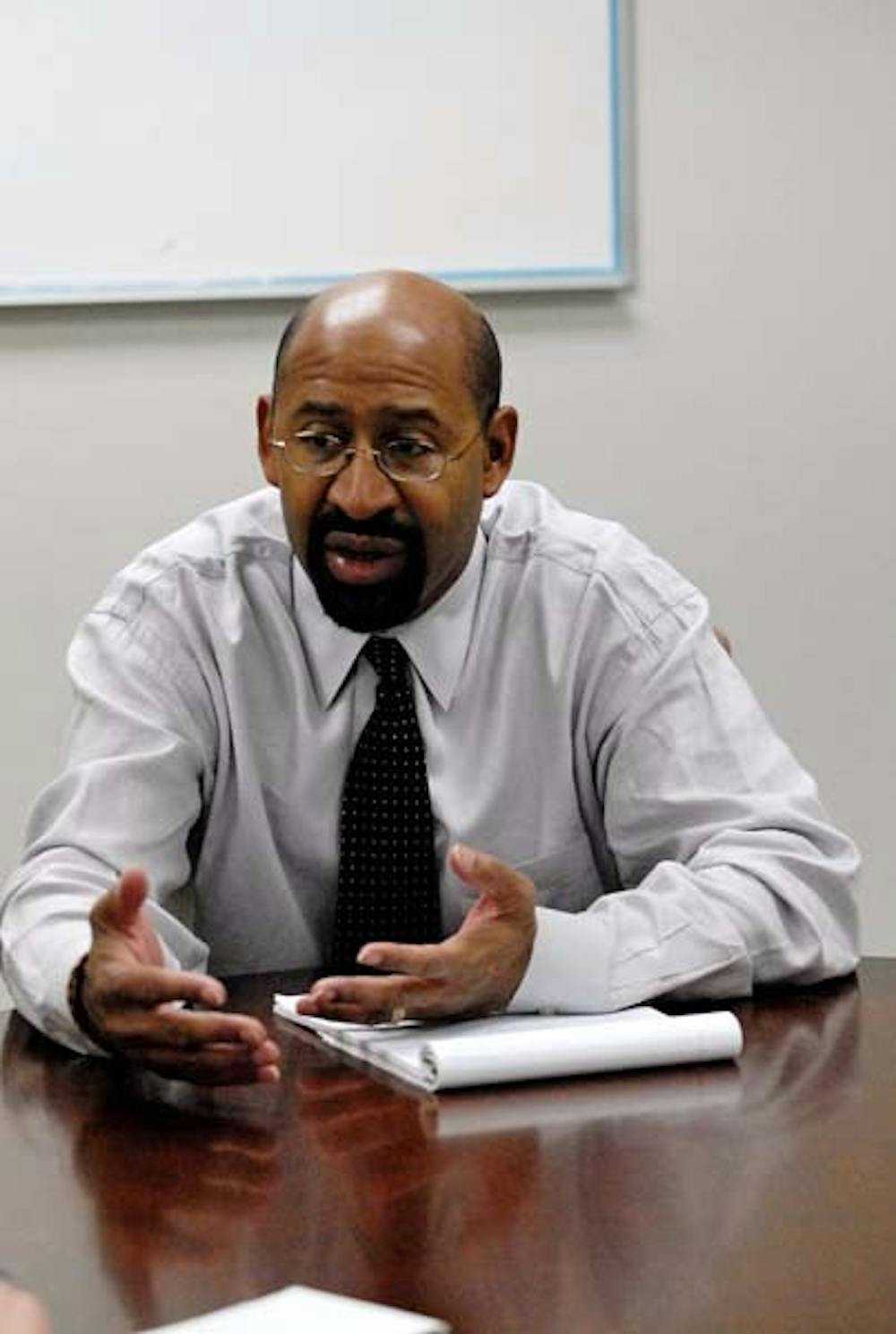
After a bruising primary for Michael Nutter, the actual election should be a breeze.
Nutter emerged from an extremely competitive five-way Democratic primary in May, taking 37 percent of the vote.
But while experts now peg the former Councilman as a lock to win the general election, Nutter is still plowing full steam ahead with his campaign as the election enters its final stages.
Melanie Johnson, spokeswoman for Nutter's campaign, said Nutter is taking the upcoming election very seriously. She noted that the candidate has visited cities like Baltimore and Chicago to get ideas on solving urban issues.
On the other side of the ticket, Republican nominee Al Taubenberger has a more happy-to-be-here attitude. Having run unopposed in the primary, Taubenberger has little chance in a city where registered Democrats outnumber Republicans five to one.
Taubenberger - who has little more than a few thousand dollars in his campaign chest at last count - says he is focusing his efforts on meeting with residents face to face.
"I want to talk about my passion for bringing jobs here," he said. "Companies should have confidence in their government, and we need to be proactive in getting businesses to come to Philadelphia."
He added that having "two competitive parties does a great deal in stopping inefficiency and corruption."
"I want to give people the opportunity to have a choice," he said.
Ellen Kaplan, vice president and policy director for the Committee of Seventy, a non-partisan government watchdog group, praised both candidates for taking the election seriously despite the obvious odds in Nutter's favor.
She said it's especially important to have a legitimate election given that Nutter's heavy advantage could decrease voter turnout this November.
"People might feel that the winner is preordained, but there is still an election, and it's important to vote. Strange things happen."
Nutter, who is widely known for his emphasis on ethics reform and his role in brokering the city's smoking ban, said in his victory speech in May that the city's high crime rate, public school problems and government corruption were all issues that need to be addressed.
"We have to change the direction of this city, and many people are not happy about where we are," he said. "We have a lot of work to do."
But while Nutter's reputation for ethics reform is undoubtedly important for a city with a history of political corruption, Kaplan said that campaign contribution limitations, enacted after the 2003 mayoral elections, have also made the 2007 mayoral race more open to the public.
"The candidates were limited by the amount of money they could raise from each person," she said. "That really changed the tenor of the race, because candidates had to start reaching out to many people."

