

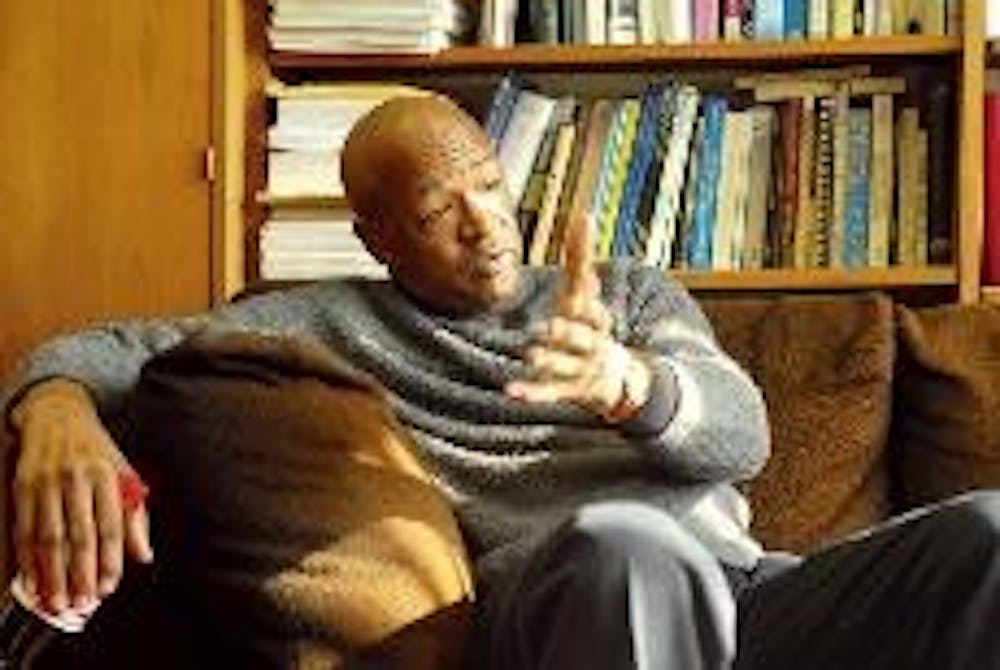
Two distinguished professors of African-American culture will be leaving Penn this fall for positions at other peer institutions.
Elijah Anderson, a Sociology professor for over 32 years at the University and a noted specialist on urban inequality will join the sociology department at Yale University, while Religious Studies professor Michael Eric Dyson will become a university professor - the highest position a faculty member can hold- - at Georgetown University.
Anderson's departure from Penn comes after serving as chairman of the undergraduate Department of Sociology and publishing noted articles and books on the urban black experience, including The Code Of The Street: Decency, Violence and the Moral Life of the Inner City.
And it was with some of his publications that Anderson encountered controversy at Penn in 2005. Anderson publicly released a statementsaying that a fellow Penn Sociology professor, Kathryn Edin, failed to properly cite his work in her book Promises I Can Keep: Why Poor Women Put Motherhood Before Marriage, and accused her of alleged conceptual plagiarism.
The problem was privately resolved later during 2005, and Anderson told The Chronicle of Higher Education that the controversy had no influence on his decision to migrate to Yale.
"That [disagreement] is pretty much in the past," he said, though he did say in an e-mail interview that Edin and her co-author didn't include citations of his work in a recently released paperback edition of the book as they had agreed to.
Edin couldn't be reached for comment.
Tukufu Zuberi, Sociology Department chairman and director of the Center for Africana Studies, also noted that Edin submitted a letter of resignation to the department before Anderson announced his retirement this year.
"This issue for him was gone . [and] I doubt that is what motivated him to leave Penn," Zuberi said.
At Yale, Anderson will be teaching courses such as urban ethnography and his coming was hailed by the school.
"Professor Anderson is the most respected and accomplished sociologist of the black urban community, [and] we are thrilled that the leading expert in an area of such social and political importance will be conducting his research . at Yale," Yale Provost Andrew Hamilton said in a press release.
Dyson's resignation, on the other hand, came after only five years of teaching at Penn. But Religious Studies chairman Stephen Dunning said that "we understood he wouldn't stick around that long. . This is the way it often is with public intellectuals. Other schools are constantly making offers."
"They have all kinds of mobility, these academic stars. [Dyson] is a star and, we're sorry to lose him," he added.
In a press release, Georgetown Provost James O'Donnell called Dyson an "intellectual leader in society."
Last month, he released his 15th book, Know What I Mean?, an examination of hip-hop music.
Dunning added that Georgetown's location in the nation's capital was the primary factor that lured him away from Penn.
"Philadelphia is an exciting city, but in terms of power politics it's not the same" as Washington D.C., he said. "Washington is the political hub of the nation, and that is what's taking him away from us."
But even with two black faculty members leaving, Penn remains unconcerned about loosing diversity among the faculty.
While Sociology chairman Zuberi noted that the Penn faculty is "not extremely diverse," he pointed to efforts to change this and Penn's aggressive pursuit to hire minority faculty members.
The "departures, while significant, don't eliminate all faculty of color from Penn," Zuberi said. "There are many here doing great work."
Vincent Price, associate provost for academic affairs, agreed, saying that "it's certainly a difficult thing for a university to lose senior faculty . but we recognize faculty move around for a whole host of reasons."
Price added that the coincidence of Penn losing two prominent social critics at the same time has obscured the fact that these scholars' moves follow a general trend in the upper echelons of academia, in which notable professors tend to circulate through various top schools.

