

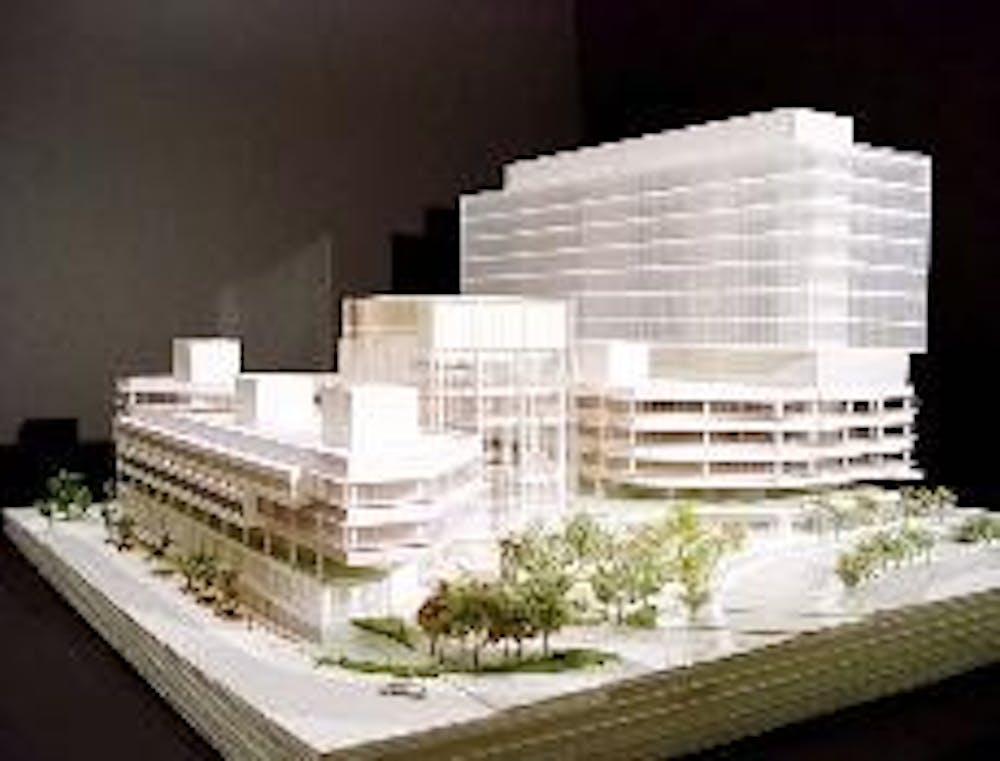
Penn's biomedical research is about to get a booster shot, in the form of a multi-million dollar, 10-story research facility.
University officials plan to construct a $370 million biomedical tower that will focus on providing resources for research into human diseases next to the Perelman Center for Advanced Medicine on Civic Center Boulevard.
Penn hopes to complete the biomedical tower by the summer of 2010, and will finish construction on the Perelman Center in 2008, said spokesman Marc Kaplan.
The tower's location near the $232 million Perelman Center, and the $140 million Roberts Proton Therapy Center, scheduled for completion in 2009, will facilitate more interaction between biomedical researchers and clinical staff, said the Health System spokeswoman Susan Phillips.
Penn decided to build the tower because "the need for new clinical and research space was identified in our five-year strategic plan, which was approved in 2003," she added.
Penn President Amy Gutmann said that the building would "accelerate Penn Medicine's innovative research enterprise."
"By design, the new building will bring together the rich and complex biomedical disciplines required to achieve progress in the conquest of disease," she said in a statement.
University officials selected Rafael Vinoly from Rafael Vinoly Architects PC of New York, architect of the Perelman Center, to design the tower in order to provide for aesthetic continuity between the facility and surrounding facilities, Phillips said.
The biomedical tower will also mean additional construction work in the Civic Center Boulevard area, but Phillips said that impact on students and staff should be minimal.
"This will be a continuation of the construction work that is already under way for both the Perelman Center and the Roberts Proton Therapy Center," she said.
In addition to focusing on human diseases and providing space for biomedical laboratories, the new facility will also specialize in translational research, which tries to better connect medical observations in the clinical world with molecular and cellular research by scientists.
"A key feature will be shared interaction spaces so that clinicians and scientists can collaborate more easily," Phillips said.

