

Michael Jordan had to wear his North Carolina shorts underneath his uniform every time he played.
Wade Boggs wouldn't be caught dead in the batter's box without eating chicken before the game.
And playoff beard? Try an entire season without a haircut. That's what Mark Zoller did for his past two years playing for Penn.
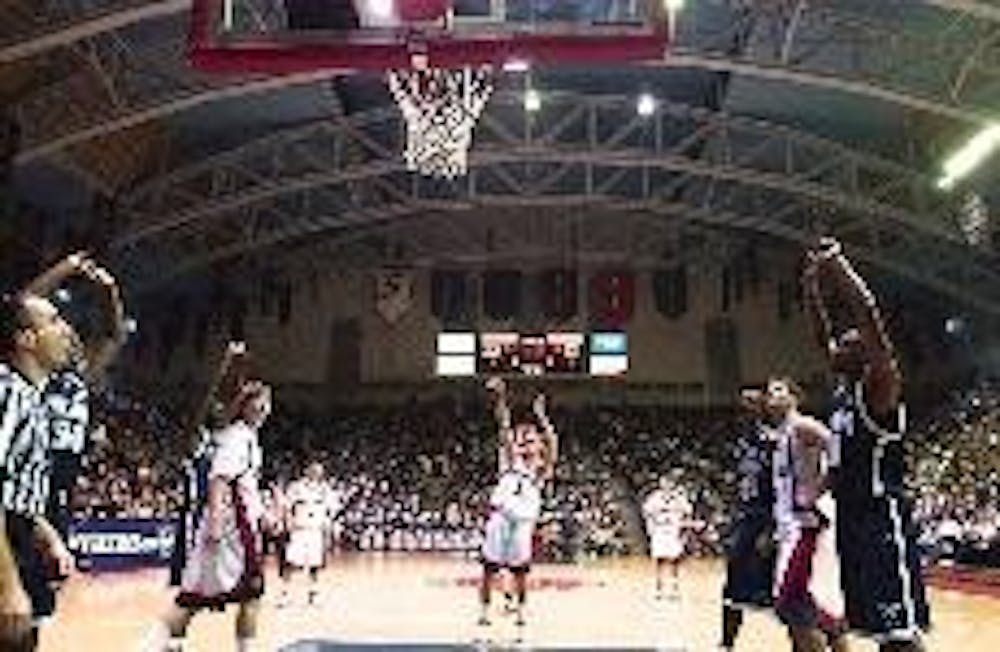
Things have changed in his senior year, and although Zoller has decided it's time to move past some of his quirks, his preparation for taking a foul shot is one superstition that he will not relinquish.
"I take a deep breath, step to the line, then envision the shot going in, take three dribbles and shoot the shot," Zoller said of his unwavering free throw routine.
Zoller might be on to something; his 77.5 percent is the best free- throw percentage on the Quakers, who shoot a league-worst 66.2 percent from the line.
After suffering from inconsistent foul shooting coming into the Ivy League season, the team's troubles reached a peak in its loss to Yale.
A furious Glen Miller looked on as the Quakers made just eight-of-21 free throws on the night en route to their only conference loss so far this season.
Philadelphia-based sports psychologist Eric Zillmer says many factors are responsible for causing even professional athletes to falter when faced with shooting the seemingly simple shot from the stripe.
"The motor memory is one part; mechanically you can practice the shot because it is a set shot and it's always the same," Zillmer explained. "But there's a mental aspect to free-throw shooting that is very important. . When it's so loud and the fans also try to disorient you visually behind the basket it's very hard, even when you practice that."
Much like kicking a field goal in football, most players that reach the collegiate level have the ability to net a free throw with ease.
But in game-time situations, what happens after the ball leaves the foul shooter's fingertips is often anyone's guess as the pressure can quickly turn a game of skill into a test of mental focus.
"For the most part, a regular shot during a game is more of a reaction and with free-throw shooting you have time to think about it," Miller said. "You have more time to set it up; it's a stationary shot, there's no defense and everybody's watching you."
Zoller, for one, is no stranger to these circumstances.
In one of the most pressure-packed moments of the season, he sunk three free throws against Temple with just 1.4 seconds on the clock to win the game.
Connecting over three quarters of the time, Zoller is 10th in the league in free-throw percentage. Cornell forward Ryan Wittman holds the top spot, shooting a lights-out 90.7 percent from the line for the Big Red.
A practice technique encouraged by both Zillmer and Miller is having players shoot free throws when they are fatigued, and players often work on foul shots before practice when they are energetic and loose, atypical of a game situation.
It's also hard to recreate the pressure often present in actual games.
"You ask your players to play games in their head, so even when you're in the gym or at the playground all by yourself, imagine yourself at the foul line in a crucial situation," Temple coach Fran Dunphy said. "You set up that formula so that when you get in the game and the pressure is there, you've been there many, many times before."
Zoller is familiar with that strategy, and has been playing similar mental games since he was a kid to work on his foul shooting.
"I try to envision a situation like, 'It's the championship. Here we go, Mark Zoller steps to the line,'" he said. "I just try to imagine fans screaming and try to envision a pressure shot like a game-winning free throw."
Practicing all of the circumstances that surround the foul shot is impossible, and finding a different strategy to deal with the pressure is crucial. So maybe those crazy routines aren't so crazy after all.

