

Jacob Bevilacqua is looking forward to Spring Fling because he expects to "get a lot of action."
But for this Nursing sophomore, that action has nothing to do with his social life.
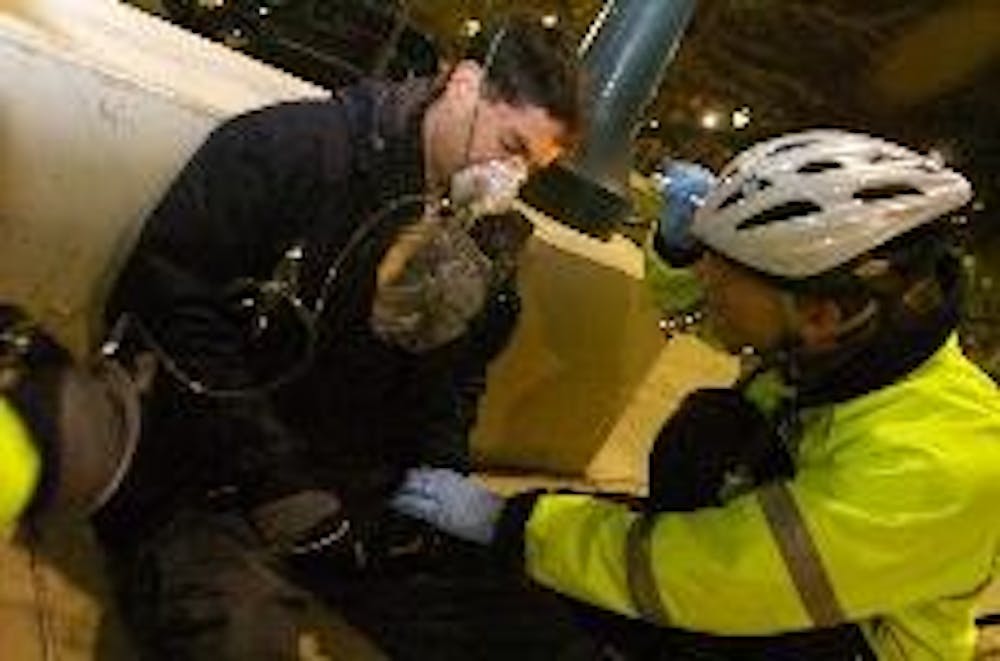
Bevilacqua is a lieutenant in the Medical Emergency Response Team - a group of student-volunteer emergency medical technicians, started last year - and Fling, Bevilacqua said, is the organization's busiest time of year.
And while MERT's services are in higher demand during certain parts of the year than during others, the 51-person strong organization is prepared to respond to emergencies at all times.
At the beginning of this semester, MERT expanded its coverage from the weekends and now operates from 7:30 p.m. until 7:30 a.m., seven nights a week.
This schedule means that MERT's state-certified EMTs are ready to respond to medical emergencies reported through 511 or to Campus Police by rushing to the scene on bicycles and stabilize victims until a professional ambulance service shows up.
MERT chief and College senior Andrew Mener said MERT's ultimate goal is to provide on-campus emergency coverage around the clock. However, he said, because of daytime classes and a lack of manpower, that kind of presence is impractical.
But because most emergencies are reported at night, MERT has been able to provide its services when it's needed most.
"Most, if not all, of the calls that have come into MERT have been in the evening," Evelyn Wiener, director of Student Health Services, said.
Since MERT was formed last April, the group has responded to over 100 on-campus emergency calls, and 22 of those were made during Fling 2006, Bevilacqua said.
MERT members are currently discussing ways to enhance the services that it will provide during Spring Fling. No final decisions have been made as of yet, but MERT leaders are using the events of last year's Spring Fling as a predictor for this year's celebrations.
The program is nearing the end of its yearlong pilot period - during which the University monitored MERT's performance - and both MERT and Penn officials are not worried about its future.
Wiener explained the pilot program was designed for three reasons: to ensure that the program would be utilized, to see if MERT would be able to recruit enough volunteers and to make sure that it would consistently operate in a safe manner.
She added that she has no concerns about the future of MERT, whose membership increased from 26 to 51 student volunteers since its conception.
"They have been very responsive to all of the questions, directions and guidance from . the University and the city," she said. "I think they should be commended."

