

'Do you bat, or bowl?"
The question catches me off-guard. I don't do either, and certainly not nearly as well as these guys do. Never mind batting or bowling - I'm just happy to be mistaken for an athlete of any type.
After getting over the initial shock, I explain myself to the group gathered on the Franklin Field turf for a Friday morning run-through: I'm not a new member of the club; I'm just here to take in a practice.
As it turns out, they aren't just flattering me - they really could use a stand-in player. The biggest problem facing the Penn Cricket Club on this day isn't preparing for the next day's crucial match: it was on-campus recruiting, and enough players had prior commitments to cripple the practice.
"Today is not a good day," sophomore Saurabh Jalan tells me apologetically.
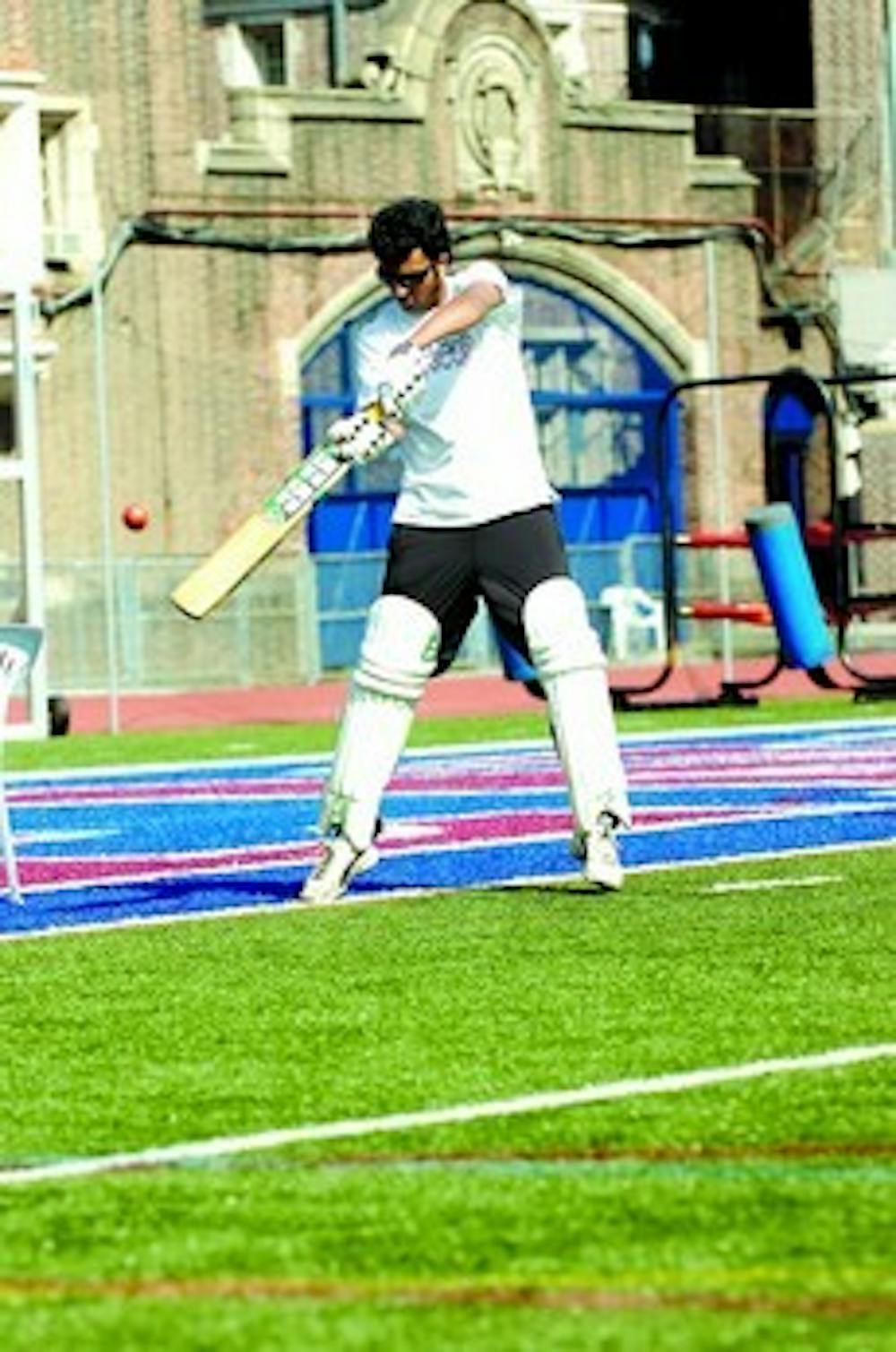
Still, the team plays on. They set a chair just behind the goal line of a football end zone, and then place a bag at the 21-yard line. Sophomore bowler Aman Agarwal, who's not exactly an imposing figure himself, begins a 10-yard run up to the bag. In a series of fluid, explosive movements, he uncorks the cricket ball toward the chair. The ball hurtles toward the ground, just in front of the chair, and then takes a violent bounce off to the side. It's a fantastic ball, and it leaves the batsman thoroughly embarrassed.
A murmur of approval ripples through the rest of the team out in the field. There's no better time than now for Penn bowlers to be embarrassing batsmen: Penn is on the cusp of reaching the semifinals of the fall Intercollegiate Cricket League tournament for the first time in three years.
A long history
To a club that's only existed in its current form for six years, that gap is an eternity. But Penn Cricket has actually been around since 1842, when William Rotch Wister founded the Junior Cricket Club, Penn's first athletic team. The first intercollegiate match wasn't until 1864, when Penn lost to Haverford College, 89-60.
The 1865 yearbook describes the worst of that inaugural year:
"Cricket matches innumerable have taken place during the year. . Last autumn the University Eleven were also beaten by the Second Eleven of the Philadelphia Cricket Club; but this defeat was the result of accident - the absence of some of the University's best men."
Cricket hit its peak at Penn around the turn of the century. 1881 saw Penn join the Intercollegiate Cricket Association, a group that included Columbia, Harvard, Haverford, Princeton and, later, Cornell. Between 1895 and 1907, the team played several international matches and even went on a Canadian tour.
After World War I, though, the program began to die down, although a club was registered with the Office of Student Life as recently as 1995. After that club folded, Salman Jawaid and Hasan Ansari (then freshmen) re-registered it and brought it back to life in February 2000.
A breakthrough result
Even 142 years after that loss to the Second Eleven of the Philadelphia Cricket Club, the hurdles haven't changed that much for Penn. At the practice, sophomore David Zhou reveals he has to miss the crucial match - he didn't get the e-mail about the match in time, and has to volunteer at a hospital.
But unlike the University Eleven of the 19th century, the 2006 Quakers manage to pull through in the big match nonetheless. Senior Varun Jalan's two sixes - a six-run hit is the cricket equivalent of a home run - help Penn score 124 runs in its innings. Atlantic County College manages only 105 before using up all ten of its wickets (essentially, outs). Penn's two wins in the group stage guarantee passage to the knockout round.
A place to call home
That win is a big step for a program that couldn't even find a practice ground six weeks ago. Cricket is normally played on a clay rectangle surrounded by a vast grass oval - needless to say, you won't find anything like that on Penn's campus. Most of Penn's matches have to be played an hour's drive away, even though it often plays nearby teams like Temple and Drexel.
But just this semester, the team has found a new place to practice regularly. For two hours a week, they meet for a session at Franklin Field like the one before the Atlantic County game.
And even though they don't use SprinTurf at famed cricket grounds like Old Trafford or Melbourne, the club is happy with its digs. Especially considering the alternatives: In late August, the team was looking to play on a basketball court on top of 1920 Commons.
Franklin Field is "nothing compared to an actual cricket ground," senior Ankit Somani admitted in an e-mail. But, he added, it's "actually a great facility to practice on - it serves the purpose rather well."
Athletes are often hesitant to tie their successes to the quality of their facilities, but Somani is under no such illusions. For a club team that practices for two hours each week, this kind of stuff matters.
Penn "has always had extremely good individual talents," he said. "In the past, we were not as competitive as we could have been due to lack of practice space. Our consistency has improved and we have become a more disciplined side due to the practice facilities we now have."
A greater purpose
For many members of this team, though, success has a broader definition than just winning on Saturday. Cricket, unlike most other sports played at Penn on club and varsity levels, is completely foreign to most Americans. It's a fact you can confirm just by looking at the roster: The team is composed almost exclusively of international students from South Asian countries such as India and Pakistan. Penn's cricketers see themselves not just as athletes but as ambassadors.
Somani, for example, is pushing to hold a cricket match at Franklin Field. He is convinced that there is a "huge" population of students from cricket-playing nations that a game could bring to the stadium. And he hopes they might bring along one or two Americans along the way, as well. "It would be a great experience for a lot of Americans - to learn about and enjoy the atmosphere at a cricket game," he said.
But the transplanted group of cricketers still takes satisfaction from what it has done so far.
"It feels good to see that cricket is being played in the U.S.," graduate student Gavish Sharma said. Sharma pointed out that even when Penn's opponents do well, he takes pride in knowing the pool of talented players in the U.S. is deep.
Still, with some of the team's biggest matches in years coming up, it clearly has its priorities in order. As Saturday's semifinal draws nearer, the players won't be worried about their club status, their practice facilities or the popularity of their sport.
"All of us are now getting into the 'cricket mode'," Sharma said. The Atlantic County College match "is an example of how serious we are toward our cricket."
"The primary goal is to win," he said. "For Penn."

