While many of his fellow graduates took desk jobs, Penn alumnus Andrew Exum -- who graduated from the College in 2000 -- became a captain in the U.S. Army, went to war in Afghanistan and wrote a book about these experiences.
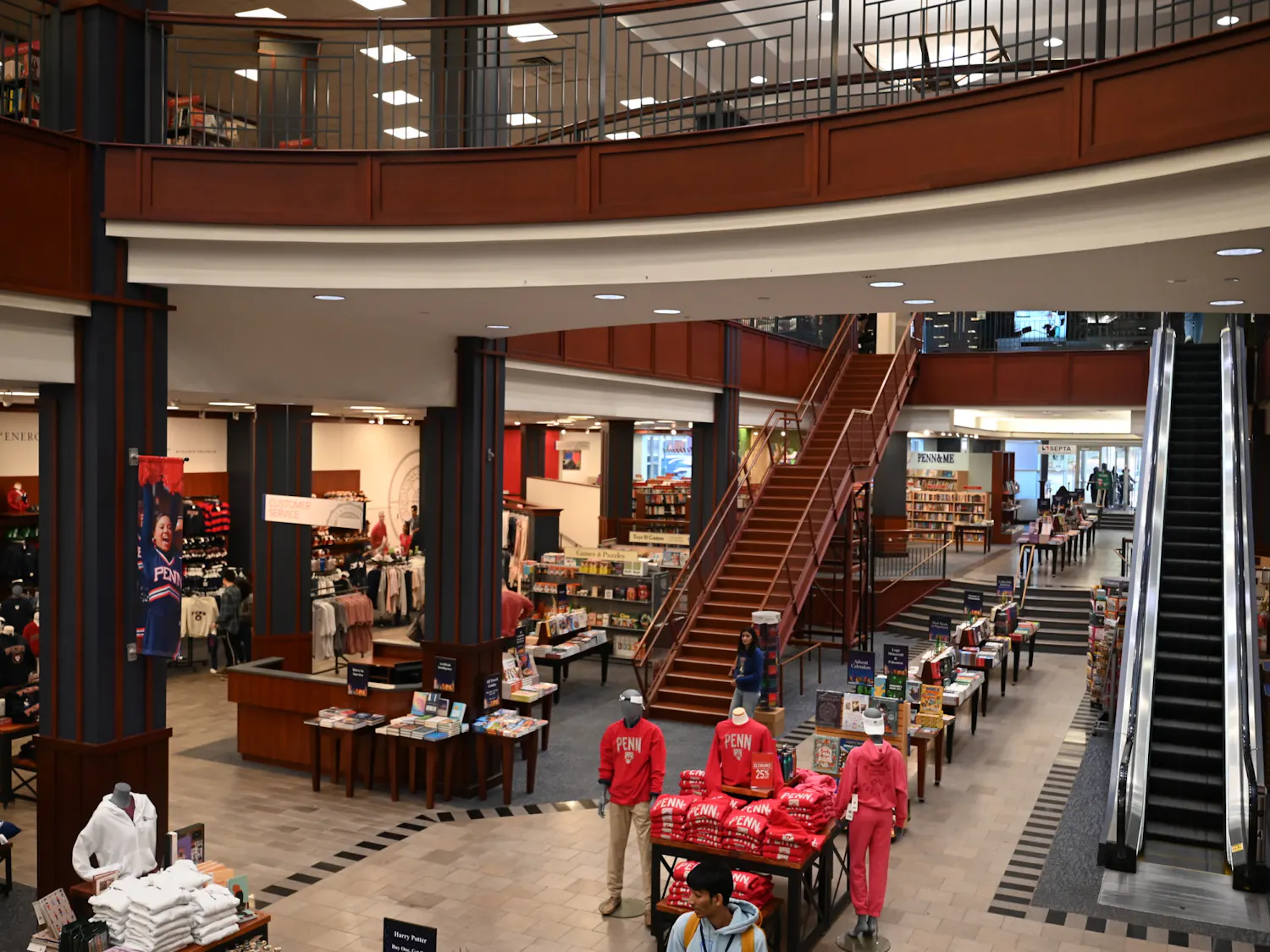
But on May 15, Exum was back on campus again, signing copies of his war narrative, This Man's Army: A Soldier's Story from the Front Lines of the War on Terrorism.
Many of Exum's former mentors and old friends sat among the group that gathered for the event at the Penn Bookstore.
Exum joked about his eastern Tennessee upbringing and the mindset it instilled.
"Coming from the state of Andrew Jackson, there is an idea that you go on to serve your country," said Exum, who later attended Penn on a Reserve Officers' Training Corps scholarship.
Andrew Exum's former ROTC major, Eric Schaertl, was among the crowd, and Exum took time to credit his ROTC supervisor for providing significant guidance through his training.
Exum described his personal transformation in the ROTC program from a noncommittal student thinking, "I've got to just muddle through this" into a committed soldier, who would eventually guide a platoon of 34 men into Afghanistan.
In 2000, following graduation, Exum joined the infantry of the U.S. Army.
"Everything took on a different slant on the morning of September 11, 2001," said Exum, who remembered sitting in the common room with his fellow soldiers watching the Twin Towers fall and hearing someone say, "Better pack your bags."
In March, Exum's platoon was deployed for U.S. Operation Anaconda to fight on the front lines in Afghanistan.
"Why does one write a first person story, a memoir on war?" he asked.
Exum's initial goal was "to convey what it's really like from a soldier's perspective," which he said differs from the accounts of reporters and historians, who tend to describe the actions of soldiers as "going from one death-defying experience to another."
According to Exum, the pace of war for a soldier moves much more slowly.
His second goal was to portray a human account, "not just of myself but the guys I was privileged to lead."
"I look up to them as my heroes," he added.
Exum described his outlook on Afghanistan, Iraq and the rest of the Middle East.
"We did not fight in the most climactic battles, but maybe this is a war that will be without any climactic battles. Maybe this is our generation's Cold War," Exum said.
Exum elicited laughter when he described his return home, saying, "First time I came back, what greeted me were four dusty cans of Pabst Blue Ribbon."
Regaining a more solemn tone, Exum added that his return felt "surreal."
Wearing khakis and a T-shirt, Exum said that he reassumed the appearance of an average American; however, the experiences of war left him feeling removed from the civilian population.
"I felt like I ought to be wearing a sign around my neck," he said.
Still, Exum rejected the idea that his persona had changed. "Innocence is something to be shed with age," he said.
Amy Calhoun, who recruited Exum to Penn, lauded the young author's character after the reading.
"For me, he is exactly the same person he was when I met him in Chattanooga -- very intelligent, charming, inclined to play down his own intelligence while showing you just how smart he really is," Calhoun said.
Former Penn student Chaz Howard attended the book signing in order to lend support to his close friend. He said that Exum's books and letter allowed a pacifist such as himself himself "to see and accept different paradigms".
Although many audience members were previously acquainted with Exum, Katherine Williams was attracted to the book signing after hearing Andrew Exum speak on "Radio Times," a public radio program.
"I found his point of view to be refreshing and honest," Williams said.
After concluding his book tour, Exum plans on moving to Beirut to study Arabic and continue writing about the Middle East.